Finance
Developing · 0 updatesFact 9/10Microsoft Shareholder Suit Puts Cloud Growth and AI Spending Under a Market Lens
Article language
English
Reuters reports that Microsoft faces a shareholder lawsuit related to disclosure questions around Azure growth and AI infrastructure spending. The case highlights market sensitivity to cloud growth, capex intensity, and the payback profile of AI build-outs. The available record is limited to a lawsuit filing, so legal conclusions cannot be drawn from it. Investors are likely to watch the next earnings release, Azure growth commentary, AI capex guidance, and margin trends across large cloud platforms. This is market context only, not investment advice.
Open article · no sign-in required
Sources and disclosure
What happened
Reuters reports that Microsoft is facing a shareholder lawsuit centered on two related claims: that the company did not adequately disclose slowing growth in its Azure cloud business and that it needed to spend billions of dollars on AI infrastructure. The report says the proposed class action was filed in Seattle federal court and was led by a Michigan pension fund. It also notes that Microsoft shares fell 10% on January 29 after the company’s quarterly earnings report the day before.
That is the full extent of what can be stated from the available metadata and snippet. The legal merits of the case, the eventual outcome, and the scale of any financial exposure are not established here. Because the source material is limited to a short Reuters snippet, the prudent approach is to treat the lawsuit as a market signal rather than as a resolved corporate or legal finding.
Why the market cares
The immediate market relevance is not the lawsuit itself, but what it reveals about investor sensitivity to the economics of cloud and AI. For years, large-cap software and cloud names were often valued on a simple growth narrative: more users, more workloads, more recurring revenue. That framework is now more complicated. Investors are asking how much capital must be committed to keep pace with AI demand, how quickly those investments can be monetized, and whether growth in a flagship cloud product is slowing at the same time that spending is rising.
Azure sits at the center of that discussion because it is one of Microsoft’s most important growth and strategic platforms. If growth in a core cloud business slows, the market may re-evaluate not only near-term revenue expectations but also the durability of the premium attached to the company’s long-term AI story. The issue is not whether AI matters; it clearly does. The issue is whether the path from AI infrastructure spending to durable earnings power is visible enough for public-market investors.
This is why the case matters beyond Microsoft. It reflects a broader market debate about whether the current AI build-out is being financed in a way that can be justified by future cash generation. Data centers, accelerators, networking gear, power contracts, cooling systems, and related software all require upfront capital. Those costs can compress margins before they support revenue. In public markets, that timing gap is often where valuation pressure emerges.
Tech / policy link
The technology link is straightforward: AI at scale is infrastructure-heavy. A cloud provider that wants to support large-model training and inference must secure compute, storage, networking, and energy capacity. That means capital expenditure, depreciation, and operating expense all become more important to the investment case. The more AI demand shifts from experimentation to production, the more investors will scrutinize whether the economics improve at the same pace as usage.
There is no direct policy development in the source snippet, and it would be inappropriate to invent one. Still, the case sits within a policy environment where disclosure quality, public-company transparency, and capital allocation discipline matter more when spending cycles are large and fast-moving. In that sense, the policy link is indirect: not a new rule, but a reminder that public-market disclosure standards shape how AI investment is interpreted.
For technology operators, the practical lesson is that AI infrastructure is not just a product story. It is also a financing story, a procurement story, and a capacity-planning story. When a company scales AI offerings, it must explain how much of the cost base is temporary, how much is structural, and what assumptions support eventual margin recovery. That explanation is now part of the market narrative.
Market Lens
Trigger: Reuters’ report that Microsoft has been sued by shareholders over disclosure questions tied to Azure growth and AI infrastructure spending.
Mechanism: The market can interpret slower cloud growth and rising AI capex as a sign that near-term earnings quality may be under pressure, even if long-term strategic positioning remains intact. Higher spending can weigh on margins and free cash flow before revenue catches up. If investors believe the payback period is lengthening, valuation multiples can come under pressure. Any broader market reaction beyond Microsoft is unverified from the available source.
Affected assets/sectors: Directly, Microsoft is the only source-supported name. Indirectly, the issue is relevant to large cloud providers, AI infrastructure suppliers, data-center ecosystems, semiconductor demand, and power-related infrastructure. However, any specific read-through to peers, ETFs, or indexes is unverified in this source.
Time horizon: Short term, the next earnings release and management commentary are the most important checks. Medium term, the market will watch whether Azure growth stabilizes and whether AI capex guidance remains elevated or begins to normalize.
Next check: Investors and operators should watch Microsoft’s next quarterly report, especially Azure growth, AI-related capital expenditure, margin trends, and any changes in disclosure language. Comparable commentary from other hyperscale cloud providers would also help determine whether this is company-specific or part of a broader sector pattern.
What to watch next
The first question is whether the reported slowdown in Azure growth is temporary or structural. A one-quarter deceleration can reflect timing, customer mix, or workload migration patterns. A persistent slowdown would carry a different market meaning. The second question is whether AI infrastructure spending is rising faster than the company can translate into revenue and operating leverage. The third is whether management becomes more explicit about the timing of returns on AI investment.
A further point of uncertainty is that the source material does not establish the lawsuit’s merits. Public-market readers should therefore avoid treating the filing itself as proof of any underlying business weakness. The more relevant signal is that investors are now willing to challenge the disclosure and economics of AI spending at one of the world’s most closely watched technology companies.
For the broader market, this is part of a larger re-pricing exercise. As AI moves from narrative to infrastructure, the market is likely to focus less on abstract adoption curves and more on concrete operating metrics: capex, depreciation, cloud growth, gross margin, and free cash flow. That shift tends to favor companies that can explain the economics clearly and penalize those whose investment cycle appears open-ended.
Market lens
Separate infrastructure signal from investable outcome
Treat market-linked stories as context: identify the mechanism, then wait for evidence before treating it as an outcome.
Impact path
Signal first, outcome later
Signals to watch
- Primary-source guidance and filings
- Price, volume, margin, and renewal evidence
- Follow-up reporting that confirms or rejects the mechanism
Verification schedule
D+1 · Jun 17
Is the mechanism visible in primary data?
D+3 · Jun 19
Do follow-up sources confirm direction and magnitude?
D+7 · Jun 23
Did the initial read overstate the market effect?
Informational context only — not investment, legal, tax, or financial advice.
Builder Implications
- Founders building on cloud and AI infrastructure should expect enterprise buyers to ask harder questions about total cost of ownership, not only model quality or feature breadth.
- Product and finance teams need a clear story for how AI usage translates into revenue, margin, and capacity planning. In public markets, that story increasingly matters as much as technical differentiation.
- Companies that sell into large enterprises or public markets should tighten disclosure discipline and internal forecasting. When AI spending rises quickly, the market will test whether the economics are visible and repeatable.
This analysis is market context only, not investment advice.
Want follow-up alerts? Subscribe by email after reading the public article.
Market lens
Separate infrastructure signal from investable outcome
Treat market-linked stories as context: identify the mechanism, then wait for evidence before treating it as an outcome.
Impact path
Signal first, outcome later
Signals to watch
- Primary-source guidance and filings
- Price, volume, margin, and renewal evidence
- Follow-up reporting that confirms or rejects the mechanism
Verification schedule
D+1 · Jun 17
Is the mechanism visible in primary data?
D+3 · Jun 19
Do follow-up sources confirm direction and magnitude?
D+7 · Jun 23
Did the initial read overstate the market effect?
Informational context only — not investment, legal, tax, or financial advice.
Visual Briefing
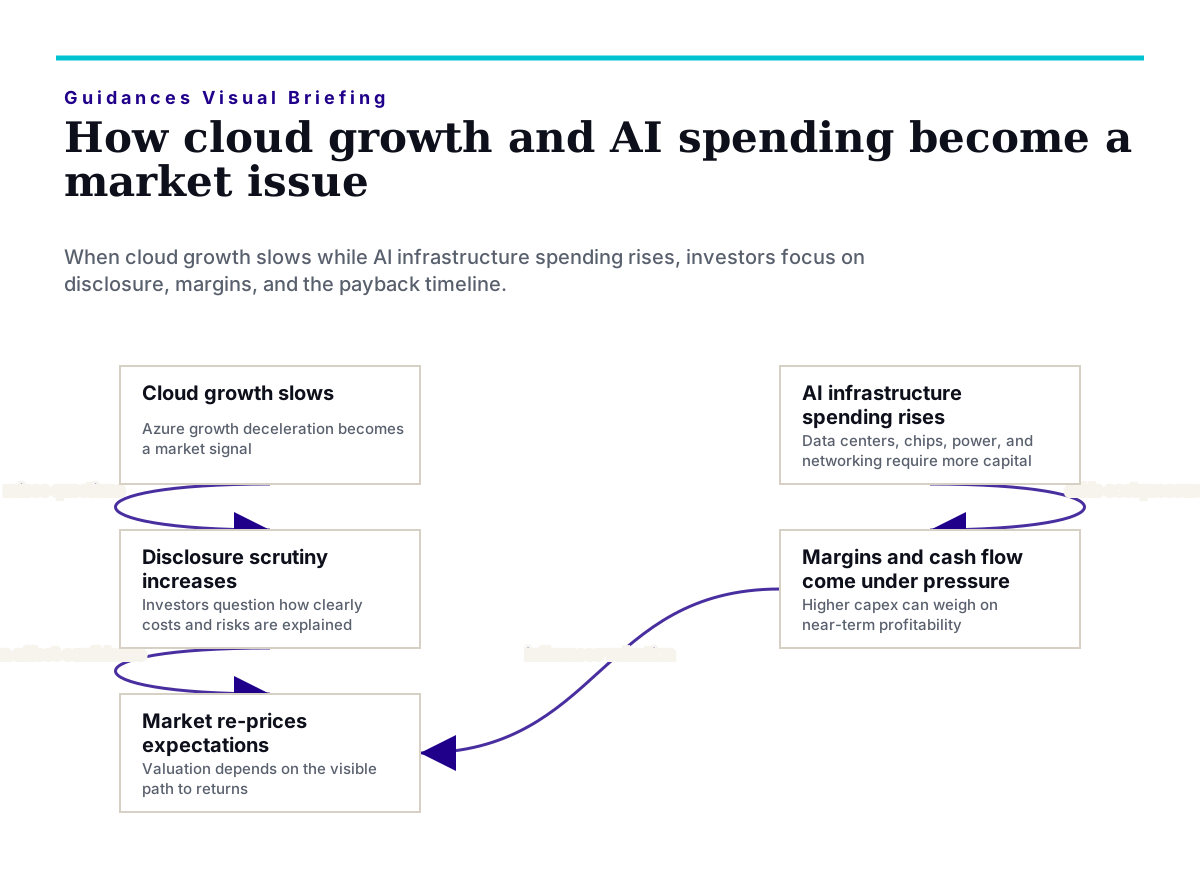
A simple market-flow diagram showing how slower cloud growth and heavier AI spending can lead to investor scrutiny and valuation pressure.
Corrections and safety
See a factual, privacy, rights, or safety issue? Review the corrections process or contact Guidances before relying on this article for important decisions.