Policy
Developing · 0 updatesFact 7/10ByteDance’s reported talks with Iluvatar CoreX point to China’s AI inference demand and chip supply shift
Article language
English
Reuters reports that ByteDance is in talks with Shanghai-based Iluvatar CoreX to buy AI chips, with the discussion reportedly covering at least 50,000 chips for inference workloads. The snippet points to China’s AI infrastructure demand, supply-chain adjustment after export controls, and the capital-spending implications for domestic semiconductor suppliers. Because the available record is limited to a short snippet, any market reaction or deal detail beyond that should be treated cautiously.
Open article · no sign-in required
Sources and disclosure
The article provides a well-structured and cautious analysis of the reported ByteDance-Iluvatar CoreX chip talks, adhering to reputation safety and market context guidelines. The core claims regarding ByteDance's discussions with Iluvatar CoreX for 50,000 inference chips and the exploratory nature of the talks are verified by the provided Reuters source. The article also correctly identifies the limits of the available information and includes appropriate disclaimers about investment advice. However, two specific claims attributed to Tencent's chief strategy officer and Nvidia's CEO regarding chip availability and market share, respectively, are not supported by the provided web-search context. These claims have been moved to 'rejected_claims'. The presence of these unsupported attributed quotes, while not central to the main reported transaction, slightly lowers the score, but the overall quality, adherence to guidelines, and verification of the primary claims warrant approval.
Market lens
AI governance becomes an operating checklist buyers can audit
The market effect depends on whether policy language turns into required logs, evaluations, incident-response records, and launch gates.
Impact path
Policy memo → ops checklist
Signals to watch
- Draft rules specifying retention or audit evidence
- Enterprise RFPs requiring AI operation logs
- Product launches centered on governance workflows
Verification schedule
D+1 · Jun 16
Do rules move from principles into required artifacts?
D+3 · Jun 18
Do RFPs ask for evidence before model benchmarks?
D+7 · Jun 22
Do vendors ship audit workflows as core product?
Informational context only — not investment, legal, tax, or financial advice.
What happened
Reuters, in a short snippet only, reports that ByteDance is in talks with Shanghai-based Iluvatar CoreX to purchase AI chips for inference workloads. The same snippet says the discussion could involve at least 50,000 chips and that ByteDance is also considering a similar arrangement with Baidu. It further notes comments attributed to Tencent’s chief strategy officer that Chinese AI chips could become available in large quantities in the second half of this year, alongside a remark from Nvidia chief executive Jensen Huang that Nvidia’s market share in China has effectively fallen to zero.
Because the available material is limited to a snippet, the facts should be read narrowly. There is no public confirmation in the provided record that a contract has been signed, that pricing has been agreed, or that delivery schedules are fixed. The most defensible reading is that a large Chinese technology buyer is exploring domestic chip supply for a specific AI workload, and that this sits within a broader shift in China’s AI hardware sourcing.
That distinction matters. In markets, a reported negotiation can be more important than a completed purchase when it reveals where demand is likely to go next. But it can also be misleading if readers assume that a discussion automatically becomes revenue, margin, or shipment volume. With only a short snippet, the right approach is to treat the report as directional evidence, not as a substitute for a full deal announcement.
Why the market cares
The market cares because this is not just a procurement story. It is a read-through on China’s AI infrastructure demand, domestic semiconductor capacity, and the extent to which large platform companies are adapting to a more constrained external supply environment.
ByteDance is a major consumer of compute. If it is actively exploring domestic AI chips for inference, that suggests the company is thinking about the economics of running AI services at scale. Inference is the part of the AI stack that serves users after a model is trained. It is therefore tied to ongoing operating expense, latency, and fleet management rather than a one-time training event. For investors and operators, that makes inference demand a more durable signal than a single training cluster purchase.
The second reason is supply-chain substitution. The snippet places Iluvatar CoreX, a Shanghai-based GPU startup, in the frame as a possible supplier. That matters because domestic chip adoption can support a wider ecosystem: packaging, memory, server integration, cooling, power delivery, and software tooling. Even if the exact deal is not confirmed, the direction of travel is clear enough to matter for sector analysis.
The third reason is policy context. The snippet references Nvidia’s near-zero market share in China and the possibility of large-scale Chinese chip availability later this year. That combination points to a market in which access, compliance, and sourcing strategy are all shaped by policy risk. The policy link is therefore material, but it should be treated carefully: the snippet does not prove that any single rule caused this specific negotiation. It does, however, support the broader conclusion that policy constraints are influencing procurement behavior.
Tech / policy link
Technically, the key word is inference. Inference chips are not interchangeable with training accelerators in every deployment. They must fit the economics of serving live traffic, where power efficiency, throughput, latency, software compatibility, and supply reliability matter as much as raw benchmark performance. If Chinese buyers are shifting more inference workloads to domestic silicon, the competitive field changes from a pure performance contest to a systems contest.
That systems contest has policy implications. Export controls and procurement restrictions can alter the addressable market for foreign chip vendors and accelerate domestic alternatives. The snippet does not provide enough evidence to quantify that effect, but it does show the market operating under that assumption. For public markets, that can influence how analysts model revenue mix, gross margin pressure, and capex allocation across the semiconductor stack.
The policy link also extends to capital formation. If Chinese AI companies expect domestic chips to be available in larger quantities in the second half of the year, they may defer, diversify, or redesign their infrastructure plans. That can affect order timing for servers, memory, networking, and data-center buildouts. The mechanism is indirect but important: policy shapes supply, supply shapes procurement, and procurement shapes capex visibility.
Market Lens
Trigger: Reuters reports that ByteDance is in talks with Iluvatar CoreX to buy AI chips for inference, with at least 50,000 chips mentioned in the snippet.
Mechanism: A large platform buyer exploring domestic chips can signal future demand for China-based AI hardware and related infrastructure. If the discussion advances, it could support domestic semiconductor suppliers and adjacent data-center supply chains. It may also indicate that foreign chip vendors face a smaller share of Chinese demand, though that specific market effect is unverified beyond the snippet.
Affected sectors / companies / indexes: Directly named companies are ByteDance, Iluvatar CoreX, Baidu, Nvidia, and Tencent. Potentially affected sectors include Chinese semiconductors, AI infrastructure, servers, memory, packaging, and data-center power and cooling. Any ticker-level move, ETF impact, or index effect is unverified in the provided material.
Time horizon: Near term, the key question is whether the talks become a signed supply agreement. Medium term, the relevant window is the second half of this year, when Tencent’s cited comment suggests Chinese AI chips may be available in larger quantities. Longer term, the issue is whether domestic chips can support sustained inference demand at scale.
Next check: Watch for official procurement announcements, quarterly capex commentary from ByteDance or peers, shipment guidance from Chinese chip vendors, and any policy updates affecting AI hardware sourcing. Those are the concrete checks that can validate whether this report reflects a one-off negotiation or a broader procurement shift.
What to watch next
The first thing to watch is whether the reported talks produce a binding order or remain exploratory. The second is whether Iluvatar CoreX can supply the volumes implied by the snippet without delays or material redesigns. The third is whether ByteDance and Baidu are testing domestic chips only for inference or for a wider set of workloads. The fourth is whether other Chinese platform companies follow a similar path, which would strengthen the read-through for domestic AI hardware demand.
There is also a valuation question, but it should be handled cautiously. A reported negotiation can support a narrative about domestic chip demand, yet it does not by itself establish revenue scale, margin durability, or market share gains. Those require evidence from shipments, earnings, and customer disclosures. In other words, the market may be tempted to extrapolate from a single report, but the data needed to do so responsibly is not yet present.
This analysis is market context only, not investment advice.
Builder Implications
- AI builders targeting China should design for inference efficiency, local chip compatibility, and supply resilience rather than assuming access to foreign accelerators.
- Infrastructure founders should treat procurement cycles, policy constraints, and domestic vendor readiness as core product requirements, not afterthoughts.
- Semiconductor and MLOps teams should prepare for a market where software support, deployment tooling, and power efficiency can matter as much as headline compute performance.
Want follow-up alerts? Subscribe by email after reading the public article.
Market lens
AI governance becomes an operating checklist buyers can audit
The market effect depends on whether policy language turns into required logs, evaluations, incident-response records, and launch gates.
Impact path
Policy memo → ops checklist
Signals to watch
- Draft rules specifying retention or audit evidence
- Enterprise RFPs requiring AI operation logs
- Product launches centered on governance workflows
Verification schedule
D+1 · Jun 16
Do rules move from principles into required artifacts?
D+3 · Jun 18
Do RFPs ask for evidence before model benchmarks?
D+7 · Jun 22
Do vendors ship audit workflows as core product?
Informational context only — not investment, legal, tax, or financial advice.
Visual Briefing
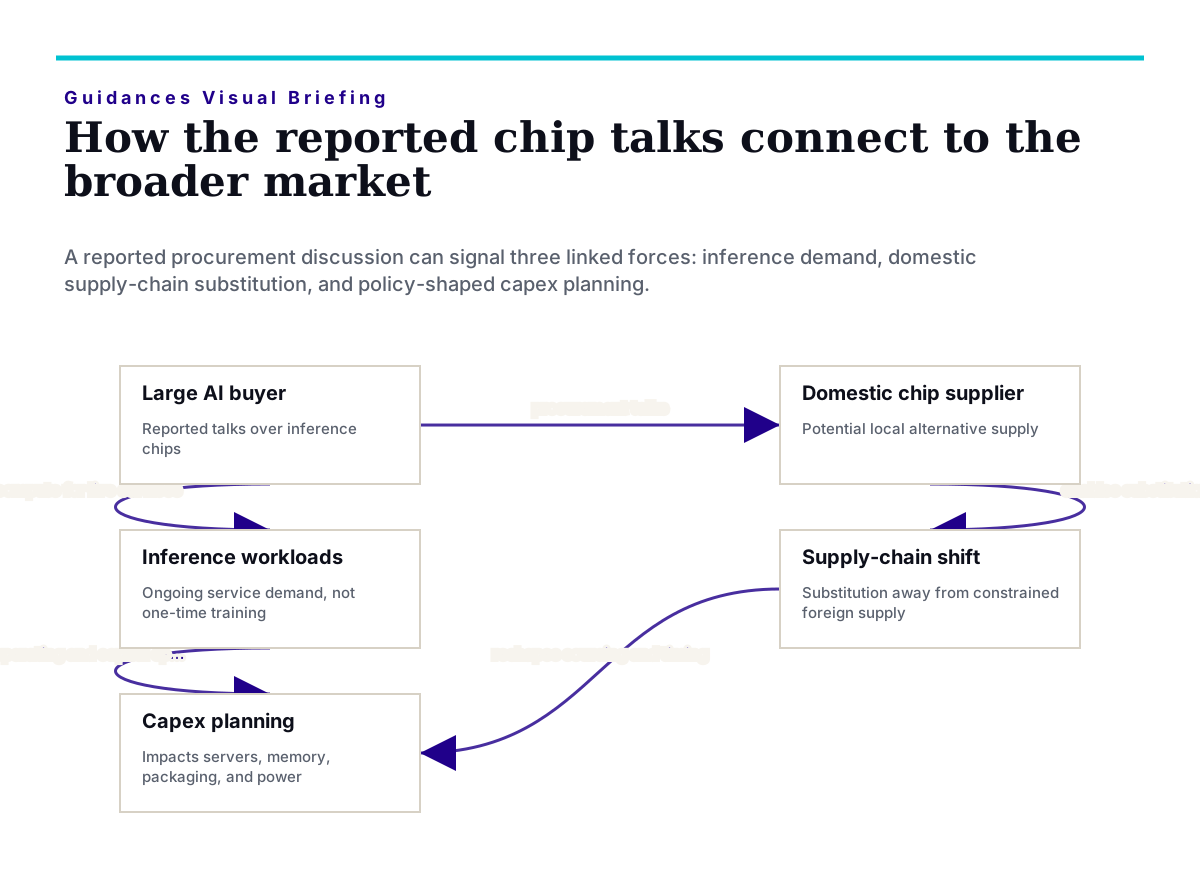
The report matters less as a single deal than as a signal about where China’s AI hardware demand may be moving.
Corrections and safety
See a factual, privacy, rights, or safety issue? Review the corrections process or contact Guidances before relying on this article for important decisions.