Policy
Developing · 0 updatesFact 8/10The AI oversight gap may become a durable policy legacy
Article language
English
Axios reports that U.S. AI governance may be shaped for an extended period less by Congress than by the executive branch, state governments, and the courts. The central issue is not only whether AI should be regulated, but which institution will set the rules and how that process will affect companies operating across jurisdictions.
Open article · no sign-in required
Sources and disclosure
The article is well aligned with the provided Axios context. Core claims about Congress struggling to set AI rules, and governance being shaped by the executive branch, states, and courts are supported. The market lens stays at a policy-operations level and avoids unsupported stock or price claims. The piece is appropriately cautious, source-attributed, and includes the required non-advice boundary.
Market lens
AI governance becomes an operating checklist buyers can audit
The market effect depends on whether policy language turns into required logs, evaluations, incident-response records, and launch gates.
Impact path
Policy memo → ops checklist
Signals to watch
- Draft rules specifying retention or audit evidence
- Enterprise RFPs requiring AI operation logs
- Product launches centered on governance workflows
Verification schedule
D+1 · Jun 16
Do rules move from principles into required artifacts?
D+3 · Jun 18
Do RFPs ask for evidence before model benchmarks?
D+7 · Jun 22
Do vendors ship audit workflows as core product?
Informational context only — not investment, legal, tax, or financial advice.
The latest Axios report points to a familiar but consequential pattern in American technology policy: when Congress does not settle the rules, other institutions begin to do the work by default. In the case of artificial intelligence, that institutional drift may matter as much as any single bill. Based on the provided article context, the issue is not only whether the United States will regulate AI, but which branch of government will define the practical boundaries of the market.
That distinction matters for developers and founders because AI governance is not a narrow compliance topic. It affects model training, deployment, procurement, liability allocation, data handling, public-sector adoption, and the pace at which firms can ship products across jurisdictions. If Congress remains unable to produce a broad consensus, then the effective rulebook will likely emerge from a mix of executive action, state-level measures, and court decisions. For companies building in the United States, that is not a theoretical concern. It is an operating environment.
Axios places this debate in a broader political context. According to the snippet, policymakers from both parties often describe AI leadership through a national security lens. That framing has two effects. First, it raises the stakes of the policy debate by linking AI governance to strategic competition. Second, it makes compromise harder, because the discussion shifts from technical safeguards to geopolitical positioning. When AI policy is discussed as a race, legislators are less likely to converge on a single, detailed framework.
Market Lens
From a market perspective, the report is less about a single company or a near-term price reaction than about the cost structure of AI deployment. A delayed federal framework can increase the importance of legal review, compliance design, and jurisdiction-by-jurisdiction monitoring. That may affect how quickly firms can scale products and how much operational overhead they must carry. The article does not support claims about winners, losers, or immediate stock moves, so the more defensible interpretation is that regulatory fragmentation can become a persistent planning variable for the sector.
For builders, the practical implication is that the United States may continue to operate with a fragmented governance structure for longer than many companies would prefer. A fragmented structure does not mean no rules. It means multiple rule-making centers, each with different priorities and timelines. A federal agency may issue guidance. A state may adopt its own requirements. A court may interpret a dispute in a way that becomes influential beyond the immediate case. The result is a patchwork that can be manageable for large incumbents with legal teams, but more burdensome for startups trying to scale quickly.
This is where the article’s policy significance becomes operational. If the federal government does not write a comprehensive AI framework, companies will need to design for uncertainty. That means more than legal review at the end of a product cycle. It means building documentation practices, evaluation processes, and governance controls into the product itself. It also means assuming that the compliance burden may differ by customer segment. A consumer-facing tool, an enterprise workflow product, and a public-sector deployment may each face different expectations even if they use similar underlying models.
The snippet also suggests a tension that is likely to remain central: the trade-off between innovation and restraint. Supporters of lighter-touch policy argue that excessive regulation could slow development and weaken the United States in global competition. Critics counter that insufficient guardrails around increasingly capable models could create strategic and operational risks. Axios presents this as a live policy argument rather than a settled conclusion. That is important, because it means the debate is still being shaped by competing definitions of what counts as leadership. Is leadership measured by speed of deployment, by safety standards, or by the ability to set global norms? The answer will influence the eventual shape of regulation.
The uncertainty is substantial. The snippet does not identify a specific bill, a concrete timetable, or a clear legislative coalition. It also does not indicate whether the administration is preparing a new federal framework or simply relying on existing authorities. Because the source material is thin, the safest reading is structural rather than predictive. The article appears to argue that the United States is at risk of leaving AI governance to a slow, uneven process of institutional substitution. That is a meaningful claim even without granular policy detail. It suggests that the absence of consensus itself may become the lasting legacy.
What to watch next is not only whether Congress acts, but whether executive agencies, state governments, and courts continue to fill the gap in parallel. For founders, that has several implications. One is procurement strategy. If federal rules remain unsettled, public-sector buyers may rely more heavily on agency-specific standards or state-level requirements. Another is product architecture. Systems that can be configured for different documentation, audit, and review needs will be easier to sell across jurisdictions. A third is risk management. Companies that assume a single national standard may find themselves reworking compliance processes later, at higher cost.
There is also a broader market signal here. When policy is fragmented, trust becomes a competitive variable. Enterprises and institutions often prefer vendors that can demonstrate disciplined governance even before the law requires it. In practice, that can reward teams that invest early in model evaluation, incident logging, data provenance, and human oversight workflows. None of these measures guarantees regulatory simplicity. But they can reduce friction when policy expectations change.
The national security framing deserves particular attention. The snippet says some policymakers view AI leadership as a matter of security, while others warn that weak guardrails could themselves become a security concern. That duality is likely to shape procurement, export controls, and public funding debates even if Congress does not pass a comprehensive AI law. For companies with cross-border operations, the implication is clear: policy risk may increasingly be tied to where systems are trained, where data is stored, and how models are used in sensitive contexts. The governance question is therefore not only domestic. It is international and operational.
What Axios appears to be describing is less a single policy event than a durable institutional condition. Congress has often struggled to regulate fast-moving technologies. AI may follow that pattern, but with higher stakes because the technology is already embedded in core business processes and public debate. If lawmakers do not settle the issue, the vacuum will not remain empty. It will be filled by executive action, state experimentation, and judicial interpretation. For builders, that means the safest assumption is not stability, but layered uncertainty.
Builder Implications
- Treat U.S. AI governance as a multi-jurisdiction problem: federal, state, and judicial signals may all matter at once.
- Build compliance, logging, and evaluation features into the product architecture rather than adding them after launch.
- If you sell into enterprise or public-sector markets, prepare for customer-specific governance requirements even in the absence of a comprehensive federal AI law.
- This article is not medical advice and not investment advice; it is a policy analysis of how AI oversight may be distributed across institutions.
Want follow-up alerts? Subscribe by email after reading the public article.
Market lens
AI governance becomes an operating checklist buyers can audit
The market effect depends on whether policy language turns into required logs, evaluations, incident-response records, and launch gates.
Impact path
Policy memo → ops checklist
Signals to watch
- Draft rules specifying retention or audit evidence
- Enterprise RFPs requiring AI operation logs
- Product launches centered on governance workflows
Verification schedule
D+1 · Jun 16
Do rules move from principles into required artifacts?
D+3 · Jun 18
Do RFPs ask for evidence before model benchmarks?
D+7 · Jun 22
Do vendors ship audit workflows as core product?
Informational context only — not investment, legal, tax, or financial advice.
Visual Briefing
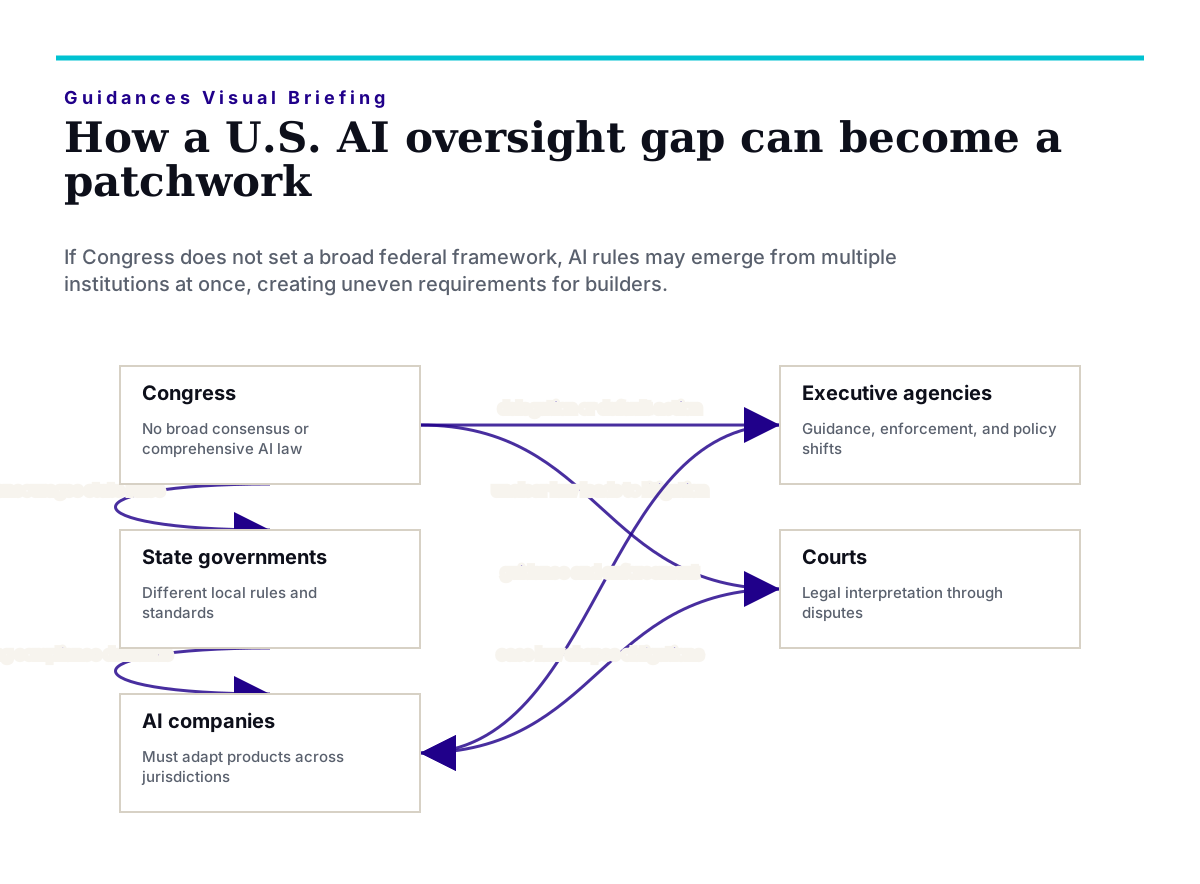
A federal policy gap can shift practical AI governance to multiple institutions, producing a fragmented rule environment.
Corrections and safety
See a factual, privacy, rights, or safety issue? Review the corrections process or contact Guidances before relying on this article for important decisions.