Policy
Developing · 0 updatesFact 9/10U.S. Bank Regulators Increase Scrutiny of AI Use in Finance, Shifting Focus to Controls and Governance
Article language
English
Reuters reports that U.S. bank regulators are increasing scrutiny of how financial firms use artificial intelligence. The focus is not on AI adoption itself, but on operating controls: data access, governance, third-party vendors, and use in higher-risk functions such as lending, know-your-customer checks, and sanctions screening. This shift suggests that the discussion around AI in finance is moving from technological performance to operational control.
Open article · no sign-in required
Sources and disclosure
The core factual claims are supported by the Reuters context: U.S. bank regulators are increasing scrutiny of AI use at financial firms, with attention to data access, governance controls, and third-party vendor risk. The article stays within policy/market context and does not make unsupported clinical or investment claims. Some interpretive language about market implications is broader than the source, but it is framed as analysis rather than a factual assertion.
Market lens
AI governance becomes an operating checklist buyers can audit
The market effect depends on whether policy language turns into required logs, evaluations, incident-response records, and launch gates.
Impact path
Policy memo → ops checklist
Signals to watch
- Draft rules specifying retention or audit evidence
- Enterprise RFPs requiring AI operation logs
- Product launches centered on governance workflows
Verification schedule
D+1 · Jun 16
Do rules move from principles into required artifacts?
D+3 · Jun 18
Do RFPs ask for evidence before model benchmarks?
D+7 · Jun 22
Do vendors ship audit workflows as core product?
Informational context only — not investment, legal, tax, or financial advice.
Reuters reports that U.S. bank regulators are stepping up scrutiny of how financial firms use artificial intelligence. The immediate significance is not that AI has become a prohibited tool, nor that regulators are rejecting automation. Rather, the signal is that AI in finance is moving from a discretionary innovation topic into a standard supervisory concern. For banks, lenders, and the vendors that serve them, that shift matters as much as any model benchmark.
According to the Reuters snippet, the Office of the Comptroller of the Currency (OCC) and the Federal Reserve have begun, in routine bank examinations, asking institutions to map how they use AI in higher-risk functions such as lending, know-your-customer (KYC) checks, and sanctions screening. The report also says regulators are pressing firms on data access, governance controls, and risks tied to third-party vendors. That combination is important. It suggests the supervisory lens is not limited to whether a bank uses AI, but extends to how the system is governed, who can touch the data, and how much of the workflow sits outside the institution itself.
That distinction is central for developers and founders. In many technology markets, AI adoption is framed as a question of product capability: better accuracy, lower cost, faster throughput. In regulated finance, those metrics remain relevant, but they are no longer sufficient. A model that performs well in a demonstration can still face obstacles if the institution cannot explain its data lineage, document access permissions, or show how human oversight is embedded in the process. The Reuters report indicates that regulators are asking precisely those operational questions. For builders, that means compliance features are not a later add-on; they are part of the product definition from the outset.
The focus on higher-risk use cases is especially telling. Lending decisions, customer identification, and sanctions screening are not peripheral back-office tasks. They sit close to the core of financial intermediation and regulatory obligations. If AI is used in these areas, the institution must be able to show how the system fits into existing controls. That includes who approved the deployment, what data was used, how exceptions are handled, and what happens when the model produces an uncertain or inconsistent result. The Reuters snippet does not provide details on any specific enforcement action or new rulemaking, so it would be premature to read this as a formal regulatory overhaul. But it does show that examiners are now treating AI as part of the normal control environment rather than as a novelty.
That is a meaningful operating change. Financial firms often move cautiously when supervisory expectations are unclear, and AI adds several layers of complexity. Data access must be tightly managed because financial information is sensitive and often fragmented across systems. Governance must be explicit because models can be updated, retrained, or replaced in ways that alter behavior over time. Third-party vendor risk is also heightened because many firms rely on external cloud services, model providers, data suppliers, or systems integrators. If regulators are asking about those dependencies, then banks will need more than a procurement checklist. They will need a documented operating model that shows where the AI system begins and ends, and who is accountable at each stage.
Market Lens
The increased regulatory scrutiny, while not yet formalized into new rules, carries significant implications for market participants across the financial sector. For established financial institutions, this shift translates into potentially higher operational costs associated with AI deployment. Banks will need to invest more in governance frameworks, data lineage tracking, audit trails, and third-party vendor management to ensure their AI systems meet supervisory expectations. This could slow the pace of AI adoption in certain high-risk areas, as firms prioritize compliance and risk mitigation over rapid deployment.
For fintech companies and AI solution providers targeting the financial sector, the competitive landscape is evolving. The market will increasingly favor vendors that can demonstrate not only strong model performance but also a clear understanding of regulatory requirements and the ability to embed governance, auditability, and human oversight into their product design from the outset. This could lead to a bifurcation in the market, where "compliance-ready" AI solutions gain faster traction, while those lacking these features face longer sales cycles and greater integration challenges. Investment decisions in the fintech space may also begin to reflect this emphasis, with investors scrutinizing a company's approach to regulatory compliance and risk management as a key indicator of its long-term viability and market access. Ultimately, this regulatory signal suggests that the operating requirements for AI in finance are rising, shifting the focus from pure technological innovation to responsible and auditable deployment.
There is also a broader strategic implication for AI startups that want to sell into financial services. Many founders assume that the path to adoption is to demonstrate a strong model and then negotiate compliance later. The Reuters report points in the opposite direction. If regulators are already asking banks to map AI use in high-risk workflows, then the burden of proof will increasingly fall on the institution and, by extension, on the vendor. Startups that design for governance from the outset may find a clearer route to enterprise adoption. Those that treat controls as optional may encounter slower sales cycles, more pilot churn, and more integration work after the fact.
The uncertainty in the Reuters report should also be noted. The snippet does not indicate whether regulators are preparing new guidance, whether the scrutiny is temporary, or whether it reflects a broader policy shift that will be formalized later. It only establishes that the OCC and the Federal Reserve have begun asking more pointed questions during routine examinations, and that the focus includes data access, governance, and vendor risk. That is enough to matter. In regulated industries, supervisory practice often shapes behavior before formal rulemaking does. Firms respond to examination questions because those questions reveal what the regulator considers material.
For founders outside the United States, the lesson is still relevant. Financial regulation tends to travel through practice as much as through law. If U.S. supervisors are now asking banks to map AI use in high-risk workflows, other regulators may follow with similar expectations, even if the wording differs. That is particularly relevant for companies building cross-border financial infrastructure, compliance tooling, or AI systems that can be deployed in multiple jurisdictions. A product architecture that assumes minimal oversight in one market may prove difficult to scale elsewhere.
The report also reinforces a familiar but often underappreciated truth: in finance, the most valuable AI systems are not necessarily the most autonomous. They are the ones that can be governed. That means the product surface must support review, override, documentation, and accountability. It also means institutions will need internal teams that can interpret model behavior and translate it into supervisory language. The technical challenge is therefore paired with an organizational one. AI adoption in finance is not only about deploying software; it is about making that software legible to risk, compliance, and examination teams.
In that sense, the Reuters report is less a story about a single regulatory action than a marker of maturity. AI in finance is entering a phase where operational discipline matters as much as experimentation. For banks, that raises the cost of deployment but also lowers the risk of uncontrolled adoption. For builders, it narrows the market for casual AI products and expands the opportunity for infrastructure that can stand up to scrutiny. The companies that understand this early will be better positioned than those that assume the market still rewards speed alone.
Builder Implications
- Financial AI products should be designed with auditability, access control, clear logging, change management, and human review as core features, not compliance extras.
- Vendors serving lending, KYC, or sanctions workflows should prepare documentation that explains data lineage, model changes, and accountability boundaries.
- Founders should expect enterprise buyers to ask how the system will perform under examination, not only how it performs in testing.
Want follow-up alerts? Subscribe by email after reading the public article.
Market lens
AI governance becomes an operating checklist buyers can audit
The market effect depends on whether policy language turns into required logs, evaluations, incident-response records, and launch gates.
Impact path
Policy memo → ops checklist
Signals to watch
- Draft rules specifying retention or audit evidence
- Enterprise RFPs requiring AI operation logs
- Product launches centered on governance workflows
Verification schedule
D+1 · Jun 16
Do rules move from principles into required artifacts?
D+3 · Jun 18
Do RFPs ask for evidence before model benchmarks?
D+7 · Jun 22
Do vendors ship audit workflows as core product?
Informational context only — not investment, legal, tax, or financial advice.
Visual Briefing
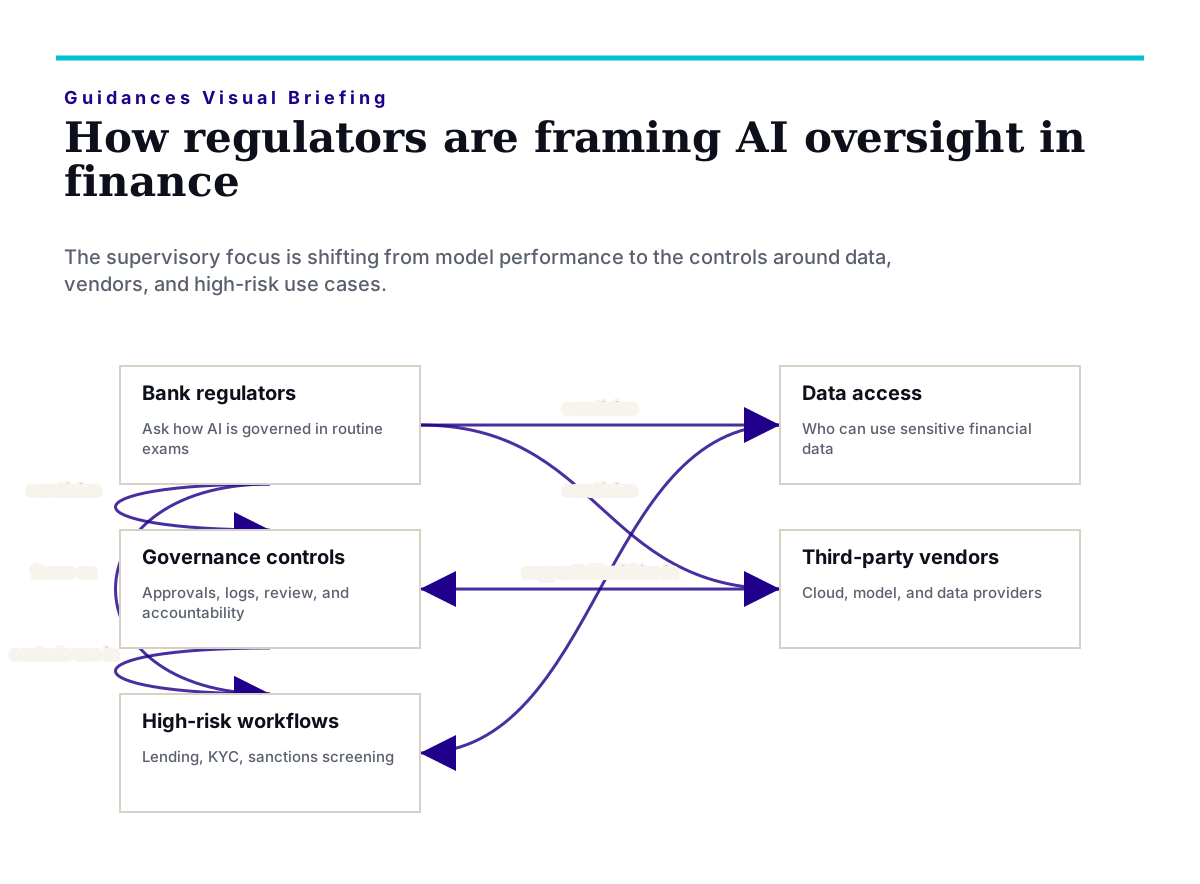
A simple map of the issues regulators are probing when banks deploy AI.
Corrections and safety
See a factual, privacy, rights, or safety issue? Review the corrections process or contact Guidances before relying on this article for important decisions.