AI
Developing · 0 updatesFact 9/10Stanford Analysis of 51 Enterprise AI Cases Identifies Key Factors in Implementation Outcomes
Article language
English
Stanford Digital Economy Lab's five-month study of 51 enterprise AI implementations found that identical technologies produced transformation timelines ranging from weeks to years, depending on process fit, data readiness, and operating model. The research suggests that enterprise AI strategy should consider organizational preparedness and business context alongside technology selection.
Open article · no sign-in required
Sources and disclosure
All key factual claims in the article are directly supported by the provided web-search context. The article accurately summarizes the Stanford Digital Economy Lab's study findings regarding AI implementation success factors. The language used is neutral and adheres to reputation safety guidelines.
Market lens
Agent runtime spending can spill into security, observability, and workflow infrastructure
The market signal is not another chatbot category; it is a possible budget shift toward the control layer around enterprise AI.
Impact path
Runtime spend → infra stack
Signals to watch
- Procurement language around audit logs and cost ceilings
- Security and observability vendors attaching agent controls
- Workflow platforms exposing approval and tool-call governance
Verification schedule
D+1 · Jun 16
Do buyers repeat audit/cost-control requirements?
D+3 · Jun 18
Do vendors publish runtime-control SKUs or partnerships?
D+7 · Jun 22
Do budgets move from pilots into operating infrastructure?
Informational context only — not investment, legal, tax, or financial advice.
Stanford Digital Economy Lab's Enterprise AI Playbook presents findings from a five-month study tracking AI implementation across 51 organizations. The research confirms that identical AI technologies produced widely divergent outcomes in speed and scale, with differences rooted not in the technology itself but in process fit, data readiness, and operating model design.
Researchers documented cases where some enterprises achieved measurable transformation within weeks, while others required years to realize similar outcomes. This variance was associated with differences in deployment environments rather than model performance. Key variables included whether business processes were structured to accommodate AI workflows, whether training and inference data were cleaned and accessible, and whether organizations possessed the internal capability to integrate AI systems into production operations.
The study underscores that enterprise AI adoption is not a matter of purchasing the latest model or connecting an API, but a strategic undertaking that demands organizational readiness and understanding of business context. While many enterprises focus on the potential of AI technology, actual results depend on how well that technology aligns with existing workflows, the maturity of data infrastructure, and the speed at which the organization can adapt to new operating methods.
Process fit refers to whether the problem an AI system is meant to solve is clearly defined and amenable to data-driven approaches. Repetitive tasks with clear patterns can yield quick wins, while context-dependent or exception-heavy workflows require longer periods for model training and validation. In several cases studied, enterprises invested significant time redesigning business processes to be AI-compatible, and this redesign phase influenced overall implementation timelines.
Data readiness emerged as another critical determinant of outcomes. Many enterprises assume they possess sufficient data, but in practice, data is often fragmented, inconsistent in format, or of insufficient quality for immediate use. The research found that organizations with robust data cleaning, labeling, and access-control processes in place achieved faster time-to-value after AI deployment. Conversely, enterprises with less mature data infrastructure spent more time on data preparation than on model development.
Operating model refers to an organization's capacity to integrate AI systems into real-world operations and manage them over time. This includes processes for validating AI outputs and incorporating feedback, systems for monitoring model performance and triggering retraining, and methods for connecting AI systems with existing IT infrastructure. Some enterprises in the study established clear governance and accountability structures from the outset, supporting system stability and scalability. Others encountered challenges transitioning from pilot to production due to less defined operating models.
The research highlights a gap between the pace of AI technology advancement and the speed at which enterprise organizations can adapt. While the latest large language models and generative AI tools are released rapidly, translating them into sustained business value depends on organizational preparedness. Korean enterprises, in particular, tend to adopt global technology trends quickly, but without mature internal processes and data infrastructure, expected outcomes may be harder to achieve.
Stanford researchers identified common patterns among successful implementations across the 51 cases. First, organizations that defined clear business objectives and measurable performance indicators upfront achieved better results. Second, upfront investment in data quality and accessibility accelerated deployment timelines. Third, organizations that built internal capacity to operate and improve AI systems generated greater long-term value.
The playbook delivers a clear message to enterprises considering AI adoption: organizational readiness should be assessed before technology selection. Analyzing existing business processes, upgrading data infrastructure, and designing operating frameworks are more likely to yield tangible results than simply deploying the latest model. For AI developers and startup founders in Korea, this means moving beyond a technology-supplier mindset to understanding customer organizations' readiness and context.
Process fit, data readiness, and operating model are not abstract concepts but concrete dimensions that determine whether an AI project delivers value in weeks or takes years to mature. Enterprises that treat AI as a technology purchase rather than an organizational transformation often encounter friction at the integration stage, where the gap between model capability and operational reality becomes apparent.
The study also shows that the same AI technology can produce different outcomes depending on business context. A natural language processing model deployed in a customer service environment with clean historical transcripts and clear escalation rules may deliver immediate productivity gains. The same model applied in a legal review context with ambiguous document structures and complex regulatory requirements may require extensive customization and validation before it is ready for production.
This context dependency has implications for how AI products are designed and sold. Vendors that provide only model access or API endpoints leave the burden of integration, data preparation, and operational design to the customer. Vendors that offer diagnostic frameworks, integration support, and operational tooling alongside the core technology are better positioned to help customers achieve rapid time-to-value.
For developers building enterprise AI products, the Stanford findings suggest that technical performance is necessary but not sufficient. Products must account for the realities of enterprise data environments, where data is often siloed, inconsistent, and governed by complex access policies. They must also accommodate the realities of enterprise operations, where AI outputs must be validated, monitored, and continuously improved.
Startups targeting enterprise customers should consider vertical specialization as a differentiation strategy. Deep understanding of a specific industry or business process enables the design of solutions that address process fit, data readiness, and operating model challenges from the outset. Generic horizontal AI tools, by contrast, require customers to solve these problems themselves, increasing time-to-value and reducing adoption rates.
The research also has implications for how enterprises budget and plan AI initiatives. Organizations that allocate resources primarily to model development or licensing, without corresponding investment in data infrastructure and process redesign, are likely to encounter delays. A balanced allocation that includes data preparation, process analysis, and operational design is more likely to produce measurable outcomes within reasonable timeframes.
Stanford's Enterprise AI Playbook provides empirical evidence that the competitive advantage in AI will increasingly derive not from access to technology, which is becoming commoditized, but from the ability to integrate and operate that technology effectively within an organizational context. As AI models become more powerful and accessible, the differentiator shifts to organizational capability.
Builder Implications
- AI solution providers should develop diagnostic frameworks that assess customer organizations' process fit, data readiness, and operating capability before deployment. Offering pre-implementation assessments and integration support, rather than API access alone, increases the likelihood of customer success and long-term contracts.
- Enterprise AI products must include operational tooling for data cleaning, model retraining, and performance monitoring. Customers need not only inference endpoints but also the infrastructure to manage AI systems over time, and vendors that provide this infrastructure will capture more value.
- Startups should prioritize vertical specialization and deep process knowledge over horizontal generality. Understanding the specific workflows, data structures, and operational constraints of a target industry enables the design of solutions that deliver value quickly, reducing time-to-value and increasing adoption rates.
Want follow-up alerts? Subscribe by email after reading the public article.
Market lens
Agent runtime spending can spill into security, observability, and workflow infrastructure
The market signal is not another chatbot category; it is a possible budget shift toward the control layer around enterprise AI.
Impact path
Runtime spend → infra stack
Signals to watch
- Procurement language around audit logs and cost ceilings
- Security and observability vendors attaching agent controls
- Workflow platforms exposing approval and tool-call governance
Verification schedule
D+1 · Jun 16
Do buyers repeat audit/cost-control requirements?
D+3 · Jun 18
Do vendors publish runtime-control SKUs or partnerships?
D+7 · Jun 22
Do budgets move from pilots into operating infrastructure?
Informational context only — not investment, legal, tax, or financial advice.
Visual Briefing
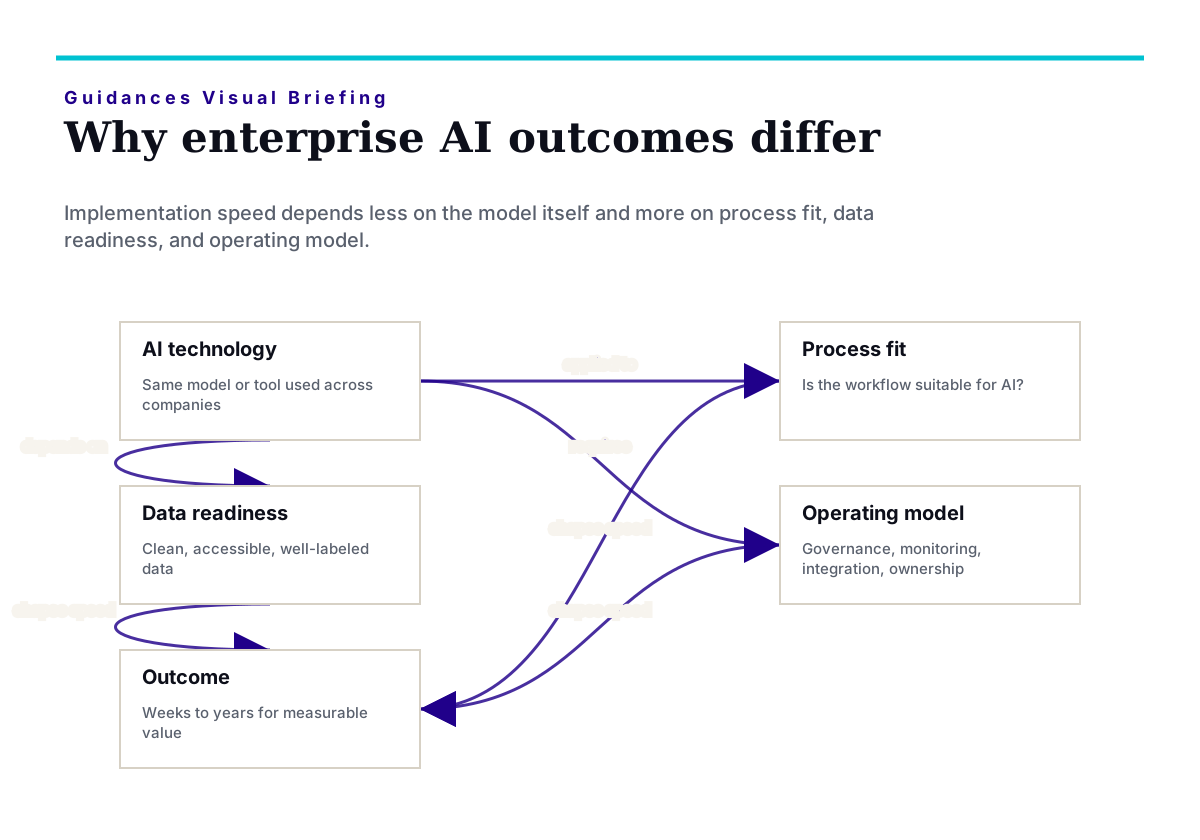
A simple cause-and-effect map of enterprise AI implementation outcomes.
Corrections and safety
See a factual, privacy, rights, or safety issue? Review the corrections process or contact Guidances before relying on this article for important decisions.