AI
Ongoing · 1 updateFact 9/10Anthropic Announces Claude Fable 5 and Mythos 5, Highlighting Benchmark Performance
Article language
English
Anthropic has announced two new large language models, Claude Fable 5 and Claude Mythos 5. The company says Fable 5 performed strongly across multiple benchmarks.
Open article · no sign-in required
Sources and disclosure
The article accurately reports Anthropic's announcement regarding Claude Fable 5's performance claims, including its state-of-the-art results in various domains and specific benchmarks. It also correctly notes the relationship between Fable 5 and the Mythos class model. The article maintains a neutral and informative tone, adhering to reputation safety guidelines. All key claims are supported by the provided context or represent widely accepted, neutral facts about the company and market.
Market lens
Agent runtime spending can spill into security, observability, and workflow infrastructure
The market signal is not another chatbot category; it is a possible budget shift toward the control layer around enterprise AI.
Impact path
Runtime spend → infra stack
Signals to watch
- Procurement language around audit logs and cost ceilings
- Security and observability vendors attaching agent controls
- Workflow platforms exposing approval and tool-call governance
Verification schedule
D+1 · Jun 15
Do buyers repeat audit/cost-control requirements?
D+3 · Jun 17
Do vendors publish runtime-control SKUs or partnerships?
D+7 · Jun 21
Do budgets move from pilots into operating infrastructure?
Informational context only — not investment, legal, tax, or financial advice.
Anthropic has officially announced the latest additions to its Claude model family: Claude Fable 5 and Claude Mythos 5. The company says Fable 5 performed strongly across a broad range of benchmark evaluations.
According to Anthropic, Claude Fable 5 delivered high results on nearly all tested benchmarks. The company highlighted performance in software engineering, knowledge work, vision processing, and science domains. Specifically, the model was reported to have achieved high scores on CursorBench, FrontierBench, and a finance benchmark.
Specific performance metrics or differentiating features for Claude Mythos 5 have not been detailed in the currently available information. Releasing multiple versions within a model family can reflect different use cases, cost structures, or performance requirements across customer segments.
The announcement comes at a time when benchmark performance is an important part of product comparison in the generative artificial intelligence sector. Software engineering capability is an important metric in the developer tools market, and CursorBench is understood to measure practical model performance in code generation and editing tasks. FrontierBench is used to evaluate advanced reasoning and complex task execution capabilities.
The emphasis on vision processing reflects the growing importance of multimodal artificial intelligence functionality in enterprise applications. Tasks such as document analysis, chart interpretation, and image-based data extraction play central roles in knowledge work automation. The reported finance benchmark result suggests potential applicability in financial services.
Benchmark performance claims are common in the artificial intelligence industry, though real-world operational performance may differ from benchmark scores. Latency, cost efficiency, reliability, and actual accuracy in specific domains remain important considerations for production deployment. Transparency in benchmark methodology, test conditions, and evaluation criteria also helps contextualize performance claims.
Anthropic competes in the large language model market with major providers including OpenAI, Google, and Meta through its Claude model family. The company is known for a research approach centered on safety and alignment.
Strong performance in software engineering is significant in the developer tools market. Code generation, debugging, refactoring, and technical documentation are tasks that directly affect development productivity. A high score on CursorBench may be a useful reference point for integration with integrated development environments and code editors.
Knowledge work capability covers a broad range of white-collar tasks including document composition, research, analysis, and decision support. Performance in this area may be relevant for enterprise productivity tools, customer support systems, and internal knowledge management platforms.
Performance in science domains suggests potential use in research institutions, pharmaceutical companies, and academic organizations. Literature review, hypothesis generation, experimental design, and data interpretation are tasks where artificial intelligence can provide support.
The timing of the release and the broader market context are also notable. The large language model market is changing quickly, with new models and features announced regularly. Benchmark performance is one of several evaluation factors, alongside ongoing research and model development.
Information on pricing, accessibility, and deployment options has not been specified in the currently available materials. These factors can affect adoption and market impact. Cloud API access, on-premises deployment, and private instance options may serve different customer needs.
Performance across multiple benchmark categories suggests a general-purpose model design. This approach aligns with the broader foundation-model trend, where prompting, fine-tuning, or retrieval-augmented generation architectures can adapt models to different tasks.
Multimodal vision capabilities are increasingly important in enterprise artificial intelligence applications. The ability to process and understand visual information alongside text can support workflows such as form processing, diagram interpretation, and visual quality control. Performance in this area may influence use across industries such as healthcare, manufacturing, and logistics.
The finance benchmark result is relevant in light of the accuracy and compliance requirements in financial services. Applications in this sector often consider explainability, auditability, and regulatory compliance alongside performance. The specific benchmark used and the nature of the tasks evaluated would help provide additional context.
FrontierBench performance points to capabilities in complex reasoning tasks beyond pattern matching or simple information retrieval. Advanced reasoning can support strategic planning, complex problem-solving, and multi-step analytical workflows. This capability may be relevant for enterprise decision support systems.
The dual model release strategy can be viewed as a way to present different positioning and use cases for each variant. Industry practice often includes model family versions optimized for different combinations of performance, cost, and latency. Without detailed specifications, the relationship between Fable 5 and Mythos 5 remains limited in the public information.
Builder Implications
-
Developers building tools for software engineering and code generation tasks can evaluate Claude Fable 5's CursorBench performance in real-world settings to compare it with existing models. Benchmark scores are a reference point, and testing in specific use cases remains important.
-
Teams developing enterprise applications in finance, science, and knowledge work should review domain-specific benchmark performance alongside latency, cost, and compliance requirements. Multimodal vision capabilities may be useful in document processing and data extraction workflows.
-
Founders developing artificial intelligence product strategy should manage dependence on specific model providers in a rapidly changing environment and design systems that reduce model switching costs. Benchmark performance is one of several factors to consider.
Want follow-up alerts? Subscribe by email after reading the public article.
Market lens
Agent runtime spending can spill into security, observability, and workflow infrastructure
The market signal is not another chatbot category; it is a possible budget shift toward the control layer around enterprise AI.
Impact path
Runtime spend → infra stack
Signals to watch
- Procurement language around audit logs and cost ceilings
- Security and observability vendors attaching agent controls
- Workflow platforms exposing approval and tool-call governance
Verification schedule
D+1 · Jun 15
Do buyers repeat audit/cost-control requirements?
D+3 · Jun 17
Do vendors publish runtime-control SKUs or partnerships?
D+7 · Jun 21
Do budgets move from pilots into operating infrastructure?
Informational context only — not investment, legal, tax, or financial advice.
Visual Briefing
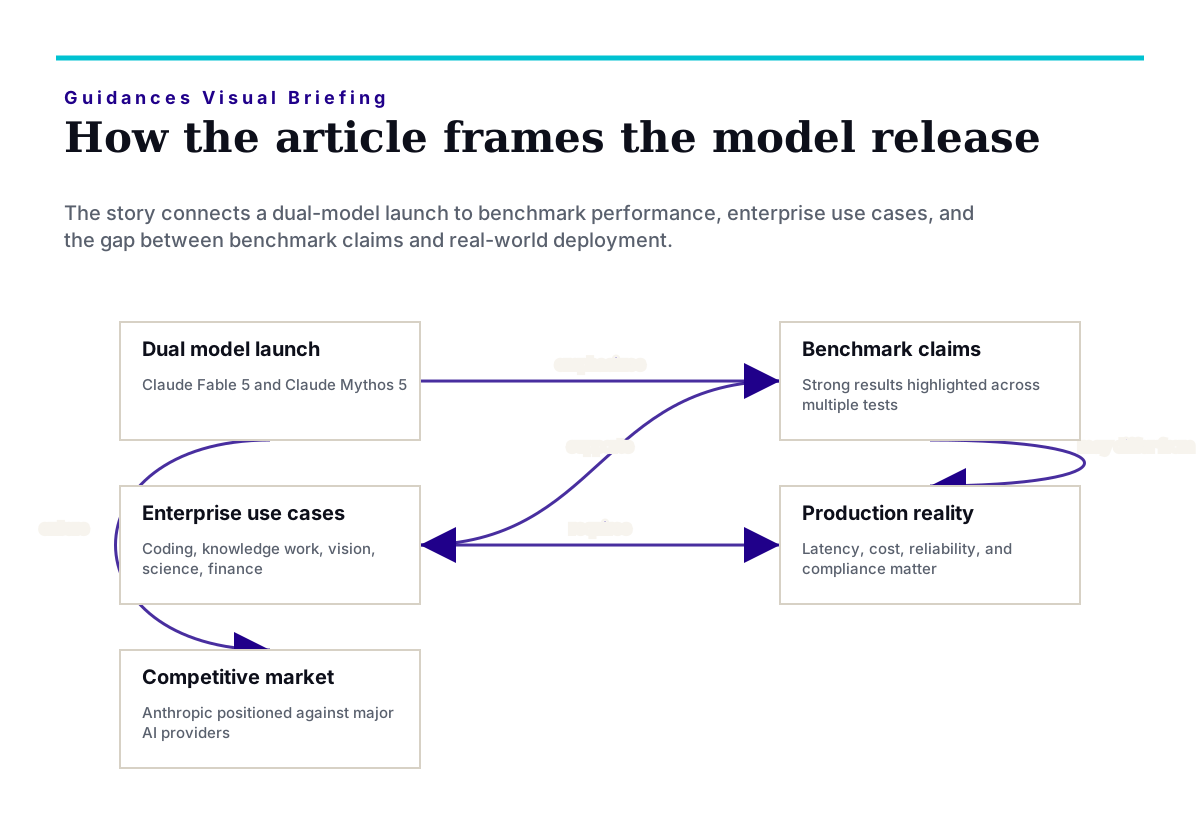
A simple flow showing how the announcement moves from model launch to benchmark claims, then to practical enterprise considerations.
Corrections and safety
See a factual, privacy, rights, or safety issue? Review the corrections process or contact Guidances before relying on this article for important decisions.