Policy
Developing · 0 updatesFact 8/10European Union Publishes Code of Practice on AI-Generated Content Transparency, Effective August 2026
Article language
English
The European Commission has published a voluntary Code of Practice on transparency for AI-generated content. The code takes effect on 2 August 2026 and addresses marking, labeling, and detection for AI-generated content, including deepfakes and certain AI-generated publications. Developers and platform operators may review the related requirements.
Open article · no sign-in required
Sources and disclosure
Core claims are supported by the provided source context: the European Commission published a final voluntary Code of Practice on marking and labelling AI-generated content, it is tied to AI Act transparency obligations, and those obligations apply from 2 August 2026. The article is broadly aligned with the source, though several details go beyond the provided evidence and should be treated as interpretive or omitted in a tighter version.
Market lens
AI governance becomes an operating checklist buyers can audit
The market effect depends on whether policy language turns into required logs, evaluations, incident-response records, and launch gates.
Impact path
Policy memo → ops checklist
Signals to watch
- Draft rules specifying retention or audit evidence
- Enterprise RFPs requiring AI operation logs
- Product launches centered on governance workflows
Verification schedule
D+1 · Jun 16
Do rules move from principles into required artifacts?
D+3 · Jun 18
Do RFPs ask for evidence before model benchmarks?
D+7 · Jun 22
Do vendors ship audit workflows as core product?
Informational context only — not investment, legal, tax, or financial advice.
The European Commission has officially published a Code of Practice on transparency for AI-generated content. While voluntary in nature, the code is designed to support compliance with transparency obligations set out in Article 50 of the European Union AI Act and will take effect on 2 August 2026. It covers marking, labeling, and detection requirements for AI-generated content, including deepfakes and certain AI-generated publications.
The code, published on the European Commission's digital strategy page, operationalizes the legal framework requiring providers and deployers of AI systems to disclose the origin and nature of generative AI outputs. Article 50 of the AI Act mandates transparency measures to ensure users can recognize when content has been generated by a machine, and this code of practice provides concrete implementation guidance. Although participation is voluntary, the code may serve as a reference point for compliance planning.
The code's core elements are organized around three technical domains. First, marking requirements stipulate that AI-generated content must include machine-readable identifiers, such as metadata or watermarks, at the point of generation. Second, labeling obligations require explicit disclosure of AI-generated status within user interfaces. Third, detection provisions encourage platform operators and service providers to deploy technical means for identifying and classifying AI-generated content. These requirements apply across multiple modalities, including text, images, audio, and video.
Deepfakes are a special focus of the code. Deepfakes are content that mimics the appearance, voice, or behavior of real individuals, and the code is expected to address marking and labeling standards for such content. Deepfakes used in sensitive contexts—such as political campaigns, public safety, or financial services—may face additional disclosure obligations.
The effective date of 2 August 2026 provides AI system providers and platform operators with approximately 14 months to prepare. During this period, companies may integrate metadata insertion, watermarking, and labeling interfaces into existing AI pipelines, review internal policies and user terms, and establish governance frameworks to monitor implementation.
The code operates within the broader regulatory architecture of the EU AI Act. The Act imposes requirements on high-risk AI systems and establishes separate obligations for generative AI centered on transparency and copyright compliance. The code of practice provides practical guidance for fulfilling these legal obligations and facilitates cooperation between industry and regulators.
The code's effectiveness depends on the maturity of technical standards and industry adoption rates. International standards bodies such as the Coalition for Content Provenance and Authenticity (C2PA) are developing content provenance frameworks, and the EU code is expected to consider interoperability with these standards. However, technical challenges remain, including the robustness of watermarking technologies, tamper-resistance of metadata, and consistency across diverse platforms.
The code's impact extends beyond the European Union. Global AI companies serving the EU market may adjust product design and operational processes to align with the code, and this may influence policy discussions in other regions. Regulators in the United States, Asia, and other regions are also examining similar transparency requirements, and the EU's approach may serve as an international reference.
Uncertainties persist. Detailed provisions of the code—particularly accuracy thresholds for detection technologies, specific labeling formats, and the scope of exemptions—have not yet been disclosed. The level of sanctions, dispute resolution mechanisms, and support measures for small and medium-sized enterprises also remain unclear. These details are expected to be published in the coming months through additional guidance or technical documentation.
Adoption of the code may require operational changes across the AI-generated content ecosystem. Model developers may implement functionality to insert metadata at the point of generation, while platform operators may introduce design patterns that clearly indicate AI-generated content in user interfaces. Content distributors may deploy detection tools to verify the provenance of uploaded content, adding a new layer to existing content moderation workflows.
The code also affects commercial use of AI-generated content. Industries that rely on AI-generated content—such as advertising, marketing, and media production—may redesign production processes to meet transparency requirements. For consumer-facing content in particular, labeling obligations may affect user experience and brand perception. Companies may develop strategies to incorporate transparency disclosures into product design or to reduce user confusion.
The long-term impact of the code depends on its ability to support trust in AI-generated content. If transparency measures are implemented effectively, users may be better able to identify and evaluate AI-generated content, strengthening the integrity of the information environment. However, if effectiveness is undermined by technical limitations, lack of user awareness, or attempts to circumvent the code, additional regulatory discussion may follow. The European Commission is expected to monitor implementation and consider transitioning to mandatory requirements if needed.
The code represents a significant step in establishing norms for AI-generated content disclosure. Its success will depend on technical feasibility, industry cooperation, and user literacy. For AI developers and platform operators, the code creates both compliance planning needs and opportunities to differentiate products through transparent practices. The next 14 months will be critical for building the infrastructure and governance needed to meet the August 2026 deadline.
Builder Implications
- Establish a technical roadmap to integrate metadata, watermarking, and labeling capabilities into AI-generated content by the 2 August 2026 effective date. Redesign existing pipelines and user interfaces as necessary.
- If offering deepfake or high-risk content generation features, prepare additional disclosure and detection mechanisms and work with legal and compliance teams to review Article 50 requirements of the EU AI Act.
- Ensure interoperability with international standards such as C2PA and consider incorporating code requirements into product design when entering the EU market.
Want follow-up alerts? Subscribe by email after reading the public article.
Market lens
AI governance becomes an operating checklist buyers can audit
The market effect depends on whether policy language turns into required logs, evaluations, incident-response records, and launch gates.
Impact path
Policy memo → ops checklist
Signals to watch
- Draft rules specifying retention or audit evidence
- Enterprise RFPs requiring AI operation logs
- Product launches centered on governance workflows
Verification schedule
D+1 · Jun 16
Do rules move from principles into required artifacts?
D+3 · Jun 18
Do RFPs ask for evidence before model benchmarks?
D+7 · Jun 22
Do vendors ship audit workflows as core product?
Informational context only — not investment, legal, tax, or financial advice.
Visual Briefing
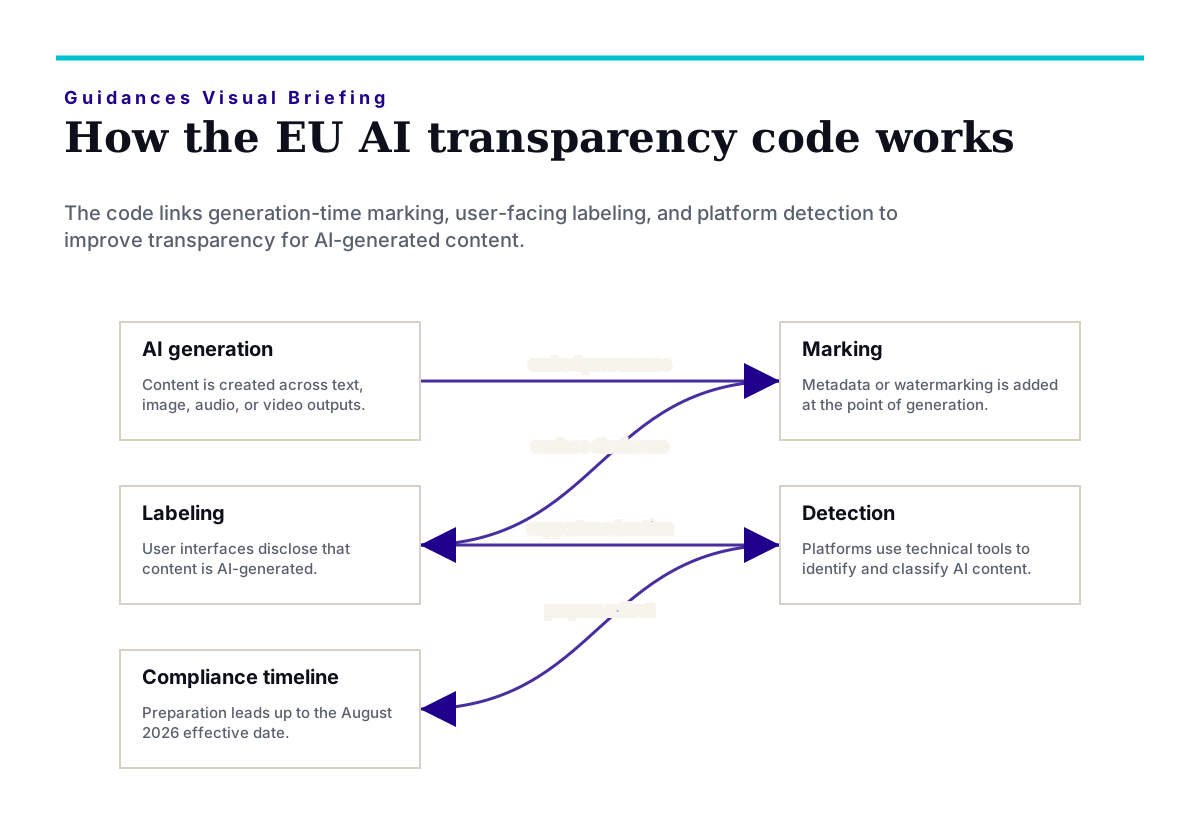
A simple workflow showing how marking, labeling, and detection fit together under the EU transparency code.
Corrections and safety
See a factual, privacy, rights, or safety issue? Review the corrections process or contact Guidances before relying on this article for important decisions.