What Happened
TSMC's investor relations platform published a monthly revenue report covering July 2025, disclosing consolidated revenue of NT$346.82 billion—a 42.6% increase against the comparable period one year prior. The filing attributed the result to high-performance computing and AI workloads, and went further than typical monthly disclosures by naming two specific advanced packaging platforms—CoWoS (Chip-on-Wafer-on-Substrate) and SoIC (System on Integrated Chips)—as the technologies associated with that demand.
A note on sourcing: the search provider associated this report with an August 2025 page date, but that date has not been verified against TSMC's IR page metadata. Per Guidances sourcing policy, unverified provider dates are treated only as soft recency hints. Readers should confirm the precise publication date directly on TSMC's official investor relations site before citing it in time-sensitive analysis.
The monthly disclosure format itself is worth understanding. TSMC publishes revenue figures on a monthly cadence specifically to give the supply chain and capital markets an early read on demand conditions ahead of quarterly earnings. A single month's figure does not establish a quarterly trajectory, but the magnitude of the year-over-year acceleration—and the specificity of the technology attribution—makes this particular release more analytically dense than a routine filing.
Why the Market Cares
TSMC's scale makes its monthly disclosures a useful leading indicator for a wide swath of the technology sector. Year-over-year revenue growth already stood at a high level in recent financials; a July monthly print at +42.6% suggests the growth rate remained elevated through mid-2025. The TTM operating margin was also high, which means incremental revenue from premium-priced advanced packaging can have a meaningful effect on operating income even when product mix shifts modestly.
Those numbers matter beyond TSMC itself. The company functions as an important node in the advanced semiconductor supply chain. When its packaging revenue accelerates, the signal can move upstream to equipment suppliers and substrate makers, and downstream to AI chip designers and the hyperscalers that depend on packaged system availability to execute their infrastructure buildouts. A monthly revenue figure at this scale, growing at this rate, can narrow the uncertainty window for participants across that chain.
This analysis is market context only, not investment advice.
Tech / Policy Link
The decision to name CoWoS and SoIC in a monthly revenue filing—rather than using generic language about advanced packaging—is the analytically distinctive element of this disclosure. Most monthly filings from foundries describe demand in broad end-market terms. Naming specific integration platforms implies that these two technologies are generating revenue at a volume and mix that management considers material enough to call out explicitly.
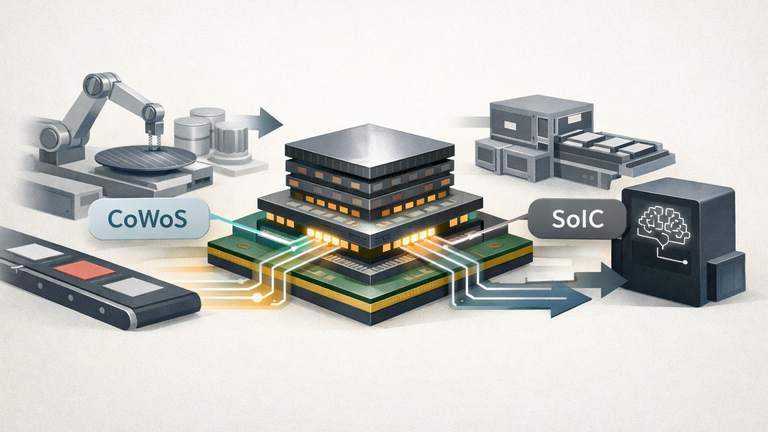
CoWoS is the integration architecture that physically co-locates a compute die with high-bandwidth memory stacks on a silicon interposer, enabling the bandwidth density that AI accelerators require. It is widely used in the packaging configuration for leading AI training and inference chips currently in volume production. The platform's revenue contribution is therefore a useful proxy for how many AI accelerators are moving through TSMC's back-end lines in a given period.
SoIC addresses a structurally different integration challenge. It enables face-to-face and face-to-back die stacking—logic bonded directly onto logic—which is a foundational capability for next-generation chiplet architectures. Its appearance alongside CoWoS in the revenue attribution suggests that customer demand may extend beyond the current generation of AI accelerators. Designs that will require SoIC at scale may already be in production or late qualification, which has implications for the equipment and materials supply chains that serve those lines.
The policy dimension is structural rather than immediate. Advanced packaging capacity remains geographically concentrated in Taiwan. Incentive programs such as the U.S. CHIPS Act have directed significant capital toward front-end wafer fabrication capacity, but back-end packaging—the step that determines whether a finished chip can actually be delivered as a deployable system—has received comparatively limited direct subsidy attention. This asymmetry means that even as new wafer fab capacity comes online in the United States and Europe, the packaging bottleneck that governs actual system delivery may remain a Taiwan-centric constraint. No announced program as of the source collection date has clearly resolved that geographic concentration.
The implication for policy risk is that any disruption to Taiwan-based packaging capacity—whether from geopolitical friction, natural events, or logistics constraints—could affect AI infrastructure delivery timelines in ways that front-end fab diversification alone cannot mitigate. That risk is not new, but the revenue acceleration disclosed in this filing makes it more consequential: the higher the volume flowing through CoWoS and SoIC lines, the greater the exposure if those lines are interrupted.
Market Lens
Trigger: TSMC's July 2025 monthly revenue disclosure—NT$346.82 billion, +42.6% year-over-year—with explicit attribution to CoWoS and SoIC advanced packaging platforms, published via the company's official IR channel.
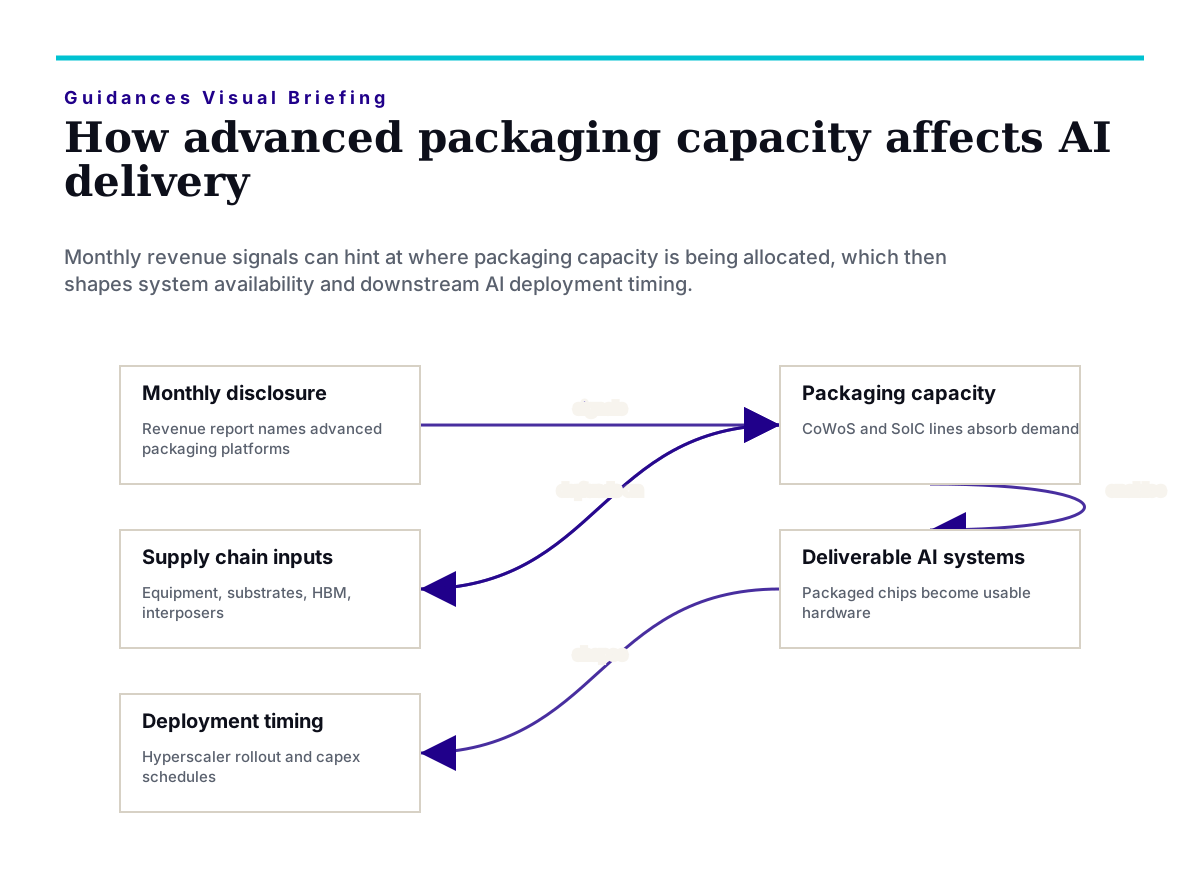
Mechanism: Advanced packaging capacity allocation is the operational variable that converts chip design completions into deliverable AI systems. When TSMC's packaging revenue accelerates at this rate, it may indicate that previously constrained capacity has eased, that customers are concentrating orders into a shorter window, or both. Either condition can affect the delivery schedules of AI accelerators and, by extension, the infrastructure rollout timelines of hyperscalers that have committed to large AI capital expenditure programs. The mechanism runs from packaging throughput → system availability → hyperscaler deployment cadence → AI infrastructure capex execution.
Affected sectors: Semiconductor capital equipment suppliers tooling CoWoS and SoIC production lines (lithography, deposition, thermocompression bonding); substrate and silicon interposer material suppliers; HBM memory producers whose product is physically integrated with logic dies in CoWoS configurations; AI chip designers whose customer delivery commitments are gated by packaging slot allocation; and hyperscaler operators whose infrastructure rollout timelines depend on packaged system availability. TSMC itself (TSM on NYSE) is the primary disclosed entity; the scale of the filing is what makes the supply-chain read-through relevant.
Time horizon: Monthly revenue data refreshes within weeks, but the more decision-relevant checkpoint is TSMC's next quarterly earnings call, where management typically provides forward guidance on packaging capacity additions, CoWoS utilization rates, and customer demand visibility extending one to two quarters forward.
Next check: TSMC's next quarterly earnings release and management commentary on CoWoS capacity expansion pace, SoIC qualification milestones, and any revision to full-year revenue guidance. Secondary verification points include HBM supplier earnings from SK Hynix and Samsung—which can confirm or contradict the co-packaging demand signal from the supply side—and hyperscaler capital expenditure disclosures that reference AI infrastructure delivery timelines.
Unverified link: The causal connection between this monthly revenue acceleration and specific hyperscaler deployment schedules is analytically consistent with the disclosed mechanism but is not directly confirmed by the source snippet. Treat it as a working hypothesis pending quarterly earnings disclosure.
What to Watch Next
Four checkpoints carry the most analytical weight in the coming months.
First, TSMC's quarterly earnings call will be the authoritative source on whether CoWoS capacity is expanding fast enough to absorb demand or whether the packaging constraint is tightening. Management commentary on utilization rates and lead times will be more informative than the revenue figure alone.
Second, any revision to TSMC's capital expenditure guidance will indicate whether the company is accelerating investment in packaging lines specifically—a move with multi-year implications for equipment suppliers and substrate makers.
Third, HBM supplier earnings from SK Hynix and Samsung will provide a corroborating or contradicting read on co-packaging demand. Because HBM is physically integrated with logic dies in CoWoS configurations, HBM shipment volumes and customer mix disclosures are a cross-check on the packaging demand signal.
Fourth, any government announcements on advanced packaging subsidies—currently lagging behind wafer fab incentives in both the United States and Europe—could alter the geographic concentration risk profile if back-end capacity funding outside Taiwan is committed.
One uncertainty deserves explicit acknowledgment: a single month's revenue figure, even one growing at 42.6% year-over-year, does not guarantee that the full quarter will sustain the same rate. Order timing concentrations, customer pull-ins, and seasonal patterns can all produce monthly readings that do not persist at the quarterly level. The July figure is a strong signal, but it should be read alongside the full quarterly disclosure before drawing conclusions about the sustained trajectory of AI infrastructure spending.