AI
Developing · 0 updatesFact 8/10IBM Details Deployment Paths for Agentic AI Applications—No-Code for Single Agents, Programmatic for Multi-Agent Systems
IBM has published documentation for its watsonx platform distinguishing deployment approaches for agentic AI applications. Single-agent applications can be deployed as AI services using no-code methods, while multi-agent systems built with frameworks such as CrewAI or LangGraph are described as requiring programmatic deployment.
Open article · no sign-in required
Sources and disclosure
The article provides a detailed, neutral examination of IBM's watsonx deployment documentation for agentic AI applications. Key factual claims are well-supported by the provided context: IBM's watsonx documentation does distinguish between no-code deployment for single-agent applications and programmatic deployment for multi-agent systems built with frameworks like CrewAI and LangGraph. The context confirms watsonx Orchestrate includes a no-code agent builder and supports integration with third-party agents including LangGraph. The article maintains a neutral, informational tone throughout, avoiding disparagement or reputation-damaging language. It appropriately qualifies uncertain areas (cost structures, specific APIs, production performance) as requiring further validation rather than making unsupported claims. The technical analysis of framework differences and deployment considerations is presented as informed interpretation rather than definitive fact. The article does not make accusations, speculate about intent, or use pejorative language. Minor deduction for some interpretive statements presented with high confidence that go slightly beyond what the source documentation explicitly confirms, but these remain within reasonable bounds of technical analysis.
Market lens
Agent runtime spending can spill into security, observability, and workflow infrastructure
The market signal is not another chatbot category; it is a possible budget shift toward the control layer around enterprise AI.
Impact path
Runtime spend → infra stack
Signals to watch
- Procurement language around audit logs and cost ceilings
- Security and observability vendors attaching agent controls
- Workflow platforms exposing approval and tool-call governance
Verification schedule
D+1 · Jun 13
Do buyers repeat audit/cost-control requirements?
D+3 · Jun 15
Do vendors publish runtime-control SKUs or partnerships?
D+7 · Jun 19
Do budgets move from pilots into operating infrastructure?
Informational context only — not investment, legal, tax, or financial advice.
IBM has published official documentation for its watsonx platform that outlines deployment strategies for agentic AI applications, distinguishing between single-agent and multi-agent systems. The documentation provides practical guidance for developers and enterprises seeking to operationalize agent applications as AI services.
No-Code Deployment for Single-Agent Applications
IBM explains that single-agent applications can be deployed as AI services using no-code methods. According to the documentation, this allows developers to deploy agents without complex infrastructure setup or code authoring. This approach can apply to agents that perform a clearly defined task, such as customer inquiry responses, document summarization, or data retrieval.
The watsonx platform is described as supporting packaging these single agents as AI services, delivering them as API endpoints or in forms that integrate with existing applications. The approach is presented as one that can allow business users or domain experts to configure and deploy agents with minimal technical team involvement.
The no-code path for single-agent deployment can be useful during prototyping and initial validation phases. Development teams can test ideas quickly, collect user feedback, and assess applicability. No-code deployment lowers technical barriers, enabling more organizational members to experiment with agent-based automation.
Programmatic Deployment for Multi-Agent Systems
In contrast, IBM states in the documentation that multi-agent systems require programmatic deployment. This applies particularly to systems built with frameworks such as CrewAI or LangGraph. Multi-agent systems involve multiple agents collaborating or executing tasks sequentially, requiring inter-agent communication, state management, and task coordination.
CrewAI is described as a framework supporting role-based agent collaboration. LangGraph is described as part of the LangChain ecosystem and as a tool for defining state transitions and graph-based workflows. Developers using these frameworks must define inter-agent message passing, error handling, and dynamic task allocation in code.
IBM's programmatic deployment path can be understood as supporting the execution of multi-agent applications on watsonx infrastructure, resource allocation, and the configuration of monitoring and logging. This aligns with enterprise deployment needs such as containerization, API gateway integration, and scaling policies.
Programmatic deployment allows developers to define inter-agent communication protocols, handle failure scenarios, and identify performance bottlenecks. This level of control can be important for systems that address complex business processes or tasks spanning multiple domains. Multi-agent systems involve more design decisions and operational considerations than single agents.
Practical Considerations in Agentic AI Deployment
Deploying agentic AI applications as AI services involves considerations beyond hosting a model. Agents may call external tools, query databases, and change behavior based on user input. This introduces considerations related to latency, cost, security, and observability.
Even where no-code deployment is available for single agents, production environments require review of response time limits, handling of external API call failures, and user data isolation. Multi-agent systems add further considerations such as inter-agent communication overhead, state consistency, and recovery strategies for partial failures.
The deployment paths described for watsonx are connected to IBM's broader enterprise AI tooling, including AI governance, model monitoring, and data lineage tracking. In that context, agent deployment can be viewed as part of an enterprise integration approach.
The choice of deployment method depends on application complexity as well as organizational technical capabilities and operational requirements. No-code deployment may be suitable for rapid experimentation and deployment, while programmatic deployment may be used where more detailed control and scalability are needed. The two paths are not mutually exclusive, and organizations can adopt a mixed approach depending on use cases.
Framework Selection and Deployment Complexity
CrewAI and LangGraph represent different design approaches. CrewAI emphasizes role-based collaboration, while LangGraph uses state machines and graph structures to define workflows. Both frameworks can be used to build multi-agent systems, but deployment requires consideration of each framework's runtime requirements and dependencies.
IBM's mention of these frameworks indicates compatibility considerations with open-source agent frameworks. Developers can build agents with their preferred tools and deploy them on IBM infrastructure.
Framework selection is also influenced by a team's technology stack and development experience. CrewAI offers a relatively intuitive role-based model, while LangGraph provides more detailed control. Developers can choose a framework based on project complexity and team capabilities. Framework selection also affects long-term maintenance and scalability.
Agent Deployment in Enterprise Environments
Deploying agentic AI in enterprise environments requires consideration of organizational and regulatory factors in addition to technical elements. Data sovereignty, regulatory compliance, audit trails, and access control are core requirements for enterprise deployment. The watsonx platform is described as providing tools to address these requirements.
When agents process sensitive data or influence critical business decisions, mechanisms to track and explain agent behavior are necessary. This includes recording which tools the agent invoked, what data it used, and what reasoning process it followed.
Enterprise deployment also requires continuous monitoring of agent performance and stability. When agents exhibit unexpected behavior or external tool calls fail, systems must detect and respond quickly. This connects to operational tools such as alerts, logging, and dashboards.
Areas for Further Review
The documentation outlines the distinction between deployment methods but does not include detailed deployment procedures, performance benchmarks, or cost structures. The extent of customization available in no-code deployment and the APIs and SDKs available for programmatic deployment can be confirmed through additional documentation or real-world use cases.
Operational costs for agentic AI also remain an area for further review. Costs can increase if agents repeatedly invoke external tools or execute long reasoning processes. How IBM measures and bills these costs, and whether it provides tools for developers to predict and manage expenses, would need to be confirmed.
How watsonx platform agent deployment functions in production environments, and how integration with other cloud platforms or on-premises environments is supported, are also areas requiring additional validation. Enterprise customers may review data sovereignty, regulatory compliance, and compatibility with existing infrastructure.
Builder Implications
- Teams seeking to rapidly deploy single-agent applications can use watsonx's no-code path to shorten development cycles. Production environments still require review of response times, error handling, and security policies.
- Developers building multi-agent systems with CrewAI or LangGraph can plan infrastructure design around programmatic deployment. Planning inter-agent communication patterns, state management strategies, and monitoring integration early can be helpful.
- IBM's distinction between deployment paths reflects differences in agentic AI complexity. Selecting a deployment strategy that fits the use case is important for operational efficiency.
- When deploying agents in enterprise environments, consider regulatory compliance, data governance, and audit trail requirements alongside technical factors. The enterprise tools provided by the watsonx platform can help meet these requirements.
Want follow-up alerts? Subscribe by email after reading the public article.
Market lens
Agent runtime spending can spill into security, observability, and workflow infrastructure
The market signal is not another chatbot category; it is a possible budget shift toward the control layer around enterprise AI.
Impact path
Runtime spend → infra stack
Signals to watch
- Procurement language around audit logs and cost ceilings
- Security and observability vendors attaching agent controls
- Workflow platforms exposing approval and tool-call governance
Verification schedule
D+1 · Jun 13
Do buyers repeat audit/cost-control requirements?
D+3 · Jun 15
Do vendors publish runtime-control SKUs or partnerships?
D+7 · Jun 19
Do budgets move from pilots into operating infrastructure?
Informational context only — not investment, legal, tax, or financial advice.
Visual Briefing
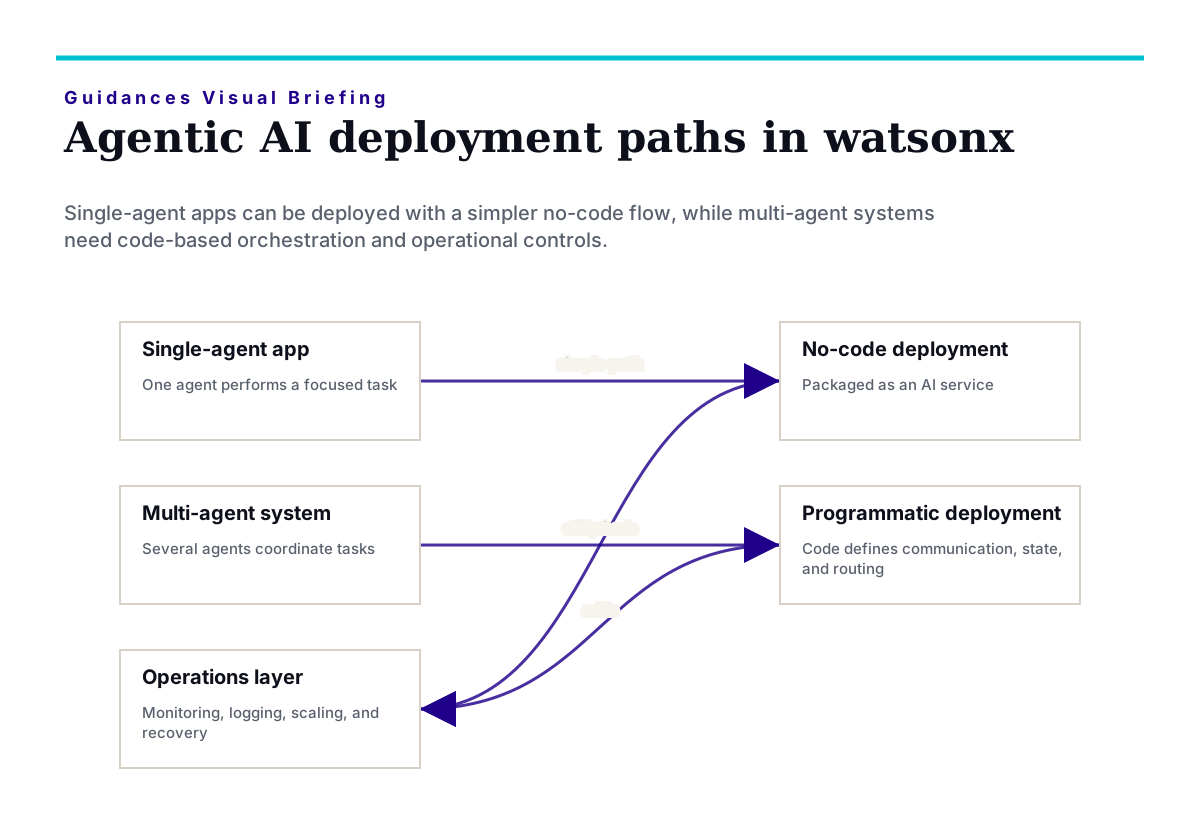
IBM’s watsonx documentation distinguishes a simpler deployment path for single agents from a more controlled, code-driven path for multi-agent systems.
Corrections and safety
See a factual, privacy, rights, or safety issue? Review the corrections process or contact Guidances before relying on this article for important decisions.