Policy
Developing · 0 updatesFact 8/10Harvard Labor Policy Analysis Outlines Local Authority and Policy Tools for Workplace AI Regulation
Article language
English
A Harvard labor policy analysis maps legal and policy pathways through which U.S. cities and states may regulate workplace artificial intelligence systems. The report points to transparency mandates, impact assessments, worker protections, and oversight frameworks as practical tools for local governance. It also argues that, amid delays in federal regulation, local governments can play a role in worker protection.
Open article · no sign-in required
Sources and disclosure
The article is broadly supported by the provided Harvard source context. Core claims about local authority, transparency, impact assessments, worker protections, and oversight are consistent with the source summary. Some specific examples and jurisdictional references are more detailed than the context, but they are presented as illustrative rather than central claims.
Market lens
AI governance becomes an operating checklist buyers can audit
The market effect depends on whether policy language turns into required logs, evaluations, incident-response records, and launch gates.
Impact path
Policy memo → ops checklist
Signals to watch
- Draft rules specifying retention or audit evidence
- Enterprise RFPs requiring AI operation logs
- Product launches centered on governance workflows
Verification schedule
D+1 · Jun 15
Do rules move from principles into required artifacts?
D+3 · Jun 17
Do RFPs ask for evidence before model benchmarks?
D+7 · Jun 21
Do vendors ship audit workflows as core product?
Informational context only — not investment, legal, tax, or financial advice.
A policy analysis published by Harvard University’s Center for Labor and a Just Economy sets out legal and policy pathways through which U.S. cities and states may regulate artificial intelligence systems used in the workplace. The report places its argument in the context of delayed federal AI policymaking and contends that local governments can serve as policy actors for worker protection. At the same time, the analysis makes clear that the practical reach of any local measure will depend on state authority, enforcement capacity, and the relationship between local rules and federal law.
The report focuses on a workplace environment in which AI use is expanding across multiple functions. It refers to algorithmic scheduling, performance monitoring, automated hiring tools, and automated termination-related tools as examples of systems that are increasingly present in employment settings. The policy concern is not limited to one stage of employment. Rather, the analysis treats workplace AI as a broader governance issue that can affect decision-making, surveillance, working conditions, and the ability of workers to understand how automated systems shape their jobs.
To address those concerns, the report identifies four main policy instruments. The first is transparency mandates. These require employers to disclose the existence, purpose, operational logic, and data collection scope of AI systems used in the workplace. The second is impact assessment regimes. These require employers to evaluate how AI systems affect workers’ rights, safety, discrimination risks, and working conditions before and after deployment. The third is worker protection provisions. These are safeguards designed to limit uses of AI that may interfere with worker rights or procedural fairness. The fourth is oversight frameworks. These give local governments the administrative capacity to monitor use, investigate violations, and impose sanctions where appropriate.
Transparency mandates are presented as a basic condition for worker awareness. The report notes that workers often do not know whether AI systems are evaluating productivity, predicting turnover, or influencing promotion decisions. Requiring employers to disclose the use, purpose, and data sources of workplace AI would give workers a clearer basis for understanding automated decisions and, where necessary, challenging them. New York City’s Local Law 144 is cited as a precedent because it requires disclosure and bias audits for automated employment decision tools. The report suggests that similar requirements could be extended beyond hiring to ongoing employment contexts such as performance reviews, shift assignments, and disciplinary actions.
Impact assessment regimes shift the regulatory emphasis from reaction to prevention. Under this approach, employers would be required to assess whether an AI system may produce discriminatory outcomes based on protected characteristics, whether surveillance tools may chill organizing activity, or whether automated scheduling may destabilize workers’ lives. The report presents the EU AI Act as a model because it uses a risk-based framework and classifies certain workplace AI applications as high-risk, subjecting them to conformity assessments. The Harvard analysis does not claim that U.S. jurisdictions should copy that model exactly. Instead, it argues that cities and states could adapt similar frameworks to local labor market conditions and enforcement capacity.
Worker protection provisions are described as legal safeguards that can limit specific uses of workplace AI. The report gives examples such as restrictions on AI-based surveillance that excessively intrudes on privacy, or limits on systems that automatically make wage reduction or termination decisions. It also refers to possible prohibitions on certain applications, such as emotion recognition in hiring or continuous biometric monitoring, and to requirements that automated decisions be subject to human review. California’s AB 1651 is mentioned as a bill that would have required human oversight of automated hiring decisions, though it was not enacted. Other protections discussed in the report include rights to opt out of certain data collection, rights to explanation of automated decisions, and anti-retaliation provisions for workers who challenge AI systems.
Oversight frameworks are presented as the administrative backbone of any local regulatory regime. The report argues that transparency and protection rules will have limited effect without dedicated agencies, complaint mechanisms, periodic audits, and penalties. It notes that local labor standards enforcement offices, which already handle wage theft and workplace safety complaints, could be given authority to investigate AI-related violations. Doing so would require training staff in algorithmic auditing, building technical expertise, and securing funding. The report also notes that some jurisdictions are exploring partnerships with academic institutions or third-party auditors to help build that capacity.
The analysis matters because it clarifies what local governments can do while federal policymaking remains unsettled. Under the U.S. constitutional structure, state governments possess broad police power to protect public health, safety, and welfare, and city governments may act within authority delegated by states. That framework gives local governments a legal basis to consider workplace AI rules. The report does not present local authority as unlimited, however. It acknowledges that federal law may constrain some measures, particularly through federal preemption under the National Labor Relations Act or other statutes. It also notes that interstate commerce concerns may lead to legal challenges, and that uneven rules across jurisdictions can create compliance complexity for employers operating in multiple states.
Those constraints are important because they shape how any local policy would operate in practice. A city or state can draft transparency rules, impact assessments, or worker protections, but the effectiveness of those rules depends on whether they can be enforced and whether they survive legal challenge. The report therefore treats local regulation as a practical policy option rather than a complete substitute for broader federal action. It also suggests that local experimentation may help inform future national standards, especially if multiple jurisdictions test similar approaches.
The report points to current activity in California, New York, and Illinois, where AI regulatory legislation is advancing, and in cities such as San Francisco and Seattle, where ordinances are under consideration. These jurisdictions are relevant because they combine rapid AI adoption with strong policy interest from labor unions and civil society. The analysis does not claim that all of these measures are identical. Rather, it uses them to show that local and state governments are already exploring workplace AI governance in different forms.
Worker participation is another recurring theme. The report argues that substantive protection is more likely when worker representatives are involved in the design, deployment, and evaluation of AI systems. It refers to European examples in which works councils or labor unions have consultation rights over AI adoption and suggests that U.S. policymakers could draw lessons from those institutional models. The point is not that one system can be transplanted directly into another. Instead, the report frames worker participation as a governance principle that can improve accountability and make workplace AI rules more responsive to actual conditions on the ground.
For builders, the implications are straightforward but important. Developers of AI-powered HR tools or workforce management systems should expect that transparency, impact assessment, human review, and complaint-handling features may become part of local compliance expectations. Products that operate across multiple jurisdictions may need region-specific compliance mapping, because local rules can differ from one city or state to another. In practice, that means documentation, auditability, and configurable human oversight are likely to matter as much as model performance.
The broader takeaway is that workplace AI regulation is moving from abstract debate toward concrete policy design. The Harvard analysis reflects a shift away from reliance on voluntary industry standards and toward enforceable public rules. At the same time, it does not suggest that local regulation is simple or uniform. Legal limits, enforcement capacity, and jurisdictional variation remain real constraints. For that reason, the report is best read as a framework for policy design: it identifies tools, explains their function, and shows where local governments may have room to act.
Builder Implications
- Workplace AI products should be designed with clear documentation of purpose, data use, and decision flow.
- Human review checkpoints can help align automated systems with likely local compliance expectations.
- Multi-jurisdiction products should include region-specific compliance tracking and operational controls to manage differing local rules.
Want follow-up alerts? Subscribe by email after reading the public article.
Market lens
AI governance becomes an operating checklist buyers can audit
The market effect depends on whether policy language turns into required logs, evaluations, incident-response records, and launch gates.
Impact path
Policy memo → ops checklist
Signals to watch
- Draft rules specifying retention or audit evidence
- Enterprise RFPs requiring AI operation logs
- Product launches centered on governance workflows
Verification schedule
D+1 · Jun 15
Do rules move from principles into required artifacts?
D+3 · Jun 17
Do RFPs ask for evidence before model benchmarks?
D+7 · Jun 21
Do vendors ship audit workflows as core product?
Informational context only — not investment, legal, tax, or financial advice.
Visual Briefing
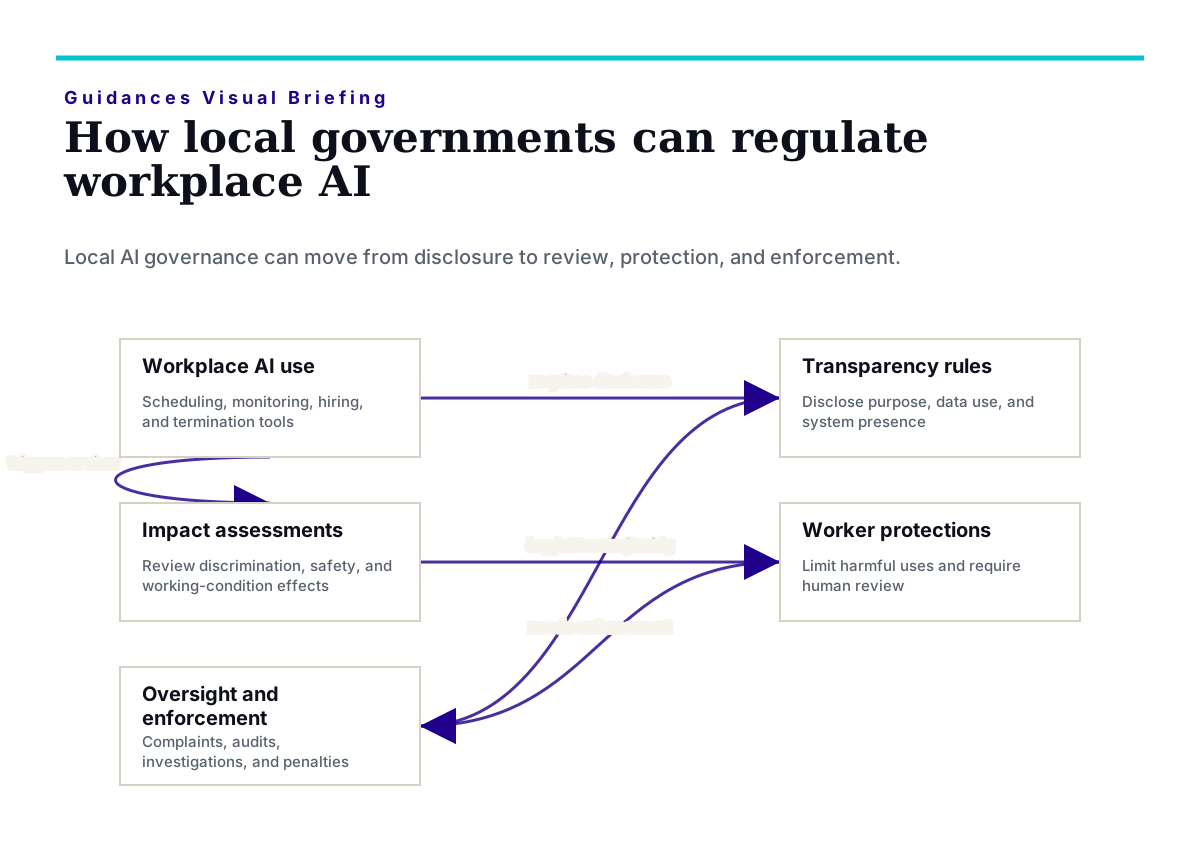
A simple policy flow showing how local rules can govern workplace AI from disclosure through enforcement.
Corrections and safety
See a factual, privacy, rights, or safety issue? Review the corrections process or contact Guidances before relying on this article for important decisions.