Startups
Ongoing · 1 updateFact 8/10OpenAI Expands Founder Support Through Startup Program
OpenAI operates a support program for founders building with its technology, providing tools, resources, and community access. The program is intended to support development and operations for AI-based startups.
Open article · no sign-in required
Sources and disclosure
The article provides a balanced, informational overview of OpenAI's startup support program without making unsupported claims or disparaging any party. The language is neutral and appropriately cautious, using phrases like 'appears to include,' 'it seems,' and acknowledging information limitations. The article correctly describes the program's structure (tools, resources, community) and strategic context. It avoids overclaiming specific benefits, acknowledges uncertainties, and provides practical considerations for founders. The competitive landscape discussion is factual and non-disparaging. Minor deduction for limited source verification of specific program details, but the article appropriately qualifies claims where information is incomplete.
Market lens
Compliance copilots can turn regulatory pain into a vertical SaaS wedge
The signal is whether review-assist tools become budgeted workflow systems rather than experimental AI add-ons.
Impact path
Compliance pain → SaaS wedge
Signals to watch
- Regulated teams buying citation and policy-lineage features
- Pilots expanding from legal review into operating workflows
- Vertical SaaS vendors packaging domain-specific compliance copilots
Verification schedule
D+1 · Jun 12
Do pilots name budget owners?
D+3 · Jun 14
Do products move from assistant UI to workflow records?
D+7 · Jun 18
Do vertical vendors show repeatable templates?
Informational context only — not investment, legal, tax, or financial advice.
OpenAI is expanding activity around its AI ecosystem through a support program for startup founders building on its platform. The program provides tools, resources, and community access, with the goal of supporting product development using AI technology.
Program Structure and Scope
OpenAI for Startups is designed to help early-stage companies use large language models and AI infrastructure. The program includes three main elements: technical tools, educational resources, and founder networking. This structure goes beyond API access and aims to support parts of the product development process.
On the technical side, the program may include access to OpenAI models along with infrastructure needed for development. This can help reduce computing costs and technical complexity for early-stage startups. Educational resources can provide practical guidance on model use, prompt engineering, and safety implementation.
The community component is an important part of the program. A network where founders can share experiences and collaborate can support not only technical problem-solving but also market entry, customer discovery, and fundraising.
Strategic Market Implications
The program has a notable place in OpenAI's market expansion strategy. By supporting startup ecosystems alongside enterprise customers, the company can broaden technology adoption and secure a wider range of use cases. Startups can test new applications and expand how the technology is used.
In a competitive environment, such programs can also increase developer familiarity with a platform. As several AI model providers offer similar support structures, founders who begin using a platform early may become more familiar with that ecosystem over time.
From a revenue perspective, the program focuses on longer-term usage growth rather than immediate returns. Startups that receive early support may increase API usage as they grow, and some may become larger customers. Success stories can also serve as examples of platform utility.
Operational Considerations for Founders
Founders considering participation may want to review several practical factors. First is the scale and duration of credits or discounts. Limited resources may be sufficient during early development, but costs can change as products scale. It is useful to understand the pricing transition after the program ends.
Second is technical dependency management. Architectures that are deeply integrated with a specific model and API can make future transitions more difficult. Designing abstraction layers or considering a multi-model strategy from the start may help preserve flexibility over time.
Third is the practical value of community participation. Networking opportunities tend to be more effective with active engagement. Founders may want to review the events, forums, and mentoring sessions offered by the program and assess whether they fit their stage and needs.
Ecosystem Impact and Uncertainties
Support programs like this can affect the broader AI startup ecosystem. Lower barriers to entry can encourage more experimentation and development, while also increasing competition and making differentiation harder. As more startups use similar technology stacks, execution, market understanding, and customer relationships may become more important.
Program sustainability and changes in terms are also factors to consider. Support scope or eligibility requirements may change depending on OpenAI's business strategy, investment environment, or regulatory developments. Founders may choose to use the program while also building their own capabilities and reducing external dependency.
Public information does not provide full details on program conditions, selection criteria, or scale. Interested founders should check official channels for the latest information and assess whether the program fits their business model and technology roadmap.
Platform Dependency and Alternative Strategies
Startup support programs can offer meaningful benefits to early-stage companies, but they also create challenges related to platform dependency. Deep integration with a specific model provider may speed up development in the short term, but it can also increase switching costs later.
To address this, founders may consider several approaches. One option is to build model abstraction layers so backend models can be changed more easily. Another is to use in-house fine-tuning for core features alongside external models. Multi-cloud strategies can also reduce reliance on a single provider.
Cost planning is also important. Founders should estimate operating costs after initial credits are used and connect those costs to revenue models to evaluate unit economics. In token-based pricing models, usage growth can lead to higher costs, so cost management matters.
Competitive Environment and Differentiation Strategies
As major AI model providers offer similar startup support programs, founders have more options. This broadens choice and makes comparison easier, but it also requires careful review of each platform's characteristics. Model performance, pricing structure, support quality, and ecosystem size are all relevant factors.
For differentiation, founders can focus on application areas and execution rather than the technology stack alone. Even when using the same foundation model, differences can come from domain expertise, data pipelines, user experience, and business models.
Community participation can also be used as a source of market information. Learning from other founders' experiences and reviewing industry trends and customer needs can support decision-making. This is most effective when participation is active rather than passive.
Technical Architecture and Long-Term Operations
Architectural decisions made during program participation can affect long-term operational flexibility. Building modular systems that separate business logic from model-specific implementations can make it easier to test other models or providers later.
Data strategy is another important factor. Using pretrained models can reduce early development burden, but building proprietary data assets and fine-tuning capabilities can create value that is not tied to a single platform. A combined approach—using external models for rapid iteration while developing internal capabilities—can balance speed and independence.
Monitoring and observability should also be established early. Tracking model performance, cost per transaction, and quality metrics can help determine when to optimize prompts, switch models, or invest in custom solutions.
Builder Implications
- When participating in the program, review not only the initial credit scale but also pricing transition paths across growth stages, and model how API costs affect revenue structure to support long-term financial planning.
- To reduce dependence on a specific model, design abstraction layers or consider a multi-model strategy from the beginning so the architecture can adapt to future model changes or pricing shifts.
- Use community and networking opportunities while also developing internal technical capabilities and market differentiation in parallel.
Want follow-up alerts? Subscribe by email after reading the public article.
Market lens
Compliance copilots can turn regulatory pain into a vertical SaaS wedge
The signal is whether review-assist tools become budgeted workflow systems rather than experimental AI add-ons.
Impact path
Compliance pain → SaaS wedge
Signals to watch
- Regulated teams buying citation and policy-lineage features
- Pilots expanding from legal review into operating workflows
- Vertical SaaS vendors packaging domain-specific compliance copilots
Verification schedule
D+1 · Jun 12
Do pilots name budget owners?
D+3 · Jun 14
Do products move from assistant UI to workflow records?
D+7 · Jun 18
Do vertical vendors show repeatable templates?
Informational context only — not investment, legal, tax, or financial advice.
Visual Briefing
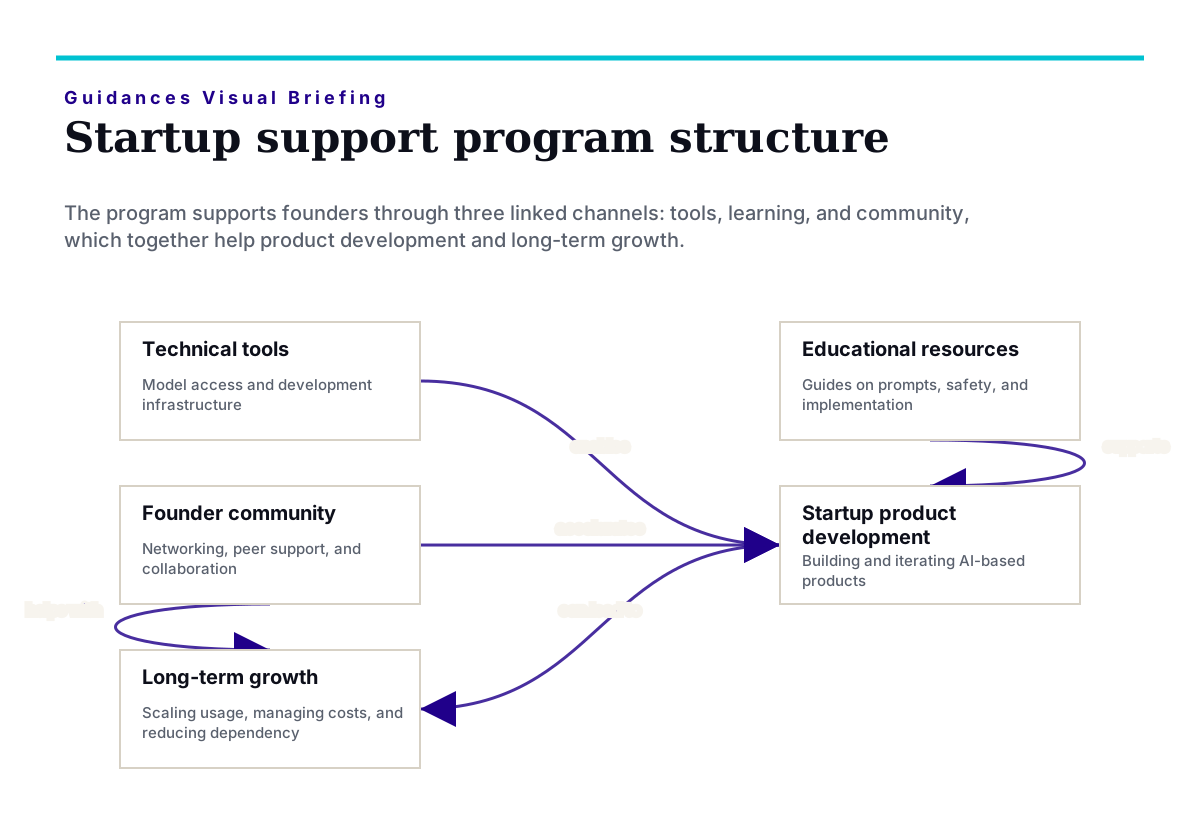
A simple workflow showing how startup support channels feed into product development and later growth.
Corrections and safety
See a factual, privacy, rights, or safety issue? Review the corrections process or contact Guidances before relying on this article for important decisions.