Finance
Developing · 0 updatesFact 8/10Fed Signals Hawkish Recalibration: Warsh Era Brings Inflation Focus, Communications Review, and Statistical Scrutiny
Article language
English
Capital Area Planning Group's Malcolm Ethridge told CNBC that the Federal Reserve is proving more hawkish than markets initially anticipated, following the latest FOMC meeting. Fed Chair Kevin Warsh indicated the central bank's primary focus remains inflation rather than employment, signaled a possible communications framework overhaul by year-end, and flagged a review of official economic statistics—developments that carry meaningful implications for rate-sensitive sectors and AI infrastructure capex planning.
Open article · no sign-in required
Sources and disclosure
What Happened
Malcolm Ethridge of Capital Area Planning Group appeared on CNBC's Closing Bell following the most recent Federal Open Market Committee meeting to assess the central bank's evolving posture. His core observation: the Federal Reserve under Chair Kevin Warsh is behaving in a more restrictive manner than market participants had initially priced in. Several specific signals emerged from the FOMC meeting and subsequent commentary that together paint a picture of a central bank in active recalibration.
First, Warsh made clear that the Fed's operational focus is squarely on inflation rather than on labor market conditions—a notable emphasis given that the dual mandate formally assigns equal weight to both price stability and maximum employment. The Fed's assessment, per the snippet, is that labor markets remain stable, which effectively removes one of the two traditional justifications for easing monetary policy. With employment concerns sidelined, the inflation-fighting mandate becomes the dominant variable.
Second, Warsh indicated he would not be surprised if the Fed revises its communications framework before the end of the year. This is a structurally significant signal. The Fed's communications architecture—including forward guidance, dot plots, and press conference conventions—shapes how financial markets interpret policy intent. Any overhaul of that framework introduces a period of interpretive uncertainty, during which market participants may find it harder to anchor rate expectations.
Third, and perhaps most analytically novel, Warsh flagged a forthcoming review of the official statistics the Fed monitors. This is an unusual public statement. Central banks typically accept government-published data as given inputs. A declared intention to scrutinize the statistical methodology underlying those inputs—whether that concerns CPI construction, employment survey methodology, or GDP accounting—could have downstream effects on how policy decisions are communicated and justified.
Separately, bond market strategist Jeffrey Gundlach was cited in the same context as being unambiguous about the Fed's inflation-first orientation, lending independent corroboration to Ethridge's read of the FOMC's current disposition.
Why the Market Cares
The Federal Reserve's policy stance is the single most consequential variable for the cost of capital across the global economy. When the central bank signals a more hawkish posture than previously anticipated, the transmission mechanism is direct: higher-for-longer interest rates compress valuations on long-duration assets, raise borrowing costs for capital-intensive businesses, and shift the risk-reward calculus for growth-oriented investments.
For technology and AI infrastructure specifically, this matters in a concrete operational sense. The current wave of AI buildout—data centers, GPU clusters, networking infrastructure, power generation capacity—is among the most capital-intensive investment cycles in recent corporate history. Hyperscalers and cloud providers have committed to multi-year capex programs running into the hundreds of billions of dollars. The financing cost of that capital, and the discount rate applied to projected future cash flows from AI services, is directly sensitive to where the Fed holds rates and for how long.
A Fed that is more hawkish than expected does not halt these programs, but it does alter the internal rate-of-return calculations that justify them. It also affects the smaller ecosystem of AI infrastructure companies—colocation providers, power utilities, semiconductor equipment firms—whose project financing depends on accessible credit markets.
Beyond technology, rate-sensitive sectors including real estate, utilities, and financial services face direct pressure when the Fed signals a prolonged restrictive stance. Consumer credit costs rise, mortgage origination slows, and corporate refinancing becomes more expensive for leveraged balance sheets.
Technology and Policy Linkage
The potential revision of the Fed's communications framework is worth examining through a policy-architecture lens. The current framework—which includes explicit forward guidance, the Summary of Economic Projections (the so-called dot plot), and regular press conferences—was itself a product of post-2008 institutional evolution. Any restructuring of that architecture would represent a meaningful shift in how the Fed manages market expectations.
For AI and technology operators, the policy linkage is indirect but real. Regulatory and monetary policy uncertainty tends to compress venture and growth-stage valuations, slow IPO pipelines, and increase the hurdle rate for large infrastructure commitments. If the Fed's communications become less predictable during a transition period, the risk premium embedded in long-duration technology investments rises accordingly.
The flagged review of official statistics adds another layer of complexity. If the Fed signals skepticism about the accuracy of headline inflation or employment data, it introduces ambiguity about the data inputs that trigger policy pivots. Markets that have been calibrated to react to specific CPI or payroll thresholds may find those thresholds less reliable as policy triggers if the underlying measurement methodology is under active review.
Market Lens
Trigger: FOMC meeting outcome and subsequent commentary from Chair Warsh, as interpreted by market observers including Ethridge and Gundlach, indicating a more hawkish stance than consensus expected.
Mechanism: A higher-for-longer rate environment raises the discount rate applied to future earnings, compresses long-duration asset valuations, increases corporate borrowing costs, and tightens financial conditions broadly.
Affected sectors (source-supported): Rate-sensitive sectors broadly; AI and technology infrastructure capex programs where financing costs are material; bond markets where duration risk is repriced. Specific tickers, ETFs, or index-level price moves are not supported by the available source metadata and are therefore excluded.
Time horizon: The communications framework review is flagged as a potential year-end development, suggesting a medium-term horizon of six to twelve months for structural policy uncertainty. The inflation-focus signal is operative in the near term.
Next check: The next FOMC meeting and accompanying statement; any formal announcement regarding communications framework changes; official CPI and PCE releases that will test whether the Fed's inflation-first posture is validated by incoming data; any public remarks from Chair Warsh elaborating on the statistical review process.
This section is market context only and does not constitute investment advice.
What to Watch Next
Several concrete developments will clarify the trajectory signaled by this FOMC meeting. Incoming inflation data—particularly CPI and the Fed's preferred PCE deflator—will determine whether the hawkish posture is sustained or moderated. Labor market data, while currently assessed as stable by the FOMC, remains a secondary watchpoint; any deterioration could reintroduce the employment side of the dual mandate as a policy constraint.
Warsh's communications framework review deserves close attention from institutional participants. If the Fed moves away from explicit forward guidance or restructures the dot plot, the market's ability to anticipate rate moves will diminish, and volatility in rate-sensitive instruments could increase during the transition.
The statistical review announcement is the most opaque signal. Observers should watch for any formal working group announcements, academic consultations, or Congressional testimony that elaborates on what specific data series are under scrutiny and what methodological changes might be contemplated.
Uncertainty and Constraints
The source for this analysis is a television segment snippet, not a full transcript or official Fed document. The characterizations of Warsh's statements are filtered through a market commentator's interpretation. Readers should treat the specific claims—particularly regarding the statistical review and communications overhaul—as reported observations requiring verification against official Fed transcripts, press conference recordings, or formal policy statements. The snippet does not provide sufficient detail to assess the scope or timeline of the statistical review with precision.
Market lens
Separate infrastructure signal from investable outcome
Treat market-linked stories as context: identify the mechanism, then wait for evidence before treating it as an outcome.
Impact path
Signal first, outcome later
Signals to watch
- Primary-source guidance and filings
- Price, volume, margin, and renewal evidence
- Follow-up reporting that confirms or rejects the mechanism
Verification schedule
D+1 · Jun 19
Is the mechanism visible in primary data?
D+3 · Jun 21
Do follow-up sources confirm direction and magnitude?
D+7 · Jun 25
Did the initial read overstate the market effect?
Informational context only — not investment, legal, tax, or financial advice.
Builder Implications
- Capex and financing planning: Founders and operators building AI infrastructure or hardware-intensive products should stress-test their capital plans against a higher-for-longer rate scenario. If the Fed's hawkish recalibration persists through year-end, the cost of debt financing and the valuation multiples applied to growth-stage companies may remain compressed longer than base-case models assumed.
- Data and policy monitoring: The Fed's flagged review of official statistics is an unusual development that could affect how macroeconomic conditions are measured and communicated. Builders whose business models depend on macro-linked triggers—consumer spending, credit availability, enterprise IT budgets—should monitor whether any statistical methodology changes alter the baseline data they use for market-sizing and forecasting.
- Communications uncertainty as a planning variable: If the Fed restructures its forward guidance framework, the predictability of rate decisions will decrease during the transition. Founders raising capital or planning large infrastructure commitments in the next six to twelve months should build wider uncertainty bands into their rate assumptions rather than anchoring to a single policy path.
Want follow-up alerts? Subscribe by email after reading the public article.
Market lens
Separate infrastructure signal from investable outcome
Treat market-linked stories as context: identify the mechanism, then wait for evidence before treating it as an outcome.
Impact path
Signal first, outcome later
Signals to watch
- Primary-source guidance and filings
- Price, volume, margin, and renewal evidence
- Follow-up reporting that confirms or rejects the mechanism
Verification schedule
D+1 · Jun 19
Is the mechanism visible in primary data?
D+3 · Jun 21
Do follow-up sources confirm direction and magnitude?
D+7 · Jun 25
Did the initial read overstate the market effect?
Informational context only — not investment, legal, tax, or financial advice.
Visual Briefing
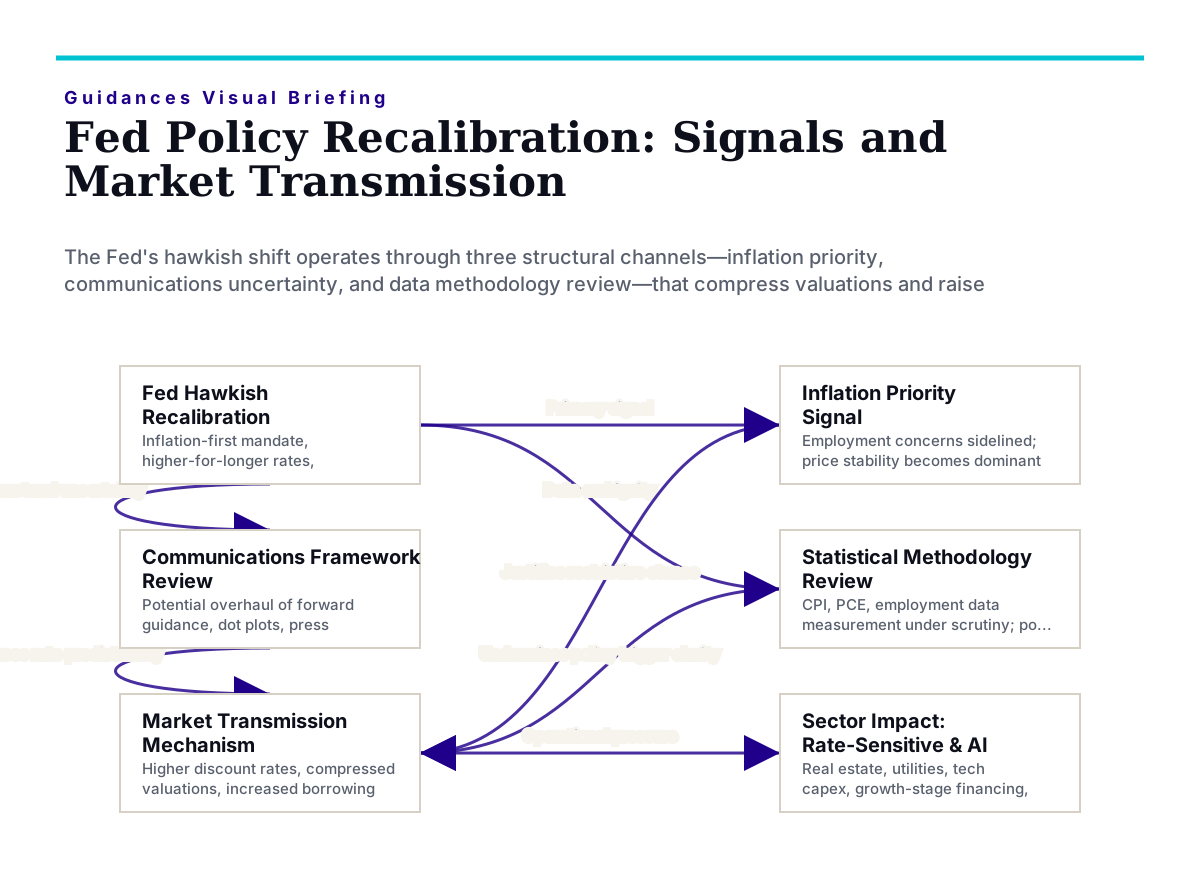
Three simultaneous Fed signals—inflation focus, communications overhaul, and statistical review—converge on a single market outcome: higher financing costs and compressed valuations for capital-intensive sectors.
Corrections and safety
See a factual, privacy, rights, or safety issue? Review the corrections process or contact Guidances before relying on this article for important decisions.