AI
Developing · 0 updatesFact 8/10What a Wall Street Analyst Call Says About AI Software and Large-Cap Consumer Exposure
Article language
English
A CNBC snippet says some top Wall Street analysts remain constructive on Snowflake, Datadog, JFrog, MongoDB, Twilio, and Walmart. Because the available metadata is thin, this analysis does not treat the note as a substitute for the full report. Instead, it examines what the call may signal for AI infrastructure software, usage-based revenue models, and large-cap consumer demand, while keeping the market links clearly bounded by the source.
Open article · no sign-in required
Sources and disclosure
The core factual claims are supported by the CNBC snippet: Bank of America analyst Koji Ikeda reiterated a buy rating on Snowflake, the note covered Datadog, JFrog, MongoDB, and Twilio, and the analyst was also more positive on Walmart. The article stays mostly within market-context framing, avoids explicit price moves, and includes appropriate uncertainty about the limited source. One caution: the phrase about Snowflake’s product revenue being 96% of overall revenue is supported by the snippet, but the broader causal interpretation around AI demand remains interpretive and should be clearly labeled as such. No healthcare boundary issues are present.
Market lens
Agent runtime spending can spill into security, observability, and workflow infrastructure
The market signal is not another chatbot category; it is a possible budget shift toward the control layer around enterprise AI.
Impact path
Runtime spend → infra stack
Signals to watch
- Procurement language around audit logs and cost ceilings
- Security and observability vendors attaching agent controls
- Workflow platforms exposing approval and tool-call governance
Verification schedule
D+1 · Jun 17
Do buyers repeat audit/cost-control requirements?
D+3 · Jun 19
Do vendors publish runtime-control SKUs or partnerships?
D+7 · Jun 23
Do budgets move from pilots into operating infrastructure?
Informational context only — not investment, legal, tax, or financial advice.
What happened
According to the CNBC snippet, some top Wall Street analysts remain constructive on Snowflake, the AI data cloud provider, and on a cluster of infrastructure software names that includes Datadog, JFrog, MongoDB, and Twilio. The snippet says Bank of America analyst Koji Ikeda reiterated a buy rating on Snowflake and described recent results from the so-called “fab five” of infrastructure software as evidence of solid execution, AI as a benefit, aligned product vision, effective go-to-market, and strong differentiation. The same snippet also says the analyst came away more positive on Walmart.
That is enough to establish the broad market signal, but not enough to reconstruct the full report. The source metadata does not provide the complete note, the full set of assumptions, or the detailed financial metrics behind the call. For that reason, this analysis stays conservative and attribution-heavy. It is a market-context read, not investment advice.
Why the market cares
The immediate reason investors pay attention to this kind of note is that it links AI enthusiasm to operating businesses rather than to abstract theme exposure. Snowflake, Datadog, JFrog, MongoDB, and Twilio sit in different parts of the enterprise software stack, but they share a common feature: they are infrastructure or workflow tools that can benefit when companies move AI from pilot projects into production systems.
That matters because the market has spent much of the AI cycle debating where value accrues. Semiconductor makers and model developers often capture the first wave of attention. Yet enterprise software can become the second-order beneficiary if AI increases data movement, observability needs, deployment complexity, developer productivity tooling, and integration demand. In that sense, a positive analyst note on these names is not just about one company. It is a read-through on whether the AI buildout is broadening into the software layer that supports day-to-day operations.
Snowflake is the clearest example in the snippet because the note reportedly emphasized that product revenue makes up 96 percent of overall revenue and is driven by platform usage. That is a meaningful market detail because usage-based revenue can be interpreted as a proxy for customer activity. If AI workloads increase data processing, storage, and query demand, then investors may infer a path to stronger consumption trends. The key word is “may.” The snippet supports the mechanism in principle, but it does not prove the magnitude of the effect.
Walmart adds a different angle. A more positive stance on a large retailer can be read as a signal about consumer resilience, pricing discipline, inventory management, or operational execution. In a market that is still sensitive to macro growth, inflation, and household spending patterns, a constructive view on Walmart can matter beyond the stock itself. It can shape how investors think about defensive consumer exposure and the quality of earnings in a slower-growth environment. Again, the snippet does not specify which of those factors drove the view, so any stronger claim would be unverified.
Tech / policy link
The technology link here is the commercialization of AI inside enterprise software. If AI adoption is moving from experimentation to production, then the value chain extends beyond model training and chip supply. It reaches data platforms, monitoring tools, developer infrastructure, deployment pipelines, and messaging or integration layers. Snowflake, Datadog, JFrog, MongoDB, and Twilio all sit somewhere in that stack.
For founders and operators, that is the more important signal than the analyst rating itself. A favorable note from a major bank suggests that public-market investors are still willing to reward software businesses that can show AI-related usage, product differentiation, and go-to-market discipline. In practical terms, the market is likely to ask whether AI is creating incremental consumption, whether it is improving retention, and whether it is expanding the addressable workload inside existing accounts.
There is no direct policy development in the snippet, so any policy read-through would be speculative. Still, enterprise AI software remains exposed to data governance, privacy, security, procurement, and cross-border data handling rules. Those issues can affect adoption timing and customer budgets even when the product thesis is strong. Because the source does not mention a specific policy event, any policy-market link here is unverified.
Market Lens
Trigger: A CNBC item highlighted a Wall Street analyst note that was positive on Snowflake and several infrastructure software names, while also turning more constructive on Walmart.
Mechanism: The market may interpret the note as evidence that AI demand is translating into enterprise software usage, and that execution quality remains intact across selected software vendors. For Snowflake specifically, the usage-based revenue model can amplify investor sensitivity to workload growth. For Walmart, the mechanism is more about consumer demand durability and operating efficiency. Some of these links are supported by the snippet; others remain unverified because the full report is not available.
Affected sectors / companies / indexes: AI infrastructure software, data cloud platforms, observability, developer tools, enterprise application software, and large-cap retail could all be in focus. Broader growth-oriented equity indices and software ETFs may also react, but that index-level effect is unverified from the available metadata.
Time horizon: The most relevant horizon is near to medium term: the next earnings prints, guidance updates, and any commentary on usage trends or customer spending. If the analyst thesis is correct, the market will want to see it confirmed in reported revenue mix, consumption growth, and forward commentary rather than in sentiment alone.
Next check: Snowflake’s next earnings release, product revenue trend, and any usage commentary; comparable updates from Datadog, JFrog, MongoDB, and Twilio; and Walmart’s next report for evidence on consumer demand and execution. Those are the concrete checks that can validate or weaken the market interpretation.
What to watch next
The most important follow-up is whether the positive tone shows up in company guidance. For software names, the market will look for evidence that AI-related demand is not just a narrative but a measurable contributor to consumption, retention, and deal flow. For Walmart, the question is whether the company continues to demonstrate resilience in a consumer environment that remains sensitive to inflation and spending trade-offs.
A second question is whether this analyst view is isolated or part of a broader re-rating of infrastructure software. If multiple firms begin to emphasize the same themes, the market may treat the group as a more durable AI beneficiary set. If not, the note may remain a stock-specific call rather than a sector-wide signal.
A third question is valuation discipline. Even when analysts are constructive, public markets usually want a clear bridge from product strength to revenue growth and margin durability. Without that bridge, enthusiasm can fade quickly. The snippet does not provide enough detail to assess that bridge, so caution is warranted.
Uncertainty and constraints
The source is a short snippet, not the full article or the underlying analyst report. That means the evidence base is thin. We do not know the exact valuation framework, the time horizon of the analyst, or whether the note was driven by company-specific results, channel checks, or broader sector rotation. We also do not know whether the market has already priced in the view.
Because of those limits, this article avoids turning the note into a substitute for the original report. It also avoids assigning a causal market move that the source does not document. The safest reading is that the snippet reflects continued investor interest in AI-enabled enterprise software and in a large retailer with durable operating characteristics. Anything beyond that would be overreach.
This is market context only, not investment advice.
Builder Implications
- Enterprise software teams should be prepared to show how AI changes usage, retention, and expansion revenue, not just product demos.
- Usage-based pricing models need clear telemetry so that customers and investors can see whether AI workloads are actually increasing consumption.
- Founders selling into large enterprises or retail should expect more scrutiny on execution, operating efficiency, and measurable ROI rather than broad AI positioning.
Want follow-up alerts? Subscribe by email after reading the public article.
Market lens
Agent runtime spending can spill into security, observability, and workflow infrastructure
The market signal is not another chatbot category; it is a possible budget shift toward the control layer around enterprise AI.
Impact path
Runtime spend → infra stack
Signals to watch
- Procurement language around audit logs and cost ceilings
- Security and observability vendors attaching agent controls
- Workflow platforms exposing approval and tool-call governance
Verification schedule
D+1 · Jun 17
Do buyers repeat audit/cost-control requirements?
D+3 · Jun 19
Do vendors publish runtime-control SKUs or partnerships?
D+7 · Jun 23
Do budgets move from pilots into operating infrastructure?
Informational context only — not investment, legal, tax, or financial advice.
Visual Briefing
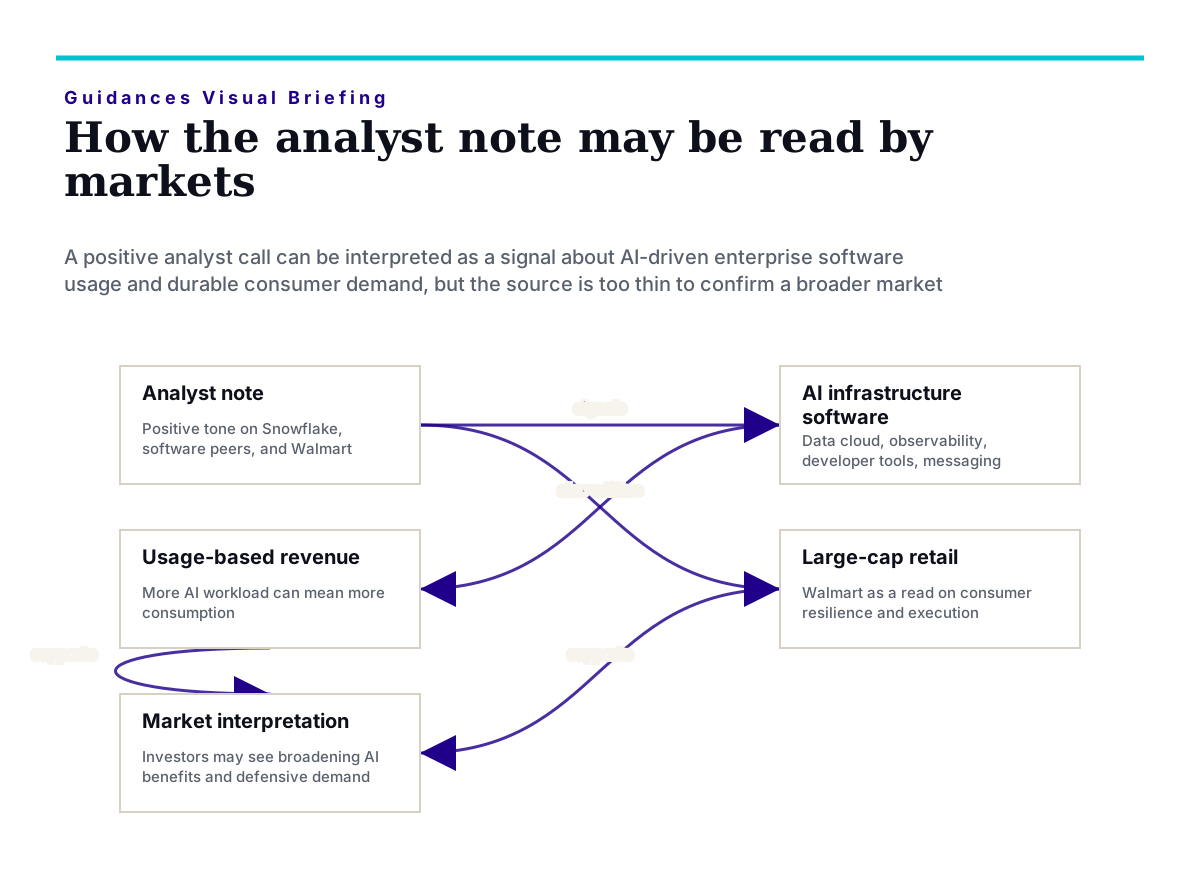
A simplified view of how a short analyst snippet can influence market interpretation across software and retail.
Corrections and safety
See a factual, privacy, rights, or safety issue? Review the corrections process or contact Guidances before relying on this article for important decisions.