Semiconductors
Ongoing · 1 updateFact 9/10NVIDIA and Samsung Announce AI Factory Collaboration for Chip Manufacturing
NVIDIA said it plans to work with Samsung on an AI factory for semiconductor manufacturing. The public disclosure is limited, and the collaboration points to the use of AI in production operations and advanced chip manufacturing.
Open article · no sign-in required
Sources and disclosure
The article's core claims regarding NVIDIA and Samsung's collaboration on an AI factory for semiconductor manufacturing are well-supported by the provided context, including official press releases from both companies and a CNBC report. The article accurately states that the partnership extends beyond HBM to broader production operations and correctly notes the limited public disclosure regarding specific project details like scope, investment, or timeline. The language used is neutral and adheres to reputation safety guidelines.
Market lens
On-device AI shifts attention from data-center chips to memory allocation and device margins
The useful read is whether local AI features create measurable pressure on memory mix, pricing, and product release schedules.
Impact path
Device AI → memory pressure
Signals to watch
- LPDDR and HBM allocation commentary
- AI PC and phone memory configurations
- Supplier lead times, spot pricing, and margin guidance
Verification schedule
D+1 · Jun 15
Do OEM launches raise baseline memory specs?
D+3 · Jun 17
Do suppliers change allocation or pricing language?
D+7 · Jun 21
Do device margins absorb or pass through memory cost?
Informational context only — not investment, legal, tax, or financial advice.
NVIDIA said it plans to build an AI factory with Samsung for semiconductor manufacturing. The public disclosure is limited, but the central point is clear: the partnership is moving beyond next-generation HBM collaboration and into production operations and advanced chip manufacturing. That shift matters because it suggests a change in how AI is being positioned. It is no longer only a product feature or a software layer. It is increasingly being framed as a tool for industrial work.
The announcement is significant because semiconductor manufacturing is becoming more dependent on data, automation, and process control. Advanced fabrication requires coordination across equipment, yield, inspection, logistics, and quality management. Each of those functions generates data, and each can be improved, at least in principle, by machine learning systems that detect anomalies, forecast maintenance needs, automate inspection, or optimize production schedules. In that sense, the partnership reflects a broader move toward industrial AI deployment.
For NVIDIA, the collaboration shows how its accelerated computing stack can extend beyond data centers and model training infrastructure. The company has built much of its recent growth story around GPUs, cloud-scale training, and inference. That remains central. Yet manufacturing represents a different kind of opportunity: large, complex, and data-rich, but tied to physical processes rather than digital services. A semiconductor fab is an especially demanding environment because the value of better decisions can be high, while the tolerance for disruption is low. If NVIDIA can help make AI useful there, it strengthens the case for its platform in other industrial settings as well.
For Samsung, the value is equally strategic, though different in form. The company already competes on memory, foundry capability, and manufacturing scale. AI adds another lever: the possibility of improving production efficiency and process precision through software-driven control. Semiconductor manufacturing is capital intensive, and small deviations can have outsized effects on yield. That makes manufacturing AI more than a cost-saving tool. It can become part of the infrastructure that supports production stability, quality consistency, and faster process learning. This is particularly relevant for high-value memory products such as next-generation HBM, where reliability matters alongside performance.
The broader market implication is that AI infrastructure is widening. For years, the conversation has focused on chips, data centers, networking, and power. Those remain essential. But industrial AI has different requirements. Factory data is sensitive. Equipment integration is complex. Operational downtime is expensive. And in high-reliability environments, a model that performs well in a lab is not enough. It must also be explainable, resilient, secure, and compatible with existing workflows. That means industrial AI is not simply a scaled-down version of cloud AI. It is a distinct product category with its own technical and commercial constraints.
That distinction matters for developers and founders. Many AI companies still design around office workflows: customer support, document processing, coding assistance, and knowledge retrieval. Those markets are real, but they are not the only ones. Manufacturing may offer a more direct path to measurable value because the outputs are concrete: fewer defects, less unplanned downtime, better throughput, and tighter scheduling. In a semiconductor fab, even modest improvements can have meaningful economic consequences. The challenge is that the product surface is harder. Integration with factory systems, data governance, and operational reliability become part of the product, not afterthoughts.
The announcement also hints at a larger strategic shift in how AI is being deployed across the economy. The market has often treated AI as a software story, but some of the most important gains may come from physical industries such as manufacturing, logistics, energy, and quality control. Semiconductors sit near the top of that list because they combine extreme complexity with high value. If AI can help run a chip factory, it can likely be adapted to other environments where process discipline and data density are both high.
Still, the public information leaves important questions unanswered. The companies have not disclosed the scope of the project, the specific manufacturing stages involved, the investment size, or the timeline. It would therefore be premature to treat the announcement as evidence of immediate large-scale deployment. Semiconductor manufacturing also imposes practical constraints that are easy to underestimate. Security requirements are strict. Data systems are often fragmented. Equipment compatibility can be difficult. And factory operations are built around reliability, not experimentation. Those realities tend to slow adoption, even when the strategic case is strong.
That uncertainty should shape how the market reads the news. The most prudent interpretation is not that a finished AI factory is about to transform production overnight. It is that a major chipmaker and a major AI infrastructure company are signaling where they believe the next phase of industrial AI will emerge. The direction is important even if the implementation is still undefined. It suggests that the competitive frontier in semiconductors is moving beyond materials, tools, and process engineering alone. Data operations and AI-enabled control are becoming part of the contest.
There is also a product-design lesson here. In industrial settings, AI value is rarely delivered by a single model. It comes from a system: data collection, integration with existing equipment, workflow design, monitoring, governance, and human oversight. That means the winners are likely to be companies that can combine software, hardware, and operational understanding. NVIDIA brings the compute platform. Samsung brings the manufacturing environment. The combination is notable because it reflects a broader truth about enterprise AI: the most durable opportunities often sit where digital systems meet physical production.
In the near term, the key questions are straightforward. Which manufacturing processes will be addressed first? How will NVIDIA’s stack connect with Samsung’s production systems? And will the collaboration extend into adjacent areas such as packaging, foundry operations, or memory manufacturing? The public disclosure does not answer those questions. But it does establish a direction of travel. AI is moving deeper into the factory, and semiconductor manufacturing is one of the most consequential places where that shift can be observed.
Builder Implications
- Manufacturing AI can create direct value in inspection automation, predictive maintenance, and process optimization, which raises the importance of industrial data pipelines and factory integration.
- In high-reliability sectors such as semiconductors, security, explainability, and operational stability should be treated as core product requirements, not secondary features.
- AI infrastructure companies should look beyond data centers and evaluate vertical opportunities in physical industries such as manufacturing, logistics, and energy.
Want follow-up alerts? Subscribe by email after reading the public article.
Market lens
On-device AI shifts attention from data-center chips to memory allocation and device margins
The useful read is whether local AI features create measurable pressure on memory mix, pricing, and product release schedules.
Impact path
Device AI → memory pressure
Signals to watch
- LPDDR and HBM allocation commentary
- AI PC and phone memory configurations
- Supplier lead times, spot pricing, and margin guidance
Verification schedule
D+1 · Jun 15
Do OEM launches raise baseline memory specs?
D+3 · Jun 17
Do suppliers change allocation or pricing language?
D+7 · Jun 21
Do device margins absorb or pass through memory cost?
Informational context only — not investment, legal, tax, or financial advice.
Visual Briefing
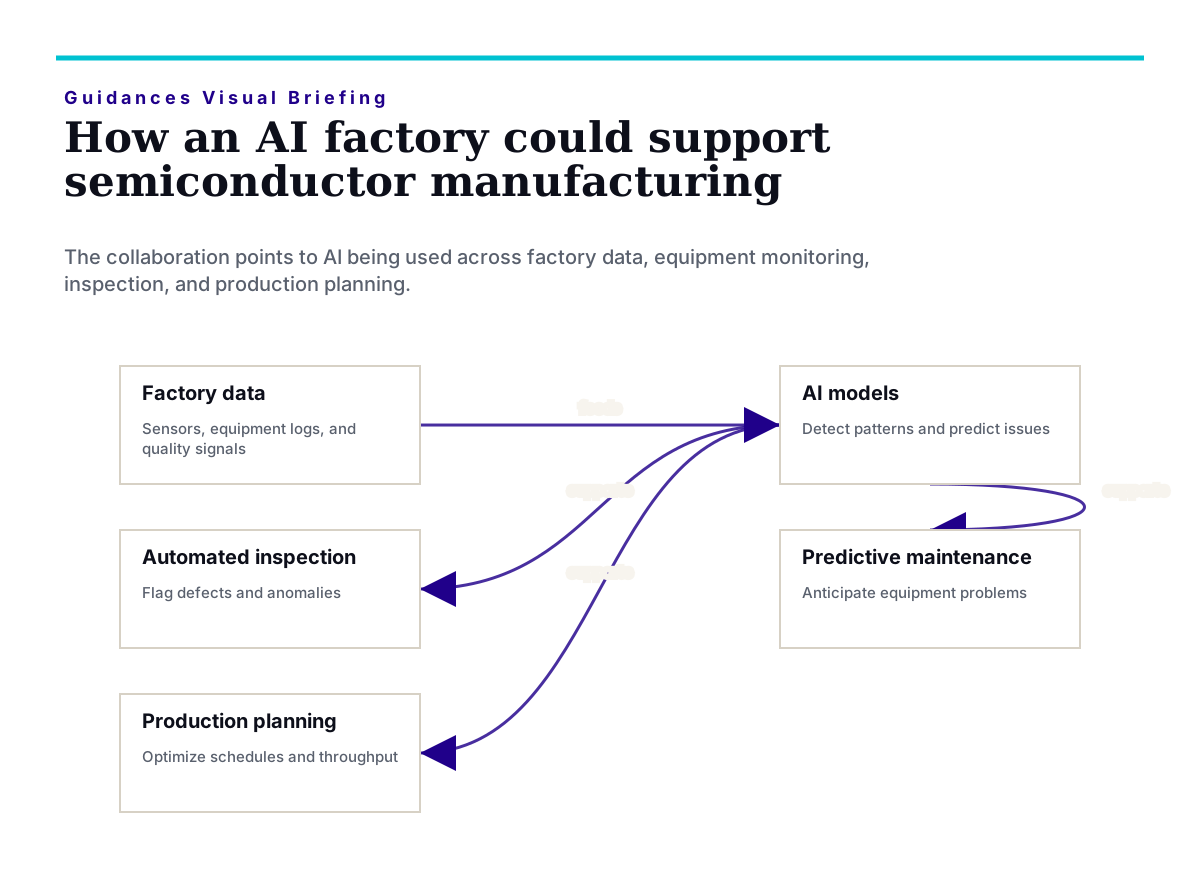
A simplified workflow showing how AI can connect factory data to inspection, maintenance, and planning.
Corrections and safety
See a factual, privacy, rights, or safety issue? Review the corrections process or contact Guidances before relying on this article for important decisions.