Policy
Developing · 0 updatesFact 8/10Korea’s MSCI Moment Meets a Volatility Test
Article language
English
Bloomberg’s snippet says South Korea’s equity market is again drawing attention for a possible path toward MSCI developed-market status. The same note also flags a sharp rise in volatility and repeated exchange safeguards. The market question is less about the headline milestone itself than about the transmission channel: how index expectations, foreign flows, and AI-linked large caps may interact with policy, liquidity, and benchmark rebalancing.
Open article · no sign-in required
Sources and disclosure
The article is broadly source-aligned with the Bloomberg snippet and Reuters context. It correctly frames MSCI developed-market status as a possibility rather than a confirmed outcome, and it attributes the KOSPI’s strong year-to-date performance, AI-linked buying, and repeated exchange safeguard triggers to the source context. The policy and market-structure discussion is presented as general mechanism rather than a specific confirmed policy change. Main limitations are that exact MSCI timing, specific foreign-flow effects, and any company-level winners remain unverified, so those should stay clearly labeled as conditional or omitted.
Market lens
AI governance becomes an operating checklist buyers can audit
The market effect depends on whether policy language turns into required logs, evaluations, incident-response records, and launch gates.
Impact path
Policy memo → ops checklist
Signals to watch
- Draft rules specifying retention or audit evidence
- Enterprise RFPs requiring AI operation logs
- Product launches centered on governance workflows
Verification schedule
D+1 · Jun 16
Do rules move from principles into required artifacts?
D+3 · Jun 18
Do RFPs ask for evidence before model benchmarks?
D+7 · Jun 22
Do vendors ship audit workflows as core product?
Informational context only — not investment, legal, tax, or financial advice.
What happened
Bloomberg’s snippet says South Korea’s equity market is drawing renewed attention because of a possible path toward MSCI developed-market status. The framing matters: this is not a confirmed reclassification, but a market conversation about whether Korea is moving closer to a milestone it has pursued for years. The same snippet also says the KOSPI has been among the stronger major equity benchmarks this year, helped by investor enthusiasm for artificial intelligence winners. At the same time, it notes that the market has become unusually volatile, with exchange safeguards triggered repeatedly in recent days.
That combination is important. A strong index can attract attention from global allocators, but a volatile one can raise questions about market structure, liquidity, and the durability of the rally. For operators and market readers, the relevant issue is not only whether Korea is “hot,” but whether the current move is being translated into a more durable institutional re-rating.
Why the market cares
MSCI classification is not a cosmetic label. It can influence how global asset managers, benchmark-aware funds, and passive vehicles allocate capital. If a market is viewed as closer to developed-market status, the conversation can shift from local performance to global portfolio construction, index inclusion, and foreign ownership patterns. That is why even a tentative “MSCI moment” can matter for equities beyond the headline itself.
The market also cares because the snippet links the rally to AI. That is a direct bridge to one of the most important public-market themes of the cycle: semiconductor demand, memory pricing, packaging, equipment, and the broader AI infrastructure buildout. South Korea sits near the center of that supply chain. When investors rotate into AI-linked names, Korean large caps often become part of the conversation because they are exposed to global capex cycles rather than only domestic demand.
Still, the source does not provide a list of companies, ETFs, or index products that are directly affected. Any such mapping would be speculative, so it should be treated as unverified unless confirmed by additional reporting or filings.
Tech / policy link
The technology link is straightforward: AI infrastructure spending tends to flow through semiconductors, memory, advanced packaging, server components, power management, and related industrial inputs. Korea’s listed market has meaningful exposure to those areas, which helps explain why AI enthusiasm can have an outsized effect on the KOSPI.
The policy link is more conditional. MSCI’s classification framework typically reflects market accessibility, trading mechanics, settlement infrastructure, and the ease with which foreign investors can participate. The snippet does not mention any specific policy change, so it would be incorrect to infer one. But the broader implication is clear: if Korea wants to move closer to developed-market status, the market will keep watching regulatory and infrastructure details, not only price performance.
That makes this a policy-and-market story rather than a pure momentum story. The relevant variables include foreign access, exchange safeguards, market depth, and whether the rally is broad enough to support a more stable institutional narrative.
Market Lens
Trigger: Bloomberg says South Korea’s market is approaching a possible MSCI developed-market milestone, while also experiencing a sharp rise in volatility.
Mechanism: A potential MSCI upgrade can affect expectations for foreign inflows, benchmark reweighting, and passive allocation. AI-led strength can reinforce the move by lifting semiconductor and infrastructure-linked names, which in turn can support index-level performance. Higher volatility, however, can offset that narrative by making the market look less stable to global allocators.
Affected sectors / companies / ETFs / indexes: Source-supported exposure is strongest at the index level, especially the KOSPI and the broader Korean equity market. Sector exposure likely includes semiconductors and AI infrastructure, but specific companies and ETFs are unverified from the snippet alone. MSCI itself is central as the benchmark provider.
Time horizon: Near term, the focus is on volatility, exchange safeguards, and foreign flow behavior. Medium term, the key question is whether MSCI review processes or policy adjustments change the market-access story. Longer term, any classification shift would matter for capital costs and portfolio allocation, but that outcome is not established here.
Next check: Watch MSCI review milestones, Korean policy statements on market access, foreign investor flow data, semiconductor export figures, and earnings or capex guidance from major Korean exporters. Exchange safeguard frequency is also a useful check on market microstructure.
What to watch next
The first thing to watch is whether the MSCI conversation becomes more concrete. A market can trade on anticipation for a long time, but the signal becomes more meaningful when official review language, policy steps, or benchmark commentary appears.
The second is whether volatility remains elevated. Repeated safeguard activation can indicate stress in order flow or positioning, but the snippet does not identify the cause. That uncertainty matters. Without a clearer read on liquidity conditions, it is difficult to separate a healthy repricing from a more fragile one.
The third is whether AI enthusiasm is translating into fundamentals. For Korea, that means watching semiconductor exports, monthly revenue trends, and capex guidance from major firms. If the rally is anchored in real demand and investment, it is more likely to persist than if it is driven mainly by narrative.
Constraints and uncertainty
This analysis is intentionally conservative because the source material is thin. It does not confirm MSCI timing, policy changes, or specific stock winners. It also does not provide enough detail to assign a causal market reaction to any single event. Those links remain unverified.
The article should therefore be read as market context only, not investment advice. The same caution applies to any interpretation of the AI angle: the source supports the existence of AI-linked enthusiasm, but not a precise forecast for earnings or valuation.
Builder Implications
- Founders building for Korean capital markets should treat index classification, foreign access, and market microstructure as product requirements, not background noise.
- AI and semiconductor tooling companies in Korea should track export data, capex guidance, and benchmark-driven flows because those variables shape customer demand and investor attention.
- Data products for investors and operators can add value by monitoring MSCI review dates, exchange safeguard events, and foreign flow indicators in one place.
Want follow-up alerts? Subscribe by email after reading the public article.
Market lens
AI governance becomes an operating checklist buyers can audit
The market effect depends on whether policy language turns into required logs, evaluations, incident-response records, and launch gates.
Impact path
Policy memo → ops checklist
Signals to watch
- Draft rules specifying retention or audit evidence
- Enterprise RFPs requiring AI operation logs
- Product launches centered on governance workflows
Verification schedule
D+1 · Jun 16
Do rules move from principles into required artifacts?
D+3 · Jun 18
Do RFPs ask for evidence before model benchmarks?
D+7 · Jun 22
Do vendors ship audit workflows as core product?
Informational context only — not investment, legal, tax, or financial advice.
Visual Briefing
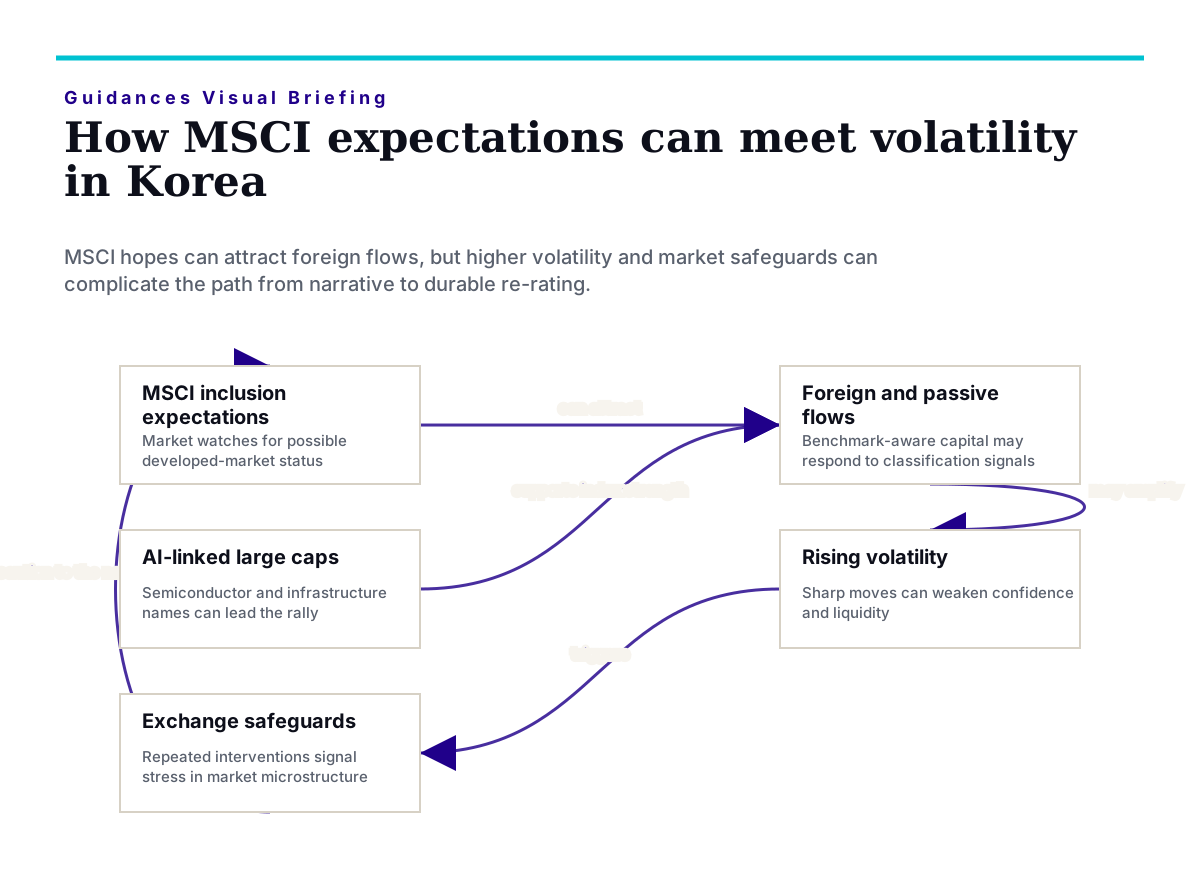
A simplified view of the feedback loop between MSCI hopes, AI-led strength, and volatility controls.
Corrections and safety
See a factual, privacy, rights, or safety issue? Review the corrections process or contact Guidances before relying on this article for important decisions.