AI
Developing · 0 updatesFact 10/10Anthropic cuts off access to Fable 5 and Mythos 5 after a government directive, highlighting the relationship between AI deployment and compliance
Article language
English
CNBC reports that Anthropic disabled access to its Fable 5 and Mythos 5 models after a U.S. government export-control directive. The episode shows how model availability can be shaped not only by capability and demand, but also by jurisdiction, identity controls, and compliance operations.
Open article · no sign-in required
Sources and disclosure
All key factual claims in the article are directly supported by multiple sources within the provided `verification_context`. The article accurately attributes information to CNBC and other news outlets. It correctly identifies the limitations of the available information regarding the precise legal scope, duration, and specific definitions of the directive. The article maintains a neutral, informational tone, avoids speculative or accusatory language, and explicitly refrains from offering investment or medical advice. The 'Market Lens' and 'Builder Implications' sections provide relevant analysis and guidance based on the verified facts, without crossing into prohibited territory. Reputation safety guidelines are fully met.
Market lens
Agent runtime spending can spill into security, observability, and workflow infrastructure
The market signal is not another chatbot category; it is a possible budget shift toward the control layer around enterprise AI.
Impact path
Runtime spend → infra stack
Signals to watch
- Procurement language around audit logs and cost ceilings
- Security and observability vendors attaching agent controls
- Workflow platforms exposing approval and tool-call governance
Verification schedule
D+1 · Jun 16
Do buyers repeat audit/cost-control requirements?
D+3 · Jun 18
Do vendors publish runtime-control SKUs or partnerships?
D+7 · Jun 22
Do budgets move from pilots into operating infrastructure?
Informational context only — not investment, legal, tax, or financial advice.
Anthropic has disabled access to its Fable 5 and Mythos 5 models after receiving a U.S. government directive tied to export-control authorities, according to CNBC. The company said it was instructed on Friday afternoon to suspend access for foreign nationals and then cut off the models for all customers in order to comply. Anthropic also said its other models were not affected. Because the available material is limited to a short snippet, the precise legal scope, operational mechanics, and any exceptions remain unclear.
Even with that constraint, the significance of the episode is straightforward. It shows that access to frontier AI models is no longer governed only by product quality, pricing, or uptime. Jurisdiction, identity controls, and compliance procedures can determine whether a model is available at all. For developers and founders, that is not a peripheral issue. It is part of the operating environment in which AI products are built, sold, and maintained.
The immediate takeaway is that model availability can change for reasons that sit outside the normal product roadmap. A team may choose a model because it performs well on a benchmark, integrates cleanly with an API, or supports a particular workflow. Yet if access is later restricted by policy or by a government order, the technical merits of the model become only one part of the equation. The more a product depends on a single provider or a single model family, the more exposed it becomes to changes in access conditions.
That matters especially for companies building customer-facing applications. A model cutoff is not merely a backend event. It can affect response quality, latency, feature parity, and contractual commitments. If a product architecture assumes that one model will always be available, the business inherits a hidden dependency. The CNBC report suggests that Anthropic moved quickly to ensure compliance, but the broader lesson is about preparedness. Teams need a design that can absorb policy-driven changes without forcing a full service interruption.
In practical terms, that means abstraction layers matter. A well-designed AI application should not hard-code a single model into every workflow. It should support routing, fallback options, and feature flags that allow operators to shift traffic when conditions change. It should also distinguish between core product logic and model-specific behavior. If a company can swap models without rewriting the entire application, it can respond more gracefully to access changes of the kind described in this report.
The episode also highlights the growing importance of identity and access management in AI. The snippet indicates that the directive referenced foreign nationals, which implies that user classification was part of the compliance requirement. That is a reminder that AI platforms increasingly need policy systems that can evaluate who is allowed to access what, and under which conditions. For global products, this affects account provisioning, enterprise tenancy, audit logging, and customer communications.
Market Lens: the report is relevant to public-market and private-market participants because it reframes AI infrastructure as a compliance-sensitive category. That does not justify a conclusion about any immediate stock move or valuation change. It does suggest that investors, procurement teams, and operators may place greater weight on regulatory readiness, geographic controls, and continuity planning when comparing providers. In that sense, the episode is a reminder that model access is part of the product itself, not just an administrative layer around it.
For founders, the commercial implication is that model selection should be treated as a governance decision as well as a technical one. Procurement teams often compare providers on capability, cost, and reliability. Those remain important, but they are incomplete. Buyers should also ask how a provider handles regional restrictions, government directives, and sudden access changes. They should want to know whether the provider can isolate affected models, preserve continuity for unaffected services, and communicate clearly when policy changes alter availability.
This is particularly relevant for startups that build on top of third-party models. A young company may not have the legal or operational bandwidth to manage complex jurisdictional issues on its own. That makes provider choice even more consequential. If a startup is serving users across multiple countries, it should assume that access conditions may differ by geography and by user category. The safest approach is to build with modularity from the start, rather than waiting until a policy event forces a redesign.
There is also a broader market signal here. AI infrastructure is increasingly behaving like regulated infrastructure. That does not mean every model is subject to the same constraints, nor does it mean every provider will face the same directives. But it does mean that the industry is moving beyond a simple software distribution model. Access can be shaped by external authorities, and companies must be able to respond in real time. In that sense, the CNBC report is less about one product line than about the operating reality of advanced AI deployment.
The limits of the available information should be kept in view. The snippet does not explain the exact content of the directive, the duration of the suspension, whether any customers were exempted, or how Anthropic defined the affected user group. It also does not indicate whether the models will return under revised controls or remain unavailable for an extended period. Those unknowns matter, and they prevent a more specific conclusion. What can be said with confidence is narrower but still important: a government directive changed access conditions, Anthropic responded by disabling the models, and the company said its other models were not affected.
What to watch next is not a price target or a market reaction, but the operational follow-through. Readers should look for any clarification on the scope of the directive, whether access rules are limited to certain users or regions, and whether other providers describe similar compliance constraints. It will also be important to see how enterprise customers and developers adapt their architecture, especially where a single model has been embedded deeply into production workflows.
For AI developers, that is enough to justify a review of dependency risk. For founders, it is a reminder that product resilience now includes policy resilience. The companies most likely to navigate this environment well will be those that treat compliance, access control, and model portability as first-class engineering concerns rather than after-the-fact administrative tasks.
Builder Implications
- Reduce dependence on a single model by adding routing, fallback, and portability layers early.
- Build access-control logic that can handle geography- and identity-based restrictions without manual intervention.
- Evaluate providers on compliance response, customer communication, and continuity planning, not only on model performance.
Want follow-up alerts? Subscribe by email after reading the public article.
Market lens
Agent runtime spending can spill into security, observability, and workflow infrastructure
The market signal is not another chatbot category; it is a possible budget shift toward the control layer around enterprise AI.
Impact path
Runtime spend → infra stack
Signals to watch
- Procurement language around audit logs and cost ceilings
- Security and observability vendors attaching agent controls
- Workflow platforms exposing approval and tool-call governance
Verification schedule
D+1 · Jun 16
Do buyers repeat audit/cost-control requirements?
D+3 · Jun 18
Do vendors publish runtime-control SKUs or partnerships?
D+7 · Jun 22
Do budgets move from pilots into operating infrastructure?
Informational context only — not investment, legal, tax, or financial advice.
Visual Briefing
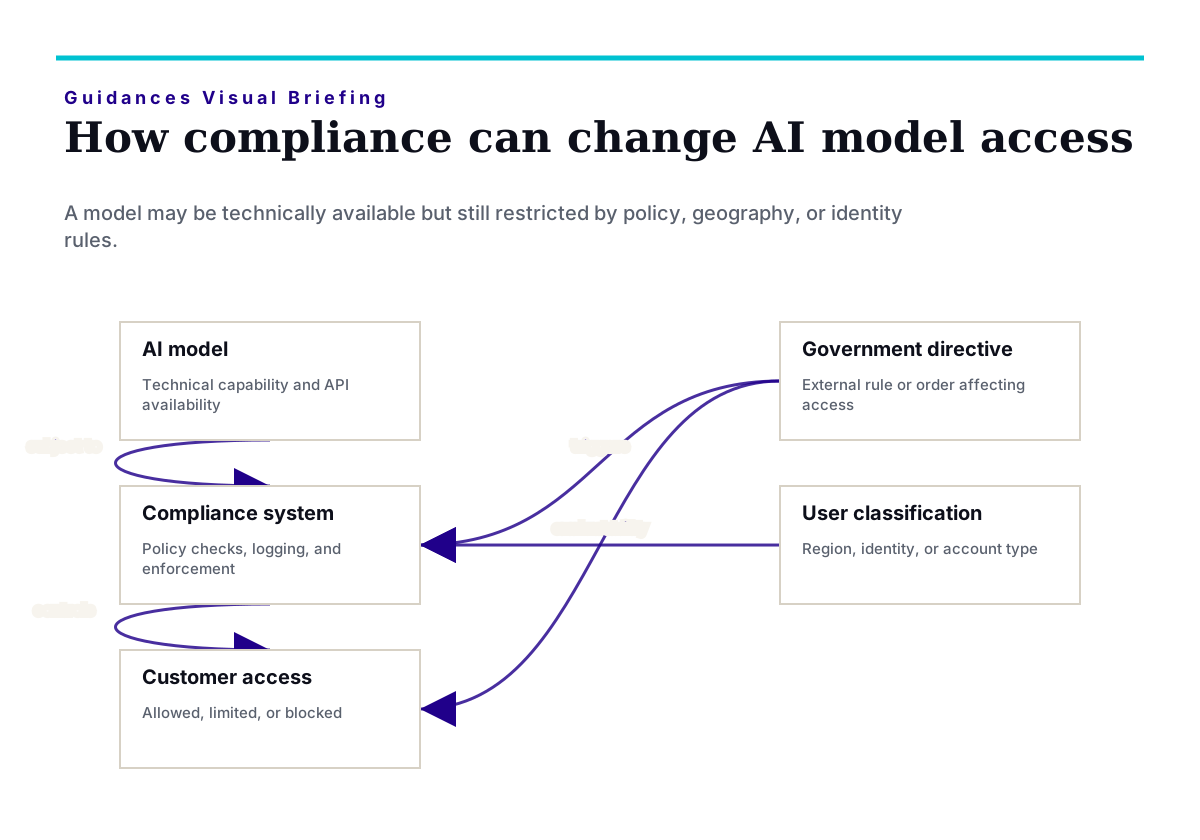
A government directive can flow through compliance systems and user classification rules to change whether customers can reach a model.
Corrections and safety
See a factual, privacy, rights, or safety issue? Review the corrections process or contact Guidances before relying on this article for important decisions.