AI
Developing · 0 updatesFact 9/10OpenAI Halts SWE-bench Verified Evaluations, Prompting Review of AI Benchmark Reliability
Article language
English
OpenAI has announced it will stop reporting SWE-bench Verified scores in its evaluations of frontier AI models. The company cited possible data contamination and test-case quality issues, saying the benchmark should be reviewed for its current evaluation purpose. The decision is likely to continue discussions about how AI evaluation metrics are maintained, interpreted, and updated. It also highlights the challenge of keeping benchmarks relevant in the rapidly evolving field of artificial intelligence.
Open article · no sign-in required
Sources and disclosure
The article's core claims are strongly supported by the provided OpenAI source, which explicitly states the company has stopped reporting SWE-bench Verified scores due to contamination and flawed tests. The article elaborates on these issues (data contamination, test-case quality, benchmark maintenance) in a neutral and informative manner. Speculative elements, such as the potential impact on other organizations, are appropriately framed with cautious language. The article adheres to reputation safety guidelines, avoiding disparagement or unsupported accusations.
Market lens
Agent runtime spending can spill into security, observability, and workflow infrastructure
The market signal is not another chatbot category; it is a possible budget shift toward the control layer around enterprise AI.
Impact path
Runtime spend → infra stack
Signals to watch
- Procurement language around audit logs and cost ceilings
- Security and observability vendors attaching agent controls
- Workflow platforms exposing approval and tool-call governance
Verification schedule
D+1 · Jun 16
Do buyers repeat audit/cost-control requirements?
D+3 · Jun 18
Do vendors publish runtime-control SKUs or partnerships?
D+7 · Jun 22
Do budgets move from pilots into operating infrastructure?
Informational context only — not investment, legal, tax, or financial advice.
OpenAI has announced its decision to stop reporting SWE-bench Verified scores in its evaluations of frontier AI models. The company stated that the benchmark requires reassessment for its continued suitability for current evaluation purposes, citing possible data contamination and test-case quality issues as reasons. This move re-emphasizes questions about how AI model evaluation systems should be maintained, updated, and interpreted over time.
What Happened
SWE-bench Verified was designed to measure an AI model’s ability to solve problems drawn from real software repositories. This benchmark presents models with tasks that require understanding, debugging, and implementing code changes within a realistic development environment. These tasks often involve navigating complex codebases, identifying bugs, and proposing solutions that integrate with existing software structures. OpenAI had previously used this benchmark as a key indicator of progress in its most advanced models, particularly in the domain of automated software engineering. The company has now decided to re-evaluate its role. This illustrates that even widely used benchmarks may require adjustment in their interpretation as model performance and data environments evolve.
Why It Matters
Benchmark scores often carry significant weight, frequently perceived as indicators of technological progress and summaries of model capabilities. However, scores can vary depending on evaluation design and data conditions, and even identical numerical values are only as meaningful as the reliability of the benchmark itself. OpenAI’s decision to cite both possible data contamination and test-case quality issues aligns with this context. It suggests that the conditions under which a score is produced can be as important as the score itself.
Data contamination is a persistent concern in large-model development. As training corpora expand, it becomes increasingly difficult to rule out inadvertent exposure to benchmark tasks, solution patterns, or closely related examples during the training process. This can occur if the training corpus includes public code repositories that also contain the specific problems or solutions used in the benchmark. When a model has been exposed to such data, its performance on the benchmark may reflect memorization or pattern recognition rather than problem-solving ability or generalization to unseen tasks. OpenAI's decision to re-evaluate SWE-bench Verified in light of this concern highlights the ongoing challenge of maintaining separation between training and evaluation data in large-scale AI development.
Test-case quality is another important variable. A benchmark's effectiveness depends on its ability to verify whether a model has solved a given problem. If test cases are incomplete, ambiguous, or do not cover a sufficient range of edge cases and failure modes, a model might appear to succeed without fully addressing the underlying task. In software engineering, where subtle interactions, environmental dependencies, and specific repository structures are common, the design of robust test suites is particularly challenging. OpenAI's concern about test-case quality suggests that the existing tests might not fully capture the nuances of real-world software development problems, potentially leading to an incomplete assessment of model performance.
The broader significance is that AI evaluation is increasingly becoming a maintenance issue, not just a static measurement issue. Benchmarks are often created to capture a snapshot of capability at a particular moment. Over time, however, models improve, training data grows, and the benchmark itself can become less representative of the capability it was meant to measure. What was once a challenging task for a model might become trivial, or the benchmark's underlying assumptions might no longer align with the cutting-edge capabilities being developed. Therefore, benchmarks require continuous maintenance, including regular updates to problem sets, re-validation of test cases, and adaptation to new model architectures and training paradigms. OpenAI's move signals a recognition that relying on static benchmarks without periodic review can limit an accurate understanding of progress in frontier AI.
OpenAI’s decision, given its prominence in the AI research community, may prompt other organizations and researchers to re-examine their own reliance on SWE-bench Verified and similar benchmarks. While the benchmark may still hold value for specific research contexts or for evaluating less advanced models, its suitability for assessing 'frontier' capabilities is now under review. This could contribute to a broader industry trend of increased skepticism toward single-metric evaluations, encouraging the development of more dynamic, comprehensive, and transparent evaluation frameworks across the AI ecosystem. The emphasis may shift from simply reporting high scores to demonstrating robust, generalizable performance across a diverse set of real-world challenges.
Operating Implications
For teams developing code generation systems, this implies a shift away from sole reliance on a single benchmark score. Instead, a more robust evaluation strategy would involve combining benchmark results with a diverse set of internal and external validation methods. This could include task-based evaluations where models are assessed on real-world coding projects, internal regression tests to check stability, and continuous monitoring of real-world usage patterns. Such a multi-faceted approach provides a more holistic picture of a model's capabilities and its readiness for deployment.
There is also a governance implication. Establishing clear governance around evaluation frameworks becomes important. Organizations should implement procedures for selecting benchmarks, documenting their rationale, and regularly reviewing their continued relevance. Processes should also be in place to track the provenance of training data and assess possible overlap with evaluation material, thereby reducing contamination risk. The quality and completeness of test suites should also be subject to ongoing monitoring and periodic reassessment, helping ensure that they remain representative of the desired capabilities. OpenAI's announcement reinforces the expectation that evaluation methodologies should be transparent, verifiable, and adaptable to the rapid pace of AI innovation.
Uncertainty or Constraints
It is important to interpret OpenAI's announcement within its stated context. The company has indicated that it will stop reporting SWE-bench Verified scores for its frontier model evaluations and has cited possible data contamination and test-case quality issues as reasons. This does not inherently invalidate the benchmark for all other uses or for other organizations. SWE-bench Verified may still serve as a useful tool for specific research purposes, for evaluating models at different stages of development, or for comparing certain aspects of code generation capabilities. The core message is not a definitive judgment on the benchmark's overall utility, but rather a call for careful consideration of its applicability and reliability, particularly when assessing the most advanced AI systems. Therefore, the key issue remains not the replacement of an evaluation metric, but the need for regular review of evaluation systems, especially when they are used to summarize fast-moving model capabilities.
Builder Implications
- When developing code generation models, do not rely solely on a single benchmark score; instead, combine benchmark results with real-world use cases, task-based testing, and internal regression checks.
- When designing internal evaluation frameworks, establish procedures to track training-data provenance and assess possible overlap with evaluation material, especially for code-oriented benchmarks.
- Review test-suite completeness and consistency on a regular basis, as benchmark reliability depends on the quality of the tests as much as on the model being measured.
- Treat evaluation frameworks as living systems that require periodic reassessment, rather than as fixed scoreboards that remain valid without revision.
Want follow-up alerts? Subscribe by email after reading the public article.
Market lens
Agent runtime spending can spill into security, observability, and workflow infrastructure
The market signal is not another chatbot category; it is a possible budget shift toward the control layer around enterprise AI.
Impact path
Runtime spend → infra stack
Signals to watch
- Procurement language around audit logs and cost ceilings
- Security and observability vendors attaching agent controls
- Workflow platforms exposing approval and tool-call governance
Verification schedule
D+1 · Jun 16
Do buyers repeat audit/cost-control requirements?
D+3 · Jun 18
Do vendors publish runtime-control SKUs or partnerships?
D+7 · Jun 22
Do budgets move from pilots into operating infrastructure?
Informational context only — not investment, legal, tax, or financial advice.
Visual Briefing
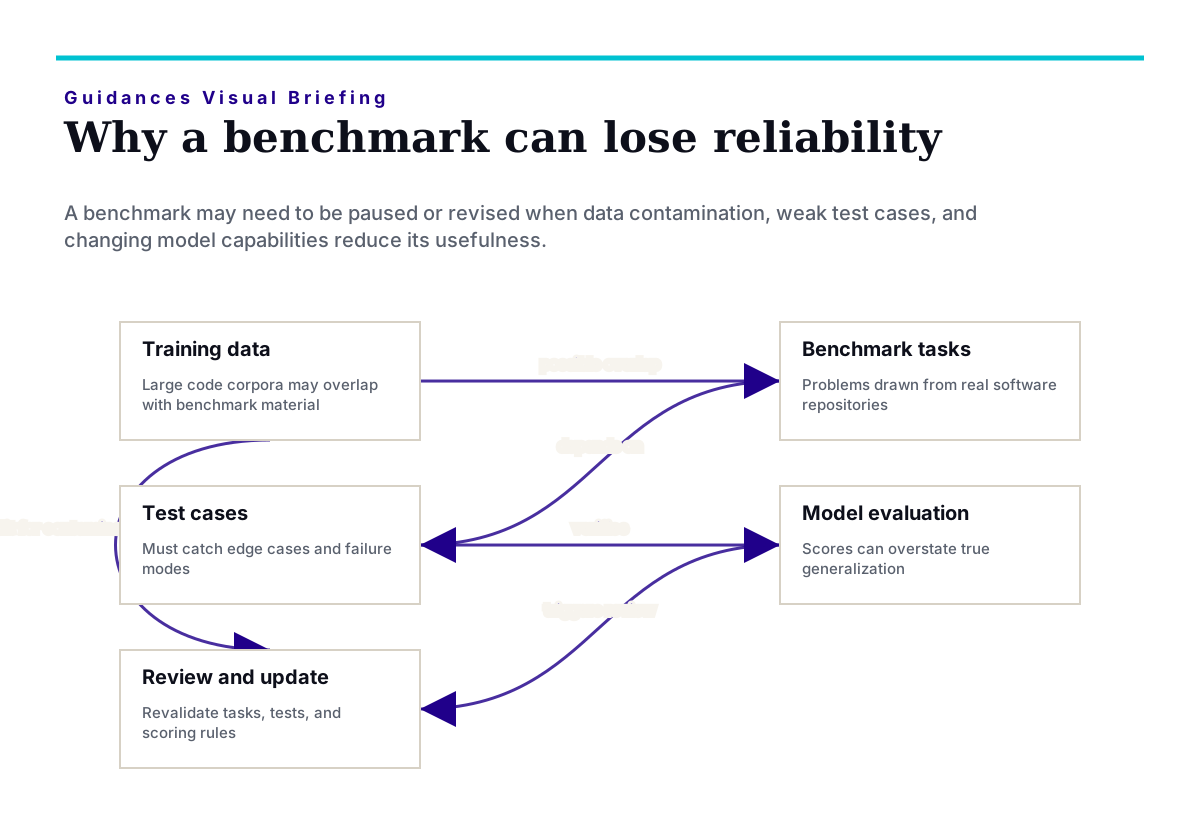
A simple workflow showing how benchmark reliability can weaken and why periodic review matters.
Corrections and safety
See a factual, privacy, rights, or safety issue? Review the corrections process or contact Guidances before relying on this article for important decisions.