What happened
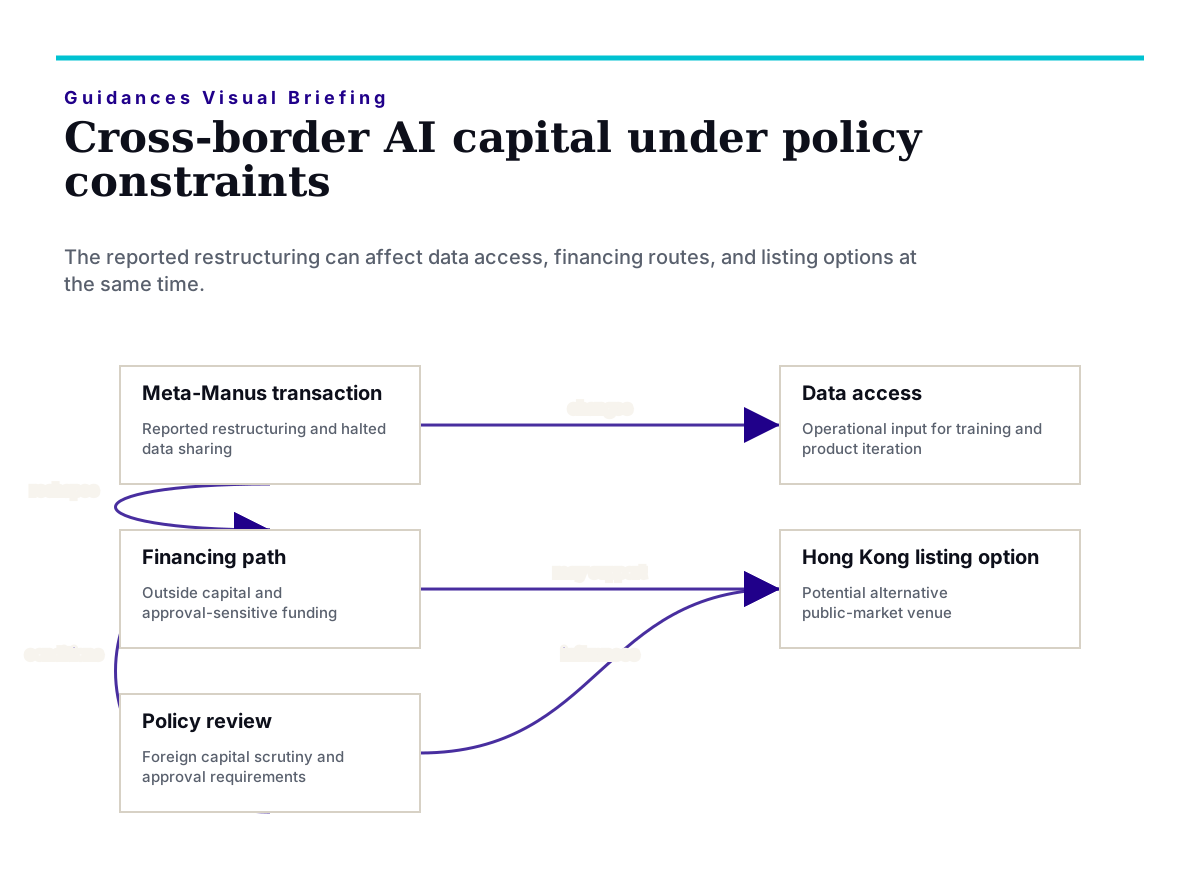
According to the TechCrunch snippet, Meta is moving to restructure a transaction involving Manus, a Chinese-founded AI startup, and has stopped data sharing between the two companies. The same snippet says Manus co-founders have held preliminary discussions about raising roughly $1 billion from outside investors. It also mentions a possible Chinese joint-venture structure and a potential Hong Kong listing. The snippet further notes that China is tightening oversight of foreign capital, with reports indicating that some AI firms may need government approval before accepting U.S. investment.
The available information is limited to a snippet, so the legal status of the transaction, the terms of any restructuring, the likelihood of new financing, and the timing of any listing are not established here. That limitation matters because AI valuations often depend not only on product performance but also on data access, capital availability, and public-market options.
Why the market cares
This story sits at the intersection of AI capital formation and policy constraints. For AI companies, the market prices more than model quality or user growth. It also prices the durability of data access, the reliability of funding channels, and the feasibility of a public listing in a chosen venue. When a cross-border transaction is reworked, the valuation framework can shift as well.
The mention of a possible Hong Kong listing is relevant for readers tracking public markets. Hong Kong has re-emerged as a venue for Chinese AI listings, according to the snippet, which suggests that some founders and backers may view it as an alternative when U.S.-linked structures are less practical. That does not mean a listing is imminent or assured. It does indicate that the market is still looking for a workable route to liquidity for Chinese AI assets.
More broadly, investors are watching whether AI capital is fragmenting into separate pools with different regulatory boundaries. If that happens, valuation multiples, financing costs, and exit options may diverge more by geography than by technology category.
Tech / policy link
The operational detail that stands out is the halt in data sharing. In AI, data flow is central to training, inference, product iteration, and internal evaluation. Once that flow is interrupted, integration benefits can weaken and the cost of separation can rise. In that sense, this is not only a cap-table story but also an infrastructure story.
The policy link is equally important. The snippet says China is tightening oversight of foreign capital and that some major AI firms may need government sign-off before taking U.S. investment. If accurate, that would reinforce a broader pattern: AI capital is becoming more conditional, more permissioned, and more sensitive to national policy priorities. For founders, that changes fundraising sequencing. For investors, it changes diligence. For public markets, it changes which listings are feasible and where.
AI companies also depend on compute, cloud capacity, and data infrastructure. If capital structures become more constrained, the pace at which firms can secure compute or scale infrastructure may also change. That link is plausible but not directly proven by the snippet, so it should be treated as a market read-through rather than a confirmed causal chain.
Market Lens
Trigger: Meta is reportedly moving to restructure a $2 billion Manus transaction, while Manus founders are said to be exploring new outside capital and a possible Hong Kong listing.
Mechanism: A transaction restructuring can reduce operational integration and force a reset in data-sharing, governance, and financing plans. If Manus pursues a new capital round and a Hong Kong structure, the company may be shifting from a U.S.-linked ownership path toward an Asia-centered capital path. That could alter valuation expectations, exit timing, and regulatory complexity. The link to broader market pricing is unverified because the snippet does not provide a confirmed market reaction.
Affected sectors / companies / indexes: Directly affected names are Meta and Manus. More broadly, Chinese AI startups, Hong Kong equity markets, cross-border venture capital, and AI infrastructure providers could be relevant. Any specific ETF or index impact is unverified from the available metadata.
Time horizon: Near term, the key horizon is the transaction restructuring and any financing discussions. Medium term, the relevant horizon is whether Manus pursues a Hong Kong listing or a joint-venture structure. Longer term, the issue is whether China’s approval regime materially changes the flow of U.S. capital into AI.
Next check: Watch for official statements from Meta or Manus, any disclosed financing terms, regulatory guidance from Chinese authorities, and any Hong Kong listing filings or pre-IPO steps. Those are the concrete checks that would move this from a structural report to a market-relevant event.
What to watch next
The first question is whether the reported restructuring becomes a formal corporate action. The second is whether Manus can actually raise the suggested $1 billion from outside investors. The third is whether a Hong Kong listing remains a strategic option or becomes only a discussion point. The fourth is whether China’s approval requirements for foreign AI investment become more explicit, because that would affect not only Manus but also the broader pipeline of cross-border AI financing.
There is also a valuation question beneath the headlines. AI startups often trade on the promise of scale, but scale depends on capital access, governance clarity, and the ability to convert technical momentum into a durable financing path. If those conditions become more fragmented by jurisdiction, the market may begin to assign a discount to structures that are operationally complex. That is a market context observation, not an investment recommendation.
Uncertainty and constraints
The source material is thin. It is a snippet, not a full article, and it does not provide contract terms, legal filings, or direct confirmation from the companies involved. As a result, any broader market interpretation should remain conditional. The Hong Kong listing angle, the joint-venture possibility, and the China approval issue are all important, but they are not fully verified in the material provided here.
This analysis is market context only, not investment advice.