Finance
Developing · 0 updatesFact 9/10What SK Hynix’s Reported Nasdaq Review Means: Verified Facts and the Limits of Market Interpretation
Article language
English
Reuters reported that SK Hynix is leaning toward Nasdaq for a planned U.S. listing. The verified facts remain limited, and the final structure and timing are unconfirmed. The story is relevant to AI memory demand, access to global investors, and Korean semiconductor capital-markets strategy, but any valuation effect or market reaction remains unverified.
Open article · no sign-in required
Sources and disclosure
The article is exceptionally well-structured, adhering strictly to the guidelines. It clearly distinguishes between verified facts and market interpretations, attributes all key claims to Reuters (the primary source), and includes robust disclaimers regarding uncertainty and the absence of investment advice. The provided web-search context strongly supports the article's factual claims and its framing of market relevance, particularly concerning AI memory demand, SK Hynix's market position, and Nasdaq's identity as a technology-focused exchange. The article's proactive inclusion of 'Uncertainty and constraints' and 'Market Lens' sections, along with explicit statements that it is not investment advice, significantly enhances its quality and compliance.
Market lens
Separate infrastructure signal from investable outcome
Treat market-linked stories as context: identify the mechanism, then wait for evidence before treating it as an outcome.
Impact path
Signal first, outcome later
Signals to watch
- Primary-source guidance and filings
- Price, volume, margin, and renewal evidence
- Follow-up reporting that confirms or rejects the mechanism
Verification schedule
D+1 · Jun 16
Is the mechanism visible in primary data?
D+3 · Jun 18
Do follow-up sources confirm direction and magnitude?
D+7 · Jun 22
Did the initial read overstate the market effect?
Informational context only — not investment, legal, tax, or financial advice.
What happened
Reuters reported, citing multiple people familiar with the matter, that SK Hynix is leaning toward Nasdaq for a planned U.S. listing. The report says the company is considering a technology-heavy exchange and that the listing could come as early as August. Those are the only verifiable points available from the source context: the story is source-based, the timeline is tentative, and the final structure has not been confirmed.
That limited fact set matters. In market terms, this is not yet a completed transaction or a disclosed financing plan. It is a reported strategic choice under consideration. For readers tracking semiconductors, AI infrastructure, and cross-border capital access, the distinction is important. A planned listing can signal intent, but it does not by itself establish valuation, proceeds, or the final investor base.
SK Hynix is already a central name in global memory supply, and the report frames it as a company tied to AI memory demand. That context is enough to explain why the listing venue is attracting attention. Nasdaq is not merely a venue; it is also a market with a strong technology identity, and that identity can shape how investors interpret a company that sits at the intersection of memory chips and AI demand. Even so, the report does not confirm any market outcome, and it would be inappropriate to infer one from the venue choice alone.
Why the market cares
The market cares because this story sits at the junction of three live themes: AI capex, semiconductor supply chains, and global investor access.
First, AI infrastructure remains a capital-intensive buildout. Memory suppliers are not the only beneficiaries, but they are essential to the performance stack that supports large-scale AI systems. If a company like SK Hynix is seen as more directly tied to AI demand, then any capital-markets move that reinforces that identity can matter for how investors frame the sector.
Second, a U.S. listing can broaden the shareholder base. That does not guarantee a valuation change, but it can alter the pool of investors who can own the stock, the analyst coverage it receives, and the way it is compared with U.S.-listed technology peers. For a Korean company with global customers, that is a meaningful strategic consideration.
Third, the story may influence how the market thinks about Korean semiconductors more broadly. If one of the country’s most important chipmakers moves closer to U.S. capital markets, investors may revisit the sector through a more global lens. That is a framing issue, not a confirmed market reaction, and it should be treated as such.
Tech / policy link
From a technology perspective, the report underscores a simple point: AI competition is not only about compute. Memory bandwidth, supply reliability, and manufacturing scale remain critical. A company that is deeply embedded in that chain may seek a market venue that better reflects its technology profile and its customer base.
From a policy and market-structure perspective, a U.S. listing can also raise the bar on disclosure, governance, and investor communication. That is not a judgment on the company; it is a structural feature of cross-border listings. For operators, the implication is that capital-market strategy increasingly sits alongside product strategy and manufacturing strategy.
The policy link is therefore indirect but real. If the listing proceeds, the company may need to navigate U.S. disclosure expectations while maintaining its existing Korean market presence. That can affect how it communicates capex, supply commitments, and demand visibility. For a semiconductor company, those are not peripheral details. They are central to how investors model the cycle.
Market Lens
Trigger: Reuters says SK Hynix is expected to choose Nasdaq for a planned U.S. listing. The report is based on unnamed sources and remains unconfirmed.
Mechanism: A Nasdaq venue can increase visibility among global technology investors and reinforce the company’s AI-linked narrative. In theory, that can broaden the shareholder base and change how the market frames the stock. The actual effect, however, depends on the final listing structure, timing, and disclosure package.
Affected sectors / companies / indices: Directly, SK Hynix. Indirectly, Korean semiconductors, memory supply-chain names, and AI infrastructure exposure more broadly. Any direct causal link to a specific ticker or index is unverified at this stage, so it should not be treated as established.
Time horizon: Near term, the key horizon is the potential August window mentioned in the report and any formal filing that follows. Medium term, investors will focus on AI demand, memory pricing, and capex guidance. Longer term, the question is whether more Asian technology firms use U.S. listings to deepen access to global capital.
Next check: The next concrete check is an official filing or company statement. After that, investors will look for listing terms, use of proceeds, and any updated commentary on AI demand, production capacity, and capital spending.
What to watch next
The first thing to watch is whether SK Hynix confirms the venue and timing. Without that, the story remains a reported intention rather than a completed market event. The second is whether the company frames the listing as a capital-raising step, a liquidity event, or a broader investor-relations move. Those distinctions matter for analysis.
The third is the company’s next earnings communication. For a memory chipmaker, the market will want to see how management describes AI-related demand, supply conditions, and capex discipline. The fourth is the broader semiconductor backdrop: export data, customer spending plans, and any signs that AI server investment is broadening beyond a narrow set of buyers.
There is also a comparative question. If SK Hynix moves ahead, the market may ask whether other Korean technology names consider similar steps. That would not be a mechanical consequence, but it would be a relevant read-through for capital-market strategy in the region.
Uncertainty and constraints
The source material is thin, so caution is necessary. There is no confirmed filing, no disclosed valuation, no stated proceeds, and no official company explanation in the snippet. It would be inappropriate to infer a market reaction, a price move, or a policy outcome from the report alone. The most defensible interpretation is that the company is exploring a venue that aligns with its technology profile and its global investor base.
This analysis is market context only, not investment advice.
Builder Implications
- Semiconductor and AI founders should treat market venue as part of product positioning. Investor access can shape how growth, capex, and supply-chain strength are interpreted.
- If a company has global customers, it should prepare disclosure materials that translate manufacturing and demand metrics into language U.S. investors can compare across peers.
- For Korean tech operators, the key lesson is that capital-market strategy and operating strategy are increasingly intertwined; listing decisions can influence hiring, partnerships, and long-term financing flexibility.
Want follow-up alerts? Subscribe by email after reading the public article.
Market lens
Separate infrastructure signal from investable outcome
Treat market-linked stories as context: identify the mechanism, then wait for evidence before treating it as an outcome.
Impact path
Signal first, outcome later
Signals to watch
- Primary-source guidance and filings
- Price, volume, margin, and renewal evidence
- Follow-up reporting that confirms or rejects the mechanism
Verification schedule
D+1 · Jun 16
Is the mechanism visible in primary data?
D+3 · Jun 18
Do follow-up sources confirm direction and magnitude?
D+7 · Jun 22
Did the initial read overstate the market effect?
Informational context only — not investment, legal, tax, or financial advice.
Visual Briefing
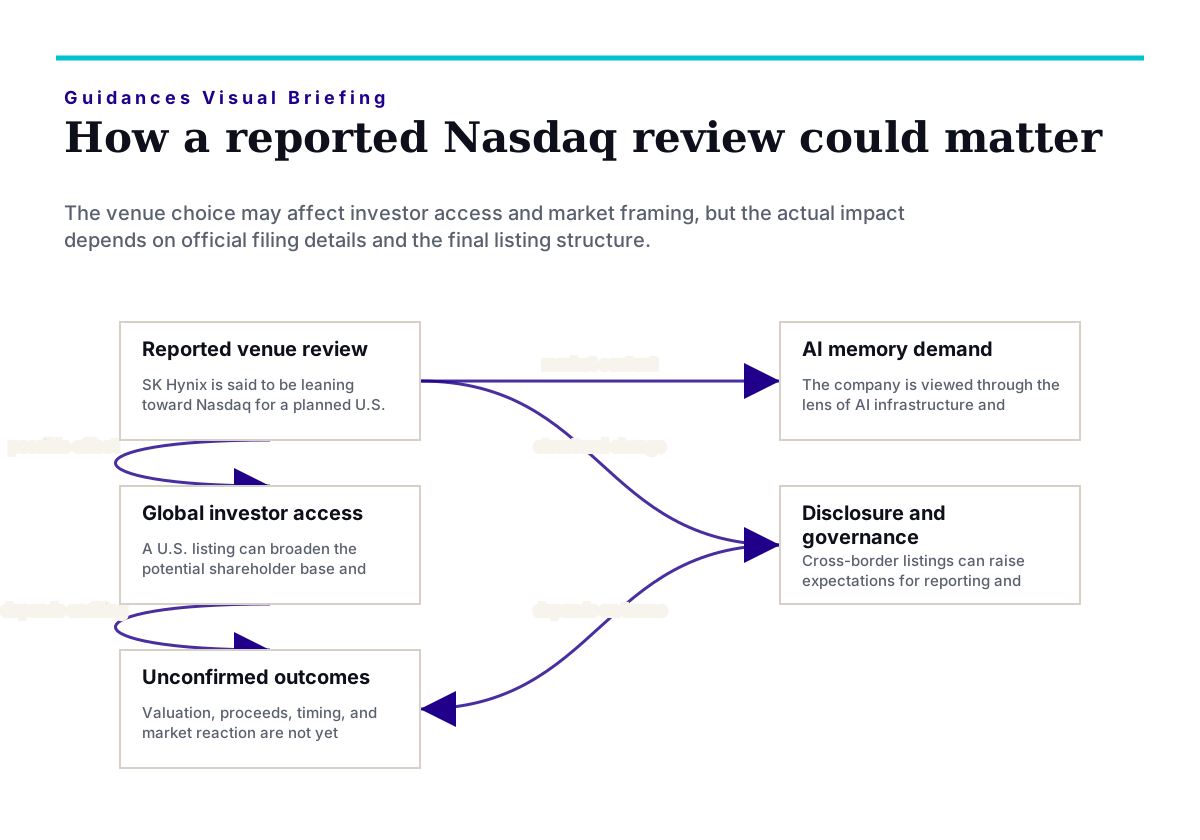
A reported Nasdaq choice sits at the intersection of AI demand, investor access, and disclosure requirements, but the outcome remains uncertain.
Corrections and safety
See a factual, privacy, rights, or safety issue? Review the corrections process or contact Guidances before relying on this article for important decisions.