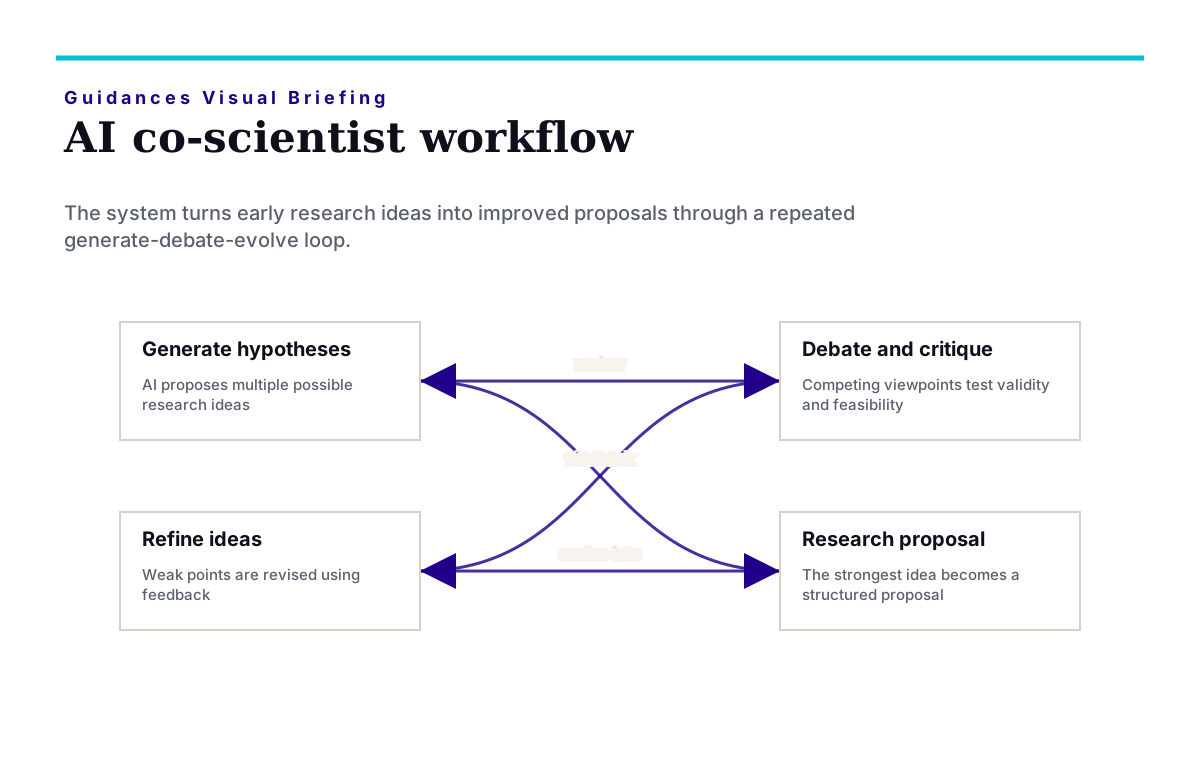
An AI co-scientist system built on Google's Gemini 2.0 large language model has been introduced through an arXiv paper. The system is designed to support hypothesis generation and research proposal writing in the early stages of scientific research, employing a generate-debate-evolve methodology.
The core operational approach of this system consists of multiple stages. First, the AI model generates possible hypotheses within a specific research domain. These generated hypotheses then undergo an internal debate mechanism, during which the validity, feasibility, and scientific value of each hypothesis are reviewed. Finally, based on the debate results, hypotheses are improved into final research proposals. This iterative approach aims for qualitative enhancement of research ideas beyond simple text generation.
The selection of the Gemini 2.0 model plays a role in the system's performance. Gemini 2.0 is Google's next-generation multimodal AI model, featuring improved reasoning capabilities and long-context processing abilities compared to previous versions. Scientific research proposal writing requires complex conceptual connections, understanding of existing literature, and maintenance of logical consistency—requirements that demand advanced language model capabilities.
The generate-debate-evolve methodology reflects aspects of how the scientific research community often works. Researchers typically present initial ideas, identify weaknesses through discussions with colleagues, and refine proposals by incorporating feedback. The AI co-scientist system can be viewed as an attempt to simulate this collaborative process within a single system. The debate stage likely employs multiple AI agents or prompting strategies representing different perspectives or critical viewpoints.
The novelty of research proposals generated by this system is an important evaluation criterion. The key question is whether it can propose genuinely new research directions beyond simply recombining existing research. While the paper states that the system generates 'novel' hypotheses, the definition and measurement of novelty, as well as how generated proposals would be evaluated by the scientific community, remain areas requiring additional verification.
The emergence of AI co-scientists can bring several changes to scientific research workflows. Researchers can explore more diverse hypotheses with AI assistance during the initial idea brainstorming stage. Particularly in interdisciplinary research or when entering new fields, AI can quickly connect relevant literature and concepts to suggest research directions. Additionally, by supporting structuring and logical development in the early stages of research proposal writing, it can save researchers' time.
However, practical application of such systems faces several constraints. First, the scientific validity of AI-generated hypotheses still requires verification by human experts. Large language models can generate plausible but factually inaccurate or less feasible proposals. Second, when access to the latest research trends and experimental data is limited, generated proposals risk repeating ideas that have already been attempted or disproven. Third, factors that AI may struggle to adequately consider—such as research ethics, experimental design practicality, and resource constraints—must be included in actual research proposals.
The development of this system is presented as an attempt to expand the range of roles AI can perform in scientific research. Previously, AI has primarily focused on auxiliary roles such as data analysis, pattern recognition, and literature search. However, hypothesis generation and research design have traditionally been considered domains where human researchers' creativity and intuition are central. The AI co-scientist attempts to broaden these boundaries and demonstrate that AI can contribute to the conceptual stages of research as well.
The technical characteristics of Gemini 2.0 also provide important context for this application. Google has emphasized improved reasoning capabilities and multimodal processing abilities in Gemini 2.0. Scientific research proposal writing may require processing various forms of information beyond text, including graphs, diagrams, and equations, and the multimodal model's capabilities in this regard enhance the system's practicality. Additionally, long-context processing capability is helpful for handling complex research backgrounds and arguments spanning multiple stages.
Acceptance of such tools in academia and industry is expected to be gradual. Initially, researchers will likely use AI-generated proposals as reference materials or sources of inspiration, while humans perform final decisions and verification. Over time, as the quality of AI proposals is demonstrated and trust builds, more direct forms of collaboration may develop. Particularly in data-intensive fields or computational science domains, the utilization of AI co-scientists is expected to be high.
This research also raises new questions regarding AI safety and accountability. If AI-generated research proposals lead to actual experiments, who bears responsibility for the results? How can ethical issues be detected and managed when AI proposes research containing such problems? These questions are challenges that must be reviewed before AI co-scientist systems are integrated into actual scientific research environments.
The system's approach reflects broader trends in AI-assisted knowledge work. Rather than replacing human expertise, the generate-debate-evolve framework positions AI as a collaborative partner that can explore solution spaces more broadly than individual researchers working alone. The debate mechanism is particularly noteworthy, as it introduces a form of self-review that may help identify weaknesses in generated hypotheses before they reach human reviewers.
From a technical architecture perspective, implementing such a system requires careful orchestration of multiple model invocations, prompt engineering strategies, and evaluation criteria. The evolution stage likely involves iterative refinement based on structured feedback from the debate phase, requiring mechanisms to track improvements and prevent degradation of proposal quality. Developers building similar systems must balance computational cost against output quality, as multiple generation-debate cycles can become resource-intensive.
The choice of arXiv as the publication venue is significant. ArXiv serves as a preprint repository where researchers share work before formal peer review, allowing rapid dissemination of ideas and early community feedback. This suggests the AI co-scientist system may still be in experimental stages, with findings subject to further validation. Builders should approach the methodology as a research direction rather than a proven production-ready framework.