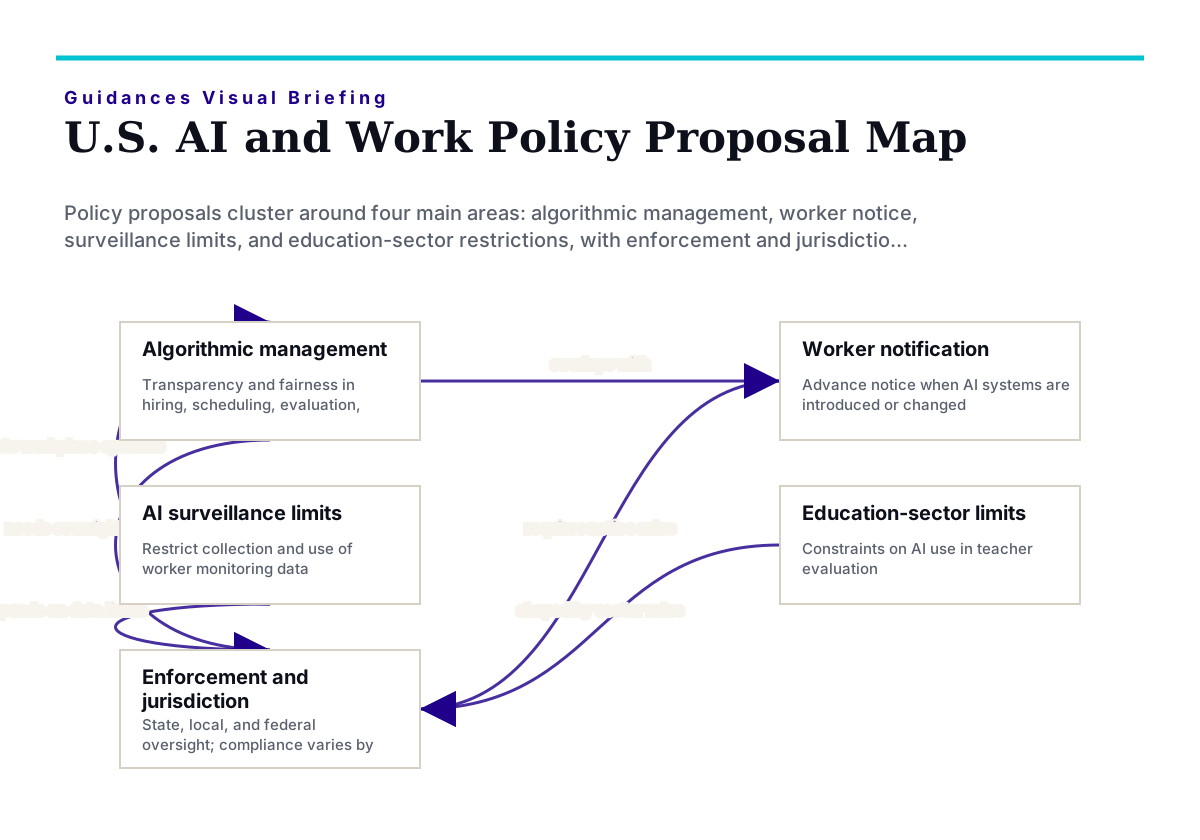
A policy guide published by the UC Berkeley Labor Center provides a systematic overview of current U.S. policy proposals addressing the intersection of technology and work. The document covers four core areas: algorithmic management, worker notification requirements, AI-driven surveillance, and education-sector AI limits, outlining regulatory approaches and legislative activity in each domain.
Algorithmic management refers to the use of AI and automated systems across the employment lifecycle, including hiring, task assignment, performance evaluation, and termination. Multiple states and federal lawmakers have introduced bills aimed at increasing transparency and fairness in these systems. Policymakers are considering measures that would require employers to disclose algorithmic decision-making processes and provide workers with avenues to challenge automated decisions.
Worker notification requirements mandate that employers inform employees in advance when AI systems are introduced or modified. The goal is to enable workers to understand their work environment and evaluation criteria, and to prepare for negotiation or other responses if needed. Some proposals specify that notifications must include details on how algorithms operate, what data is collected, and how decisions are influenced.
AI-driven surveillance encompasses technologies that track worker productivity, location, and behavior in real time. As these tools proliferate across warehouses, delivery services, call centers, and other industries, discussions about privacy and workplace conditions have continued. Policy proposals seek to limit the scope of surveillance data collection and set standards for how surveillance results may be used, with some discussions also addressing worker consent.
In the education sector, proposals include limits on using AI for teacher evaluations. Educators argue that AI systems may not fully capture the complexity and context of teaching, and discussions are underway regarding fairness and accuracy in evaluation. Some state and federal proposals address potential restrictions on AI-based teacher assessments.
These policy debates have gained momentum as the impact of AI on labor markets becomes more visible. AI tools may contribute to productivity gains, while also affecting worker autonomy, job structures, and employment practices. Policymakers are working to balance technological innovation with worker protections.
The Berkeley Labor Center guide goes beyond cataloging proposals; it analyzes the legal basis, scope of application, and anticipated effects of each measure. This is intended to facilitate participation by legislators, labor unions, businesses, and researchers in policy discussions. Notably, state and local governments often move faster than the federal government in adopting regulations, and these regional policy experiments may influence future federal legislation.
U.S. policy discussions are often compared to the European Union's AI Act. The EU has adopted a comprehensive approach, classifying AI systems by risk level and applying strict regulations to high-risk systems. In contrast, the U.S. tends to favor sector-specific and use-case-focused legislation over broad federal AI regulation. This difference reflects variations in legal systems, political environments, and industrial structures.
The effectiveness of policy proposals depends on enforcement mechanisms. Some proposals grant oversight authority to existing agencies such as the Department of Labor or the Federal Trade Commission, while others call for the creation of new regulatory bodies or allow for private lawsuits as a remedy. Securing enforcement resources and building technical expertise are identified as important factors for policy implementation.
Businesses are paying close attention to regulatory changes and compliance costs. If different states adopt divergent regulations, companies operating nationally may need to build complex compliance frameworks. Some industry groups prefer unified federal regulation and propose self-regulation and industry standards as alternatives.
Labor unions and worker advocacy organizations welcome the policy proposals but argue that stronger protections are needed. They call for measures such as prior review processes for algorithmic management systems or expanded participation by worker representatives. They also emphasize the need for retraining programs and strengthened social safety nets to address job changes associated with AI adoption.
For technology developers and AI startups, these policy discussions may influence product design and market strategy. Demand is growing for AI systems that offer transparency, explainability, and fairness, and the market for tools and services that support regulatory compliance may expand. Companies that adjust their offerings to align with emerging policy changes may be better positioned to navigate the evolving environment.
Market Lens
The evolving U.S. policy landscape surrounding algorithmic management and AI surveillance introduces important considerations for public markets and specific industry sectors. For technology companies developing AI-powered workforce solutions, the proliferation of state-level proposals and the potential for federal action may increase attention to regulatory response and compliance costs. Market participants may increasingly scrutinize companies' responsible AI capabilities, favoring those that demonstrate robust frameworks for transparency, fairness, and worker protection. This shift could increase interest in firms specializing in AI governance, audit tools, and explainable AI technologies.
The variation in regulations across states presents a complex challenge for companies operating nationally, potentially requiring adaptable product architectures and region-specific strategies. This could favor larger enterprises with greater resources for legal and technical adaptation, while posing additional burdens for smaller startups. In the education technology sector, discussions around limiting AI in teacher evaluations suggest a need for developers to review product roadmaps, potentially shifting focus from high-risk assessment tools to areas like personalized learning support or administrative efficiency. Overall, the policy trajectory suggests that regulatory compliance may become a more important factor in market evaluation and competitive strategy for AI-centric businesses.
The Berkeley Labor Center guide suggests that policy discussions are still in early stages. Many proposals have not yet been enacted into law, and even where legislation has passed, implementation details often remain unfinalized. The policy environment is expected to evolve rapidly over the coming years, with the pace of technological advancement and the process of social consensus-building shaping the direction of regulation.
Uncertainty remains regarding the scope and timing of enforcement, the degree of harmonization across jurisdictions, and the balance between innovation incentives and worker protections. Developers and founders must monitor legislative developments closely and engage with policymakers, labor groups, and industry coalitions to navigate this shifting landscape.