What happened
Bloomberg reported that Nvidia is preparing its first corporate bond sale since 2021 and is seeking to raise at least $20 billion. According to the snippet, the company is marketing seven tranches with maturities ranging from two years to 30 years, and the longest tenor was being discussed at a spread of roughly 0.9 percentage point above Treasuries. Because the source is a short news snippet rather than the full article, the final structure, pricing, and investor demand should be treated as provisional until confirmed by the company or by deal terms in the market.
The immediate fact pattern is straightforward: a large, investment-grade issuer in the center of the AI trade is returning to the public debt market at scale. That alone makes the transaction relevant beyond one balance sheet. It is a financing event for a company that sits at the intersection of semiconductors, data-center buildout, and the broader AI infrastructure cycle.
Why the market cares
The market cares because Nvidia is no longer read only as a chip vendor. It is also a proxy for the pace at which AI infrastructure can be financed, built, and absorbed by the capital markets. A bond sale of this size suggests that the company is willing to use debt markets to support a large investment agenda, preserve flexibility, or both. In practical terms, that matters because AI infrastructure is capital intensive. GPUs, networking gear, power systems, cooling, and data-center capacity all require upfront spending, and the financing mix can influence how quickly that spending proceeds.
For equity investors, the key issue is not simply whether Nvidia can borrow. It is what the borrowing says about the durability of AI capex. If a company with Nvidia’s credit profile can place long-dated paper on acceptable terms, that can reinforce the view that the AI buildout still has access to deep pools of capital. If demand is softer than expected or spreads widen materially, the market may infer that investors are becoming more selective about financing the next leg of AI spending.
This is also relevant to credit markets. Large technology issuers can affect benchmark supply, sector spreads, and investor appetite for investment-grade paper. When a marquee issuer comes to market, it can influence how portfolio managers think about duration, spread compensation, and concentration in the technology credit bucket. The source snippet does not provide enough detail to claim a specific market reaction, so any immediate price effect should be labeled unverified.
Tech / policy link
The technology link is direct. AI systems require physical infrastructure, and physical infrastructure requires capital. Nvidia sits at the center of that chain because its products are embedded in the compute layer that powers training and inference. A bond offering can therefore be read as a financing layer beneath the compute layer: a way to support the expansion of the ecosystem that depends on Nvidia hardware, software, and partner networks.
The policy link is more indirect but still important. Interest rates, Treasury yields, and credit spreads are not technology policy in the narrow sense, yet they function as a de facto policy environment for capital-intensive tech investment. If rates remain elevated, the cost of funding long-duration projects rises. If credit conditions tighten, even strong issuers may face a higher hurdle for incremental investment. In that sense, the bond market becomes part of the operating environment for AI expansion.
There is no source-supported indication here of a regulatory deadline, export-control change, or formal policy action. Those links would be unverified based on the available metadata. The relevant policy variable for this story is the broader rate and credit backdrop.
Market Lens
Trigger: Nvidia is reportedly seeking at least $20 billion in its first corporate bond sale since 2021.
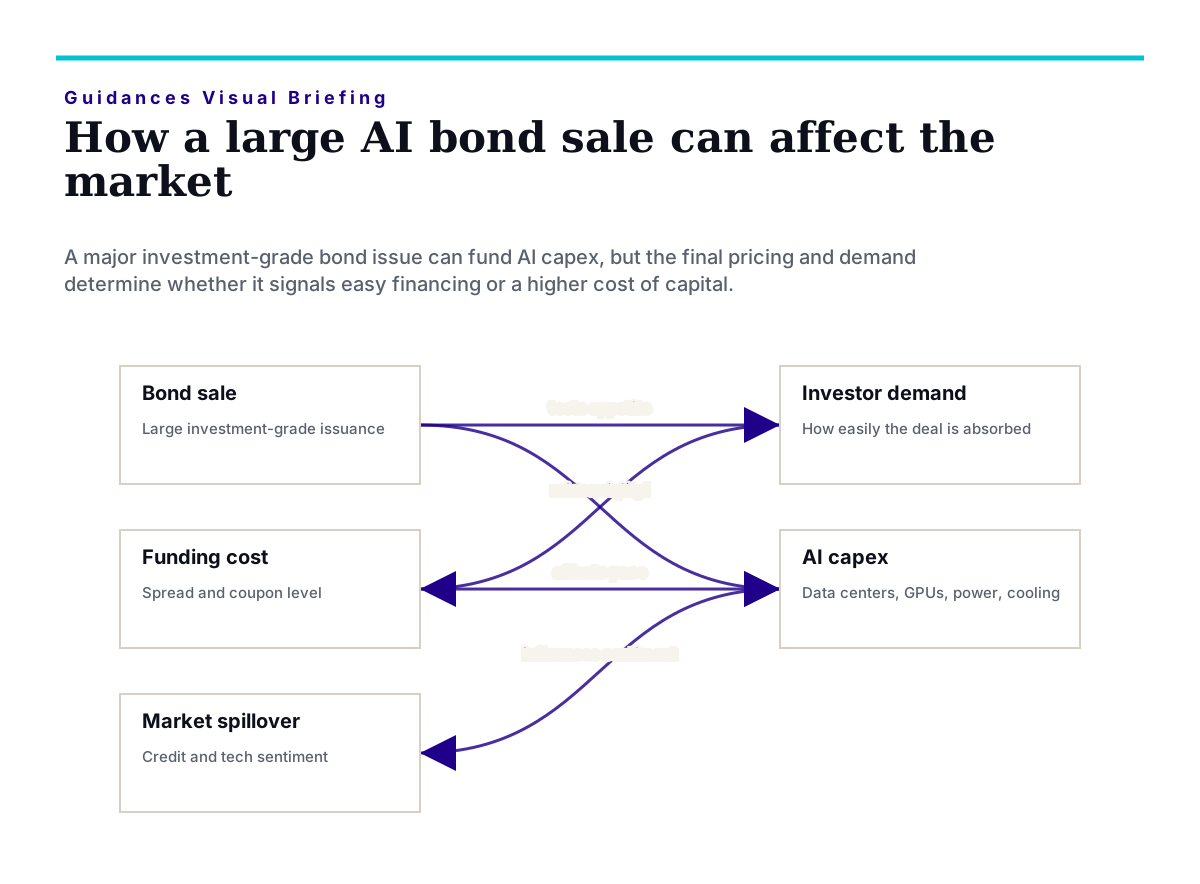
Mechanism: A large investment-grade bond issue can fund AI-related capex, extend liquidity, or diversify financing sources. If the deal is well received, it can signal that public debt markets remain open to large-scale AI infrastructure spending. If pricing is less favorable, the higher cost of capital can become a constraint on future investment pacing. The mechanism is financial rather than operational: debt markets help determine how much and how fast capital-intensive AI buildout can proceed.
Affected sectors / companies / indexes: Nvidia is the direct issuer. Secondary exposure may extend to AI semiconductors, data-center infrastructure, networking, power and cooling suppliers, and investment-grade credit markets more broadly. Technology-heavy equity indexes and AI-themed ETFs could also be watched for sentiment spillover, but any specific index or ETF reaction is unverified from the source snippet alone.
Time horizon: The immediate horizon is the pricing and placement of the bond sale. The medium-term horizon is whether the proceeds, if raised, translate into continued AI infrastructure spending and supply-chain demand. The longer horizon is whether large technology firms increasingly rely on public debt to finance AI expansion.
Next check: Confirm final deal size, tranche mix, and spreads; then watch Nvidia earnings commentary, capex language, and any follow-up on data-center demand or supply-chain orders. Broader checks include Treasury yields, investment-grade issuance conditions, and any change in credit appetite for large technology borrowers.
What to watch next
The first item is execution. The market will want to see whether the deal is completed at the reported scale and whether the longest-dated bonds clear at the indicated spread. That will help indicate how investors are pricing Nvidia’s credit and the AI spending cycle behind it.
The second item is whether this becomes a template. If other large technology firms or AI infrastructure names follow with similar financing, the market may begin to treat debt issuance as a standard funding channel for the sector. If not, this may remain a company-specific financing choice.
The third item is the operating translation. Debt issuance matters most if it supports actual buildout: data centers, compute clusters, networking, and power infrastructure. Without that link, the market impact is mostly financial. With it, the story becomes broader and more durable.
Uncertainty and constraints
The available source material is limited to a headline and a short snippet. That means several important details remain unknown: the final coupon, investor demand, use of proceeds, and whether the company will adjust the size or tenor mix before pricing. It is also not possible, from this material alone, to infer a specific equity move, a sector rotation, or a direct policy consequence. Those links would be speculative and are therefore unverified.
This analysis is market context only, not investment advice.