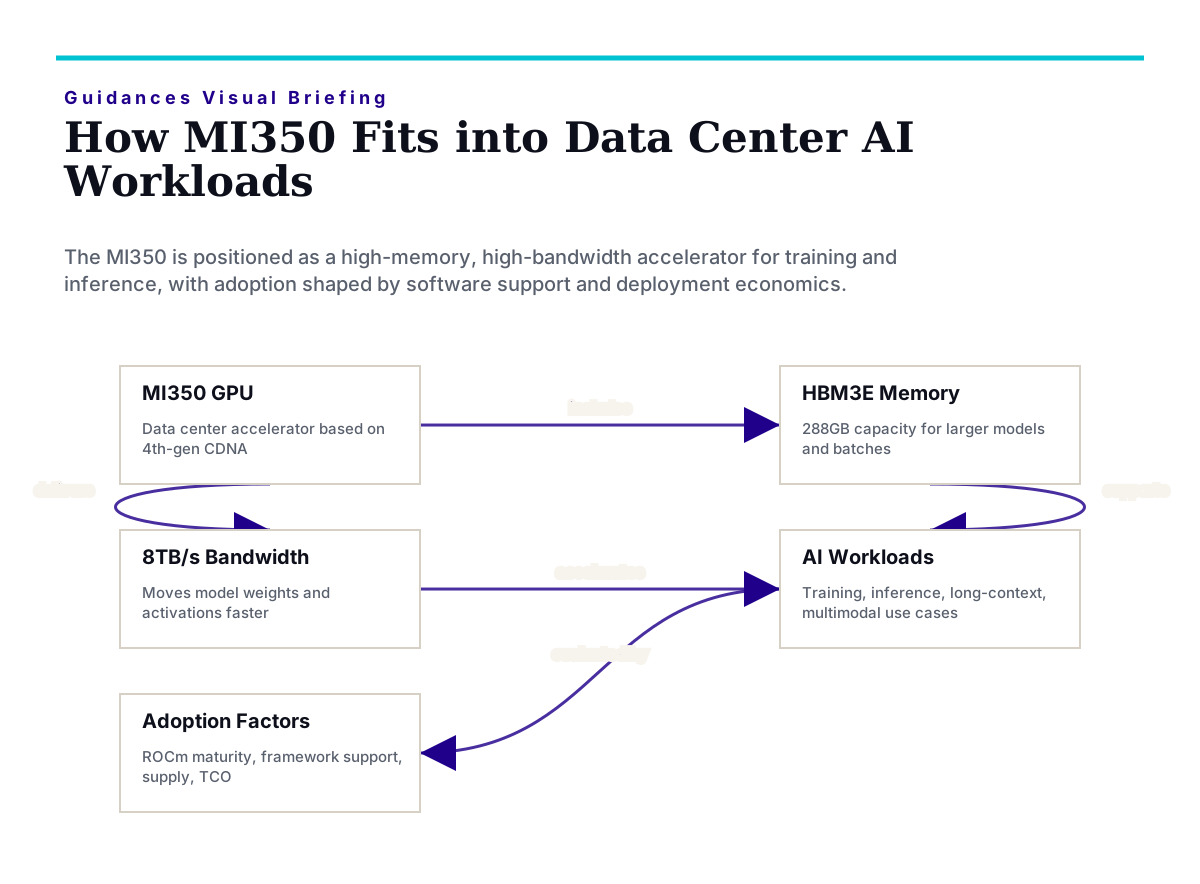
AMD has officially announced the Instinct MI350 series GPUs for data center AI workloads. The product line is built on the fourth-generation AMD CDNA architecture and is designed to support large-scale language model training and inference through high-bandwidth memory technology and improved computational performance.
According to product specifications, the MI350 series is equipped with 288GB of HBM3E memory and delivers 8TB/s of memory bandwidth. HBM3E features improved transfer speeds and power efficiency compared with the previous-generation HBM3, and the increase in memory capacity is presented as a design element intended to address the growing parameter counts of AI models. The 8TB/s bandwidth is a key specification for processing weight data in large models and may help improve data movement efficiency in generative AI environments.
AMD says the MI350 series delivers up to 2.2x AI performance compared with competing accelerators. This figure may reflect specific benchmark conditions, and actual workload performance can vary depending on factors such as model architecture, batch size, and precision settings. AMD has not disclosed the specific comparison products or test methodology.
The fourth-generation CDNA architecture is a dedicated computing architecture developed by AMD for the data center AI market. CDNA focuses on matrix operations and tensor processing rather than graphics rendering, and AMD describes it as offering improved computational throughput and power efficiency compared with earlier generations. The MI350 series is the latest implementation of this architecture.
Data center operators and cloud service providers are evaluating a range of accelerator options to manage the total cost of ownership for AI workloads. The MI350 series adds another option to the market, and the maturity of the ROCm software stack and framework compatibility are important factors in adoption decisions. AMD has expanded support for major deep learning frameworks such as PyTorch and TensorFlow, while compatibility with the CUDA ecosystem and the completeness of developer tools remain areas of evaluation.
The release timing, pricing, and specific product lineup of the MI350 series have not yet been disclosed. Data center GPUs are often brought into supply after announcement, and initial volumes may be allocated to major cloud providers and OEM partners.
In terms of memory capacity and bandwidth, the MI350 series is positioned to address the demands of larger context windows in large language models and multimodal model processing. The 288GB configuration may allow larger models to run on a single accelerator or support larger batches during inference. Actual performance will depend on software optimization, driver stability, and multi-GPU scaling efficiency, so independent benchmark results and real-world validation remain important.
AMD's announcement reflects ongoing competition in the AI accelerator market. Major cloud providers are pursuing strategies that include custom-designed chips and hardware sourcing from multiple vendors to adjust cost structures.
The 288GB HBM3E memory configuration positions the MI350 series as an option for workloads that require large context windows and high-throughput inference. The 2.2x performance figure will need to be evaluated against the benchmark methodology and workload characteristics. For large-scale deployments, adoption decisions typically also consider software ecosystem maturity, operational tools, and long-term supply support.
The fourth-generation CDNA architecture reflects AMD's continued investment in AI-specific silicon design. CDNA prioritizes matrix multiplication throughput and memory subsystem efficiency, aligning with the computational patterns of transformer-based models and other neural network architectures. The architecture used in MI350 is aimed at workloads where memory bandwidth and capacity are important.
The AI accelerator market continues to see diversification as hyperscalers and enterprise buyers broaden their hardware portfolios. In this environment, AMD's ability to expand its presence depends on performance, supply, software support, and integration with existing infrastructure.
The technical specifications of the MI350 series reflect current AI workload requirements. As large language models support longer context windows and incorporate multimodal capabilities, demand for memory capacity and bandwidth continues to rise. The 288GB configuration may be used to host larger models on a single accelerator or to process larger batches during inference.