What Happened
Malcolm Ethridge of Capital Area Planning Group appeared on CNBC's Closing Bell following the most recent Federal Open Market Committee meeting to assess the central bank's policy direction. His observation was that the Federal Reserve under Chair Kevin Warsh appears more restrictive than market participants initially expected.
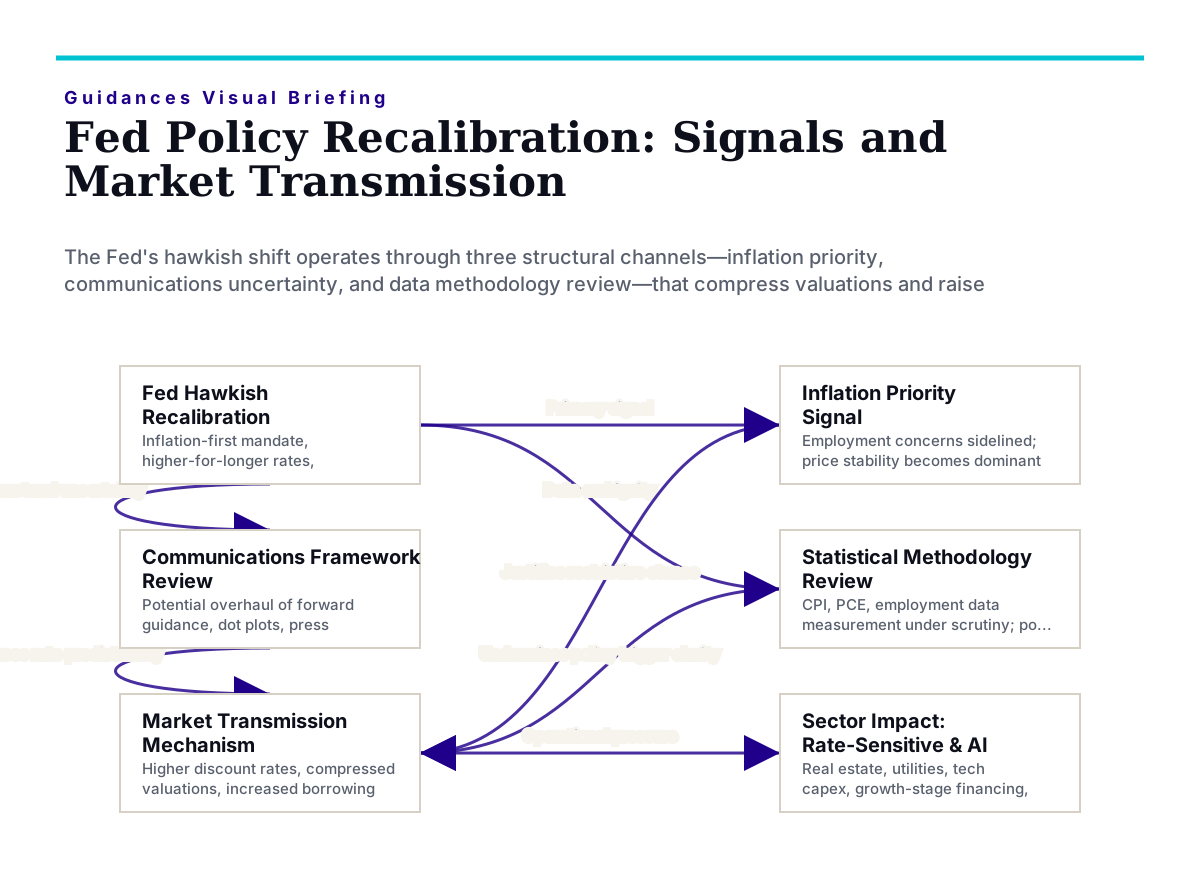
Several signals emerged from the FOMC meeting and subsequent commentary. First, Warsh said the Fed's operational focus is on inflation rather than employment. Given the Fed's dual mandate, which addresses both price stability and maximum employment, that emphasis is notable. The FOMC's assessment, as described in the snippet, is that labor markets remain stable, which may reduce one of the usual arguments for easing policy.
Second, Warsh said he would not be surprised if the Fed reviews its communications framework before year-end. The Fed's communications tools—including forward guidance, the dot plot, and press conference conventions—shape how markets interpret policy intent. Any change to that framework could alter how market participants read the rate path.
Third, Warsh flagged a review of the official statistics the Fed uses. Central banks generally rely on government-published data as inputs to policy decisions. A review of CPI construction, employment survey methodology, or GDP accounting could affect how policy is communicated and interpreted.
Bond market strategist Jeffrey Gundlach was also cited in the same context as emphasizing the Fed's inflation-first stance, alongside Ethridge's interpretation.
Why the Market Cares
The Federal Reserve's policy direction is a key variable for the cost of capital across the global economy. When the central bank signals a more restrictive stance than expected, valuations for long-duration assets, corporate borrowing costs, and return assumptions for growth investments can all be adjusted.
For technology and AI infrastructure, this is especially relevant. Data centers, GPU clusters, networking infrastructure, and power facilities are part of a capital-intensive AI buildout cycle. Hyperscalers and cloud providers have announced multi-year capex plans, and the financing cost of that capital, along with the discount rate applied to future cash flows, is sensitive to interest-rate levels.
A more restrictive Fed does not stop these programs, but it can affect the internal rate-of-return calculations used to justify them. It can also influence parts of the AI infrastructure ecosystem, including colocation providers, power utilities, and semiconductor equipment firms, where project financing depends on credit conditions.
Beyond technology, rate-sensitive sectors such as real estate, utilities, and financial services can also be affected if the Fed maintains a prolonged restrictive stance. Consumer credit costs, mortgage activity, and refinancing costs are among the areas being watched.
Technology and Policy Linkage
The potential revision of the Fed's communications framework is worth viewing through a policy-architecture lens. The current framework—forward guidance, the Summary of Economic Projections (the dot plot), and regular press conferences—has evolved over time since 2008. Any change to that structure could alter how markets form policy expectations.
For AI and technology operators, the effect is indirect but real. Uncertainty around monetary policy and regulation can affect growth-stage valuations, IPO timing, and the hurdle rate for large infrastructure commitments. If the Fed's communications become less predictable, the risk premium embedded in long-duration technology investments may also change.
The mention of a review of official statistics adds another variable. If the Fed revisits how it interprets inflation or employment data, market expectations tied to specific data thresholds may also shift.
Market Lens
Trigger: The FOMC meeting outcome and Warsh's subsequent remarks, as interpreted by market observers, suggesting a more restrictive policy stance.
Mechanism: A higher-for-longer rate environment raises the discount rate applied to future earnings, affects long-duration asset valuations, increases corporate borrowing costs, and tightens financial conditions.
Affected sectors (source-supported): Rate-sensitive sectors broadly; AI and technology infrastructure capex programs where financing costs matter; bond markets where duration risk is repriced. Specific tickers, ETFs, or index-level price moves are not supported by the available source information and are therefore excluded.
Time horizon: The communications framework review was described as a potential year-end development, suggesting a medium-term horizon for policy uncertainty. The inflation-focus signal is relevant in the near term.
Next check: The next FOMC meeting and statement; any formal announcement on communications framework changes; official CPI and PCE releases; any public remarks from Warsh elaborating on the statistical review.
This section is market context only and does not constitute investment advice.
What to Watch Next
Several developments could clarify the trajectory signaled by this FOMC meeting. Incoming inflation data—especially CPI and the Fed's preferred PCE deflator—will help indicate whether the current posture continues. Labor market data remains a secondary watchpoint; if conditions weaken, employment could again become a more important policy consideration.
Warsh's communications framework review is also important for institutional participants. If the Fed adjusts forward guidance or the dot plot, the market's ability to anticipate rate moves could change, and volatility in rate-sensitive instruments may increase during the transition.
The statistical review comment is the least specific signal. Observers should watch for formal working group announcements, academic consultations, or Congressional testimony that clarifies which data series are under review and what methodological changes may be considered.
Uncertainty and Constraints
The source for this analysis is a television segment snippet, not a full transcript or official Fed document. The descriptions of Warsh's remarks are filtered through a market commentator's interpretation. Readers should treat the specific claims—especially those about the statistical review and communications overhaul—as reported observations that require verification against official Fed transcripts, press conference recordings, or formal policy statements.