What Happened
NVIDIA's official earnings release for fiscal third quarter 2026 disclosed three headline figures that the market has been tracking closely: data center segment revenue expanded 130% compared with the same period a year earlier, gross margin reached 75%, and the company kept its full-year guidance unchanged. Management also referenced strong customer interest in Blackwell-generation systems and signaled continued momentum toward the next wave of AI infrastructure platforms.
Because this is a primary company disclosure rather than an analyst estimate or industry survey, it carries a different evidentiary weight. The numbers are auditable, the guidance is a formal commitment, and the commentary on Blackwell is attributed to management rather than to third-party speculation. That distinction matters when separating official reporting from market expectations in a sector where expectations often move ahead of results.
The broader financial context reinforces the scale of what is being reported. NVIDIA's market capitalization stands at approximately $4.74T, annual revenue has reached $215.9B, year-over-year revenue growth came in at +65.5%, and the trailing twelve-month operating margin is +64.0%. At that size, sustaining a 130% growth rate in a single segment is a notable outcome. It reflects a business that is still in the middle of a major architectural transition, where execution details — not just demand — influence the numbers.
Why the Market Cares
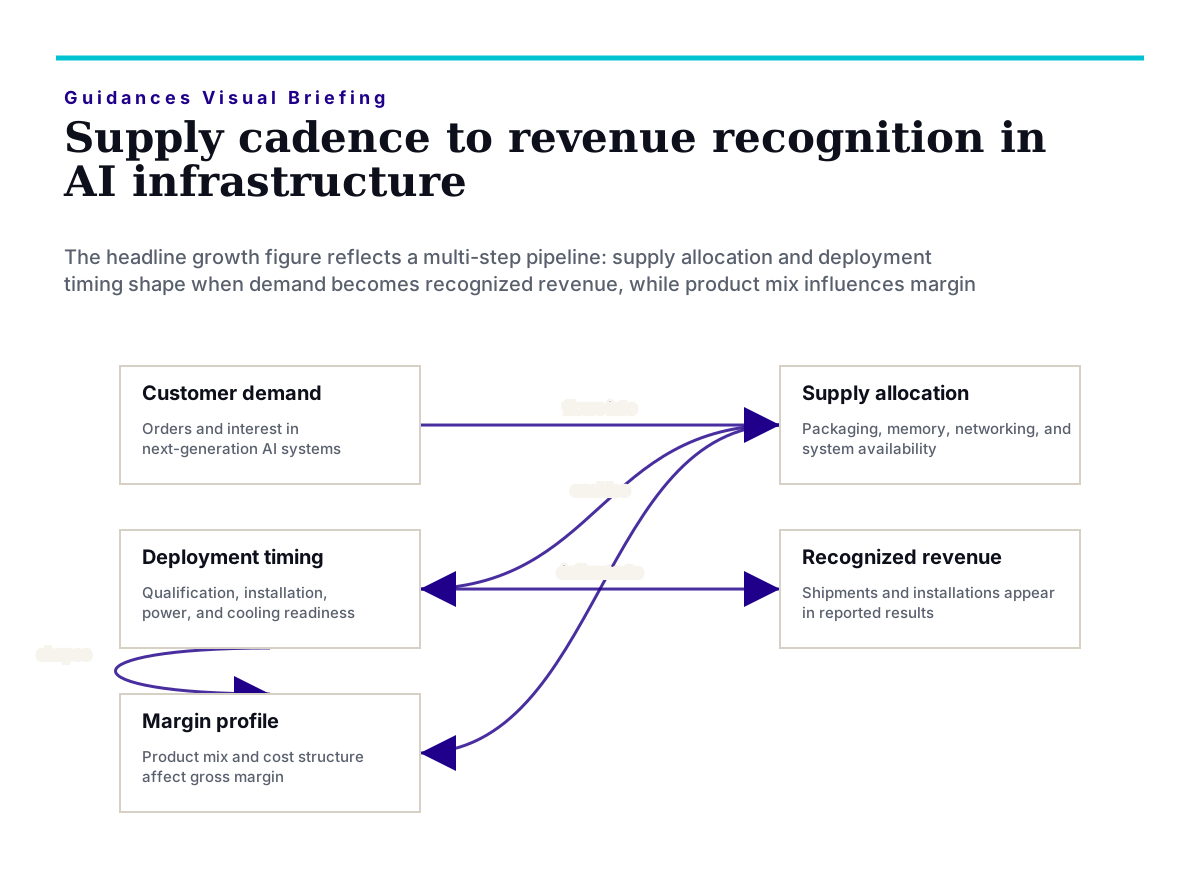
The instinctive read of a 130% data center growth figure is that AI spending remains robust. That is true, but it is also incomplete. What the market is trying to resolve is a more granular question: at what point does the pipeline of customer orders convert into recognized revenue, and what affects that conversion?
In NVIDIA's business, the answer involves several layers that sit between a purchase order and a shipped, installed, revenue-recognized system. Advanced packaging capacity, high-bandwidth memory availability, networking infrastructure, rack-level power and thermal management, software stack readiness, and customer-side qualification schedules all influence timing. A 130% growth rate indicates the conversion is happening at scale. It does not show whether the bottleneck has shifted, whether it is easing, or whether the next quarter faces a different constraint.
The 75% gross margin adds a second dimension. Margin at that level suggests that pricing power and product mix remain favorable. But in a platform ramp — where new silicon, new packaging formats, and new system architectures are all moving simultaneously — margin is not static. Component cost structures, shipment mix between different product tiers, and the relative weight of early high-margin configurations versus volume deployments can all shift the number.
The decision to maintain full-year guidance is also informative. Guidance held intact can mean two things: either demand visibility is strong enough that management is confident in the trajectory, or supply constraints are well understood enough that the company is not over-promising on volume. Distinguishing between those two interpretations requires more granular data than a snippet-level disclosure provides.
Technology and Policy Linkage
The technology mechanism behind these numbers is not reducible to a single chip. Blackwell is the product name that appears in the commentary, but the actual infrastructure story involves a full system stack. Customers deploying AI at scale are not purchasing discrete components; they are integrating compute, memory, networking, power delivery, cooling, and software orchestration into a coherent operating environment. Each of those layers has its own supply chain, qualification timeline, and deployment constraint.
This matters for understanding where growth can slow even when demand is genuine. If networking throughput becomes the binding constraint, additional GPU shipments do not immediately translate into usable capacity. If power availability at a specific data center site is limited, hardware that has been purchased may remain undeployed for a period of time. These are operational realities in large-scale AI infrastructure buildouts.
On the policy side, this earnings release does not announce a regulatory change or a new export control measure. But the AI infrastructure sector it represents is increasingly shaped by policy variables: export licensing for advanced chips, data center permitting and grid interconnection timelines, national procurement preferences, and energy policy. Large hyperscaler customers making multi-year capital commitments are doing so in an environment where those external constraints are part of the operating backdrop.
Market Lens
Trigger: NVIDIA's official fiscal Q3 2026 earnings release, disclosing 130% year-over-year data center revenue growth, a 75% gross margin, maintained full-year guidance, and management commentary on Blackwell demand and upcoming AI infrastructure platforms.
Mechanism: The operative mechanism is the conversion rate between AI infrastructure demand and recognized revenue. That rate is influenced by supply allocation across packaging, memory, and networking; customer qualification and deployment schedules; and the pace at which new platform architectures move from early shipments into volume. A high growth rate confirms the conversion is occurring; it does not confirm the rate is stable.
Affected sectors and assets: The most directly relevant sectors are semiconductors, AI server assembly, high-bandwidth memory, optical and electrical networking, data center power and cooling infrastructure, and cloud capital expenditure broadly. NVDA is the primary reference point from this source. Indirect exposure across the AI infrastructure supply chain — memory suppliers, networking equipment makers, rack integrators, power management component vendors — is plausible but remains unverified from this disclosure alone.
Time horizon: Near-term attention centers on the next quarterly reporting cycle. Medium-term, the question is whether Blackwell ramp economics — shipment mix, component costs, customer deployment pace — sustain the current margin profile. Longer-term, the durability of the growth rate depends on whether AI infrastructure capex commitments from hyperscalers and sovereign customers continue at current intensity or begin to moderate as initial buildout phases complete.
Next check: The next formal earnings checkpoint is scheduled for 2026-08-26. The consensus revenue estimate for that period, per market-data context, stands at $91.7B. That figure is the next concrete marker for assessing whether the current operating cadence is holding, accelerating, or encountering new friction. Additional SEC filings, any mid-quarter shipment commentary, and segment-level disclosures would provide earlier signals. This analysis is market context only and does not constitute investment advice.
What to Watch Next
Several specific variables deserve attention between now and the next earnings release. First, any commentary on Blackwell deployment velocity — not just order intake but actual systems moving into production at customer sites — would clarify whether the supply-to-deployment pipeline is clearing or accumulating backlog. Second, gross margin trajectory in the next quarter will indicate whether the current product mix is stable or shifting toward configurations with different cost structures. Third, the treatment of full-year guidance in the next release will reveal whether management's current outlook is being validated by actual shipment and recognition patterns.
It is also worth noting what this disclosure does not resolve. The snippet-level source does not provide product-level revenue breakdowns, geographic concentration data, or customer-specific contract structures. Those gaps mean that some of the most operationally important questions — which customer segments are driving the 130% growth, whether that growth is concentrated in a small number of hyperscaler relationships, and how the revenue profile would shift if one or two large deployments were delayed — remain open. Analysts and operators working from the full filing will have access to more granular data; the headline figures alone support a directional read but not a precise structural diagnosis.
The source publication date for this release is listed by the search provider as November 2025, but that date is unverified in the source metadata. The collected date is July 2026. Given that NVIDIA's next earnings checkpoint is August 2026 and the disclosed metrics remain the most recent official quarterly figures available in this context, the release retains analytical relevance as the current baseline for understanding the company's operating trajectory.