What Happened
The European Commission has circulated a second draft of its Code of Practice on the marking and labelling of AI-generated content, an instrument developed under Article 50 of the EU AI Act. The official source, retrieved from the Commission's digital strategy library on 25 June 2026, does not carry a machine-readable publication date for this specific draft; 25 June 2026 is the retrieval date only and should not be treated as the document's publication date. The source carries primary-official status as a Commission policy document.
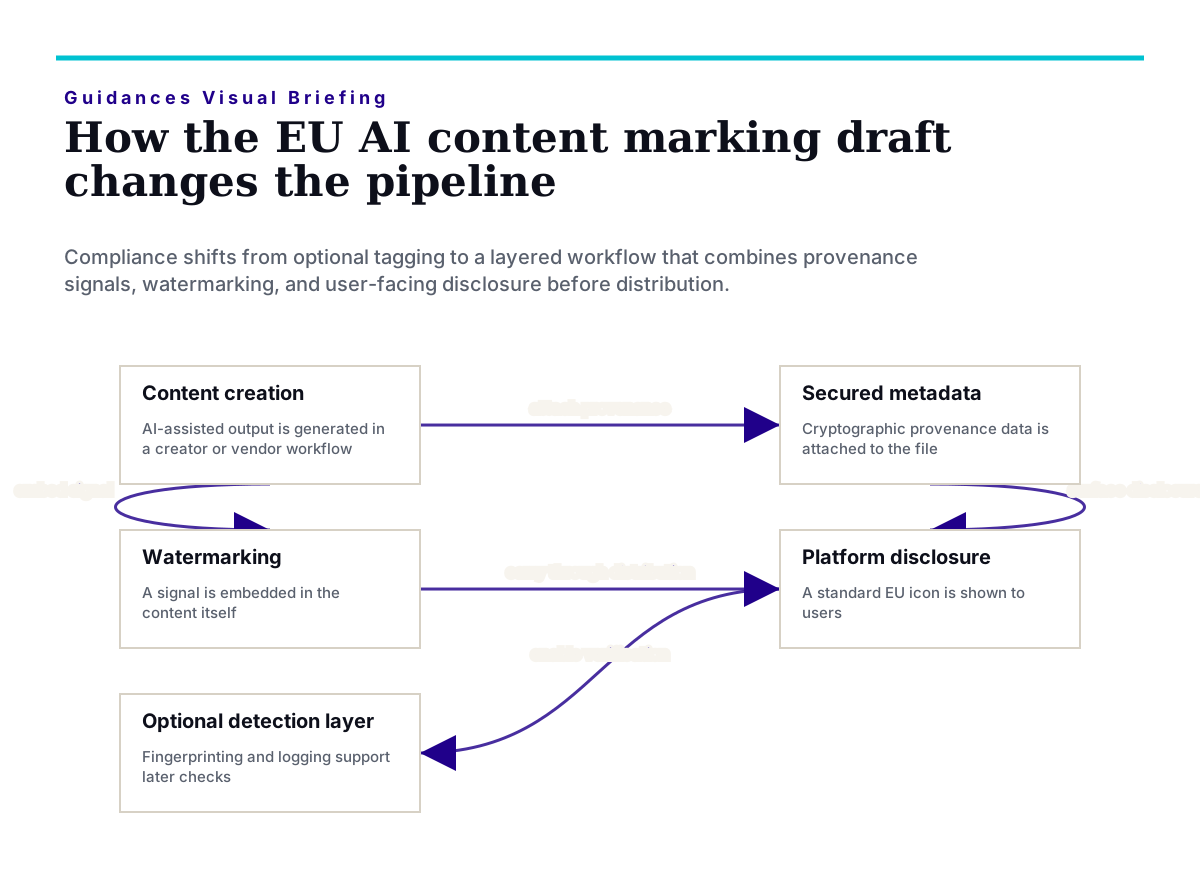
The draft's central technical commitment is a dual-layer marking architecture. The first layer combines secured metadata—cryptographically signed provenance data embedded in or associated with a file—with watermarking, a signal embedded within the content itself rather than in accompanying metadata. The second layer introduces optional fingerprinting, logging, and detection protocols. Alongside these technical requirements, the draft proposes a standardised EU icon for user-facing disclosure. The Commission has designated 2 August 2026 as the date on which these provisions become applicable, leaving operators roughly six weeks from the retrieval date to align their technical and editorial workflows.
The Code of Practice is formally a voluntary instrument, sitting alongside rather than replacing the binding obligations of the AI Act itself. However, voluntary codes in EU regulatory architecture can influence supervisory interpretation and market compliance practices.
Why the Market Cares
The AI-generated content sector has operated without a unified disclosure standard for several years. Platforms, music labels, advertising networks, news publishers, and social media companies have each developed proprietary or consortium-based approaches to content identification. The Coalition for Content Provenance and Authenticity, known as C2PA, has emerged as the most prominent open standard, but adoption has been uneven and largely voluntary.
The Commission's explicit reference to open standards and a single EU icon signals a policy direction toward a more interoperable framework. Rather than allowing each platform to define its own disclosure regime, the draft points toward a common approach. For any platform distributing content into the EU—whether a streaming service, social video platform, podcast network, or news aggregator—this creates a technical integration task with a fixed deadline.
The compliance burden is not uniform. Platforms that have already built C2PA-compatible metadata pipelines may be better positioned, though they would still need to verify that their watermarking layer meets the draft's requirements. Platforms relying on proprietary tagging systems or no tagging at all face a more substantial engineering effort. The requirement that watermarking accompany secured metadata—rather than either being sufficient alone—is the key technical constraint. Watermarking AI-generated audio, video, and image content at production scale is a non-trivial infrastructure challenge, involving decisions about signal robustness, format compatibility, and performance overhead.
For creators and rights holders, the implications cut in two directions. Standardised disclosure requirements can make AI-generated substitutes easier to identify. At the same time, creators who routinely use AI tools in their own production workflows must ensure their pipelines generate compliant provenance signals from the moment of creation. Post-hoc labelling is technically harder to implement reliably.
Tech / Policy Link
The dual-layer architecture reflects a technical judgment about the fragility of metadata in real-world distribution chains. Secured metadata, such as C2PA content credentials, is machine-readable and auditable, but it can be removed or lost during file transcoding, platform re-encoding, or format conversion. A video uploaded to a social platform, re-encoded at a lower bitrate, and then downloaded by a third party may arrive with its metadata intact or may not, depending on the platform's processing pipeline. Watermarking addresses this vulnerability by embedding a signal within the content itself, designed to survive common transformations.
The optional fingerprinting and detection protocols point toward a possible future enforcement layer. Fingerprinting allows a platform or regulator to match content against a database of known AI-generated material even when metadata has been removed or watermarks have degraded. Detection protocols suggest standardised reporting mechanisms—potentially APIs—that could be used in later compliance workflows. Whether these elements become mandatory is not confirmed by the current draft alone.
The proposed EU icon introduces a user-facing obligation that extends beyond technical infrastructure. Unlike metadata, an icon is visible to end users without any specialised tooling. This means the disclosure obligation reaches into product design and interface architecture: platforms must surface the icon in their interfaces, not merely store provenance data in file headers. The precise visual specifications—design, placement, minimum display size—are not confirmed in the available source snippet, and these details will matter significantly for implementation.
The open-standards framing also has implications for the provenance technology ecosystem. By promoting interoperable standards rather than a proprietary EU system, the Commission creates a policy environment in which existing standards bodies and watermarking technology providers may become relevant compliance infrastructure. The draft does not name specific vendors or technologies, but the direction of travel is consistent with providers whose tools are already aligned with open provenance standards.
Market Lens
Trigger: The European Commission's second-draft Code of Practice on AI content marking and labelling, with a stated applicability date of 2 August 2026, retrieved from the Commission's official digital strategy library.
Mechanism: The dual-layer marking requirement—secured metadata plus watermarking—combined with a standardised EU icon creates compliance costs and engineering requirements for any platform or AI tool provider distributing content in the EU. Platforms without open-standard provenance pipelines may need to accelerate build timelines. AI content generation tool vendors may need to adjust product specifications so outputs carry compliant signals by default. The optional fingerprinting and detection protocols could become additional elements in later drafts or implementing acts.
Affected sectors (source-supported): Synthetic media platforms; AI content generation tool providers across image, audio, video, and text; social video and streaming platforms with EU distribution; music and audio AI tool vendors; news publishers using AI-assisted content production; advertising technology companies generating AI creative assets. The open-standards orientation may also be relevant for provenance technology vendors and watermarking infrastructure providers, though no specific companies are named in the source.
Time horizon: Near-term. The 2 August 2026 applicability date is approximately six weeks from the retrieval date of this source. Platforms and tool providers that have not yet begun compliance work have a short preparation window. Because this is a Code of Practice rather than a directly binding regulation, enforcement timelines and penalty structures are not confirmed by the source snippet alone.
Next check: The finalised Code of Practice following the consultation period; any European Commission guidance on enforcement mechanisms under Article 50 of the AI Act; platform-level disclosure policy updates from major EU-facing content distributors; and any subsequent draft or implementing act that addresses whether fingerprinting and detection protocols move from optional to mandatory status.
This analysis is market context only, not investment advice.
What to Watch Next
Several open questions will determine how consequential this Code of Practice becomes in practice. The most significant is the relationship between the voluntary code and the binding obligations of Article 50. If EU supervisory authorities use the code as a reference point in compliance assessments, the voluntary label may still carry practical weight. The Commission's enforcement posture on this point has not been confirmed in the available source.
The technical specifications for the EU icon remain unconfirmed. Visual design, placement requirements, and minimum display size will all affect how platforms