What Happened
The U.S. Copyright Office has released the third installment of its multi-part examination of artificial intelligence and copyright law, with this volume focused specifically on generative AI training. The report—retrieved from the Copyright Office's official domain and classified here as a primary official source—surveys the current landscape of litigation involving AI developers and rights holders, reviews legislative proposals circulating in Congress, and synthesizes the industry debate over whether training large-scale AI models on copyrighted text, images, audio, and other creative works constitutes infringement or falls within existing fair use doctrine.
The source snippet confirms three substantive areas of analysis: the state of active lawsuits, the structure of proposed laws, and the contested question of whether AI-generated outputs can substitute for the original works used in training—a concern that sits at the intersection of copyright economics and creator livelihoods. The report's publication date has not been verified through machine-readable metadata; the document was retrieved on June 22, 2026, and should be treated as current policy context rather than a newly breaking development.
Why the Market Cares
For the technology industry, this report matters because it represents an official policy document on how the U.S. government is thinking about the legal status of AI training data. The Copyright Office is not a court and cannot issue binding rulings, but its reports can be used as reference material in legislative drafting, judicial reasoning, and regulatory guidance. When the Office highlights licensing market formation and substitutional effects, it signals the issues that future statutes or judicial decisions may need to address.
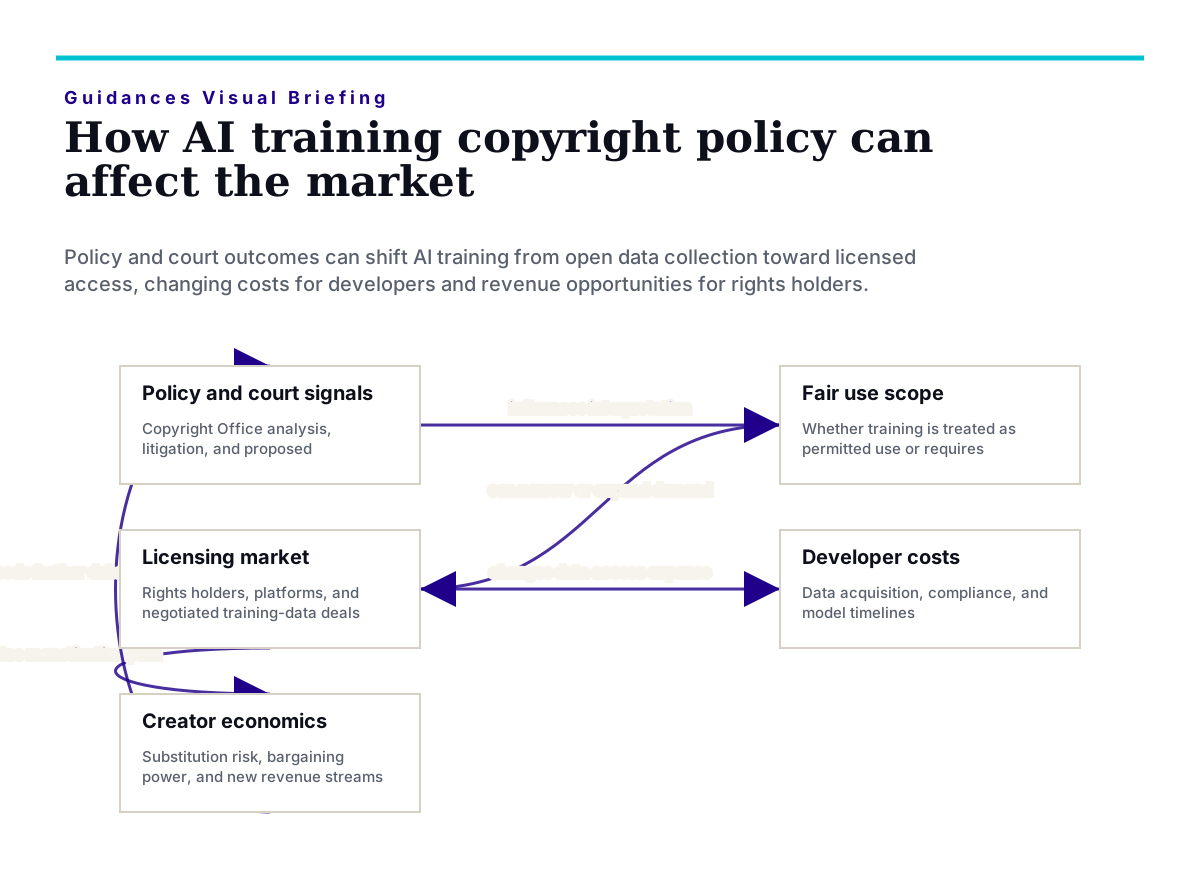
The economic stakes are substantial. Generative AI companies have built foundational models on datasets that include books, articles, music, visual art, code, and game assets. If courts or Congress determine that such training requires prior licensing, the cost structure of AI development could change. Data acquisition could move from low-cost collection of publicly accessible content toward negotiated, paid licensing. That shift could affect frontier model developers as well as downstream fine-tuning, retrieval-augmented generation, and domain-specific deployment.
The report's attention to substitutional AI output is also important from a market perspective. The substitution question asks whether an AI system trained on a creator's work can produce outputs that compete with that creator's market. If regulators or courts treat substitution as a relevant harm, the fair use defense available to AI developers could narrow, because one of the four fair use factors considers market effects on the original work.
Technology and Policy Linkage
The Copyright Office report sits within a broader global policy environment. The European Union's AI Act includes provisions on transparency for training data, and several EU member states are debating whether the text-and-data mining exceptions in the Digital Single Market Directive adequately address generative AI. In the United Kingdom, the Intellectual Property Office has conducted consultations. Japan has maintained a relatively permissive research exception, though commercial application boundaries remain under discussion.
In the United States, the legislative picture is fragmented. Multiple bills have been introduced in Congress addressing AI and copyright, but none has advanced to enactment as of the retrieval date. By cataloguing these proposals alongside the litigation record, the Copyright Office report provides Congress with a structured analytical foundation for eventual legislation. The report's framing of licensing market concerns suggests a preference for a functioning licensing infrastructure rather than blanket prohibition or blanket permission. That framing is often compared with how the music industry addressed digital streaming licensing through statutory licensing mechanisms.
For the video game and interactive media sector—one of the matched query categories for this source—the implications are particularly concrete. Game studios hold extensive libraries of character art, dialogue, music, and narrative text. AI tools that generate game assets, write dialogue, or compose adaptive soundtracks may draw on training data that includes protected game content. Guild and union contracts in the entertainment industry have begun to address AI-generated content clauses, and the Copyright Office's analysis of substitutional effects may be relevant to those negotiations.
Market Lens
Trigger: The U.S. Copyright Office's formal policy analysis of generative AI training and copyright, covering litigation, legislation, and substitutional effects for creators.
Mechanism: If the report's framing influences legislation or judicial outcomes toward a licensing requirement for AI training data, the cost structure of AI model development could shift from low-cost data acquisition toward negotiated licensing fees. This mechanism could affect capital expenditure planning, model development timelines, and the strategy of companies whose competitive position depends on proprietary or freely acquired training datasets.
Affected sectors (source-supported): Generative AI developers and their infrastructure providers; content licensing platforms and rights management companies; creative industries including publishing, music, visual arts, and interactive entertainment; legal technology firms tracking IP litigation.
Affected sectors (unverified—labeled as such): The broader semiconductor and AI infrastructure supply chain could face indirect demand-side effects if licensing costs slow model development cycles, but this link is not directly supported by the source and should be treated as speculative.
Time horizon: Policy and litigation outcomes in this domain are measured in years, not quarters. Active lawsuits are proceeding through discovery and appellate review; Congressional action on AI copyright legislation has not yet produced enacted law. The near-term market effect is primarily one of uncertainty management, with companies and market participants weighing multiple regulatory outcomes.
Next check: Congressional markup sessions or floor votes on AI copyright legislation; appellate court decisions in major AI training lawsuits; any formal Copyright Office rulemaking that follows this report; earnings calls from major AI platform companies that address data licensing costs or legal reserve disclosures.
This section is market context only and does not constitute investment advice.
What to Watch Next
Several near-term developments could clarify the trajectory established by this report. First, appellate decisions in the most prominent AI training lawsuits may further define the scope of the fair use defense. Second, if Congress moves toward markup on any of the pending AI copyright bills, the specific language around licensing requirements, safe harbors, and statutory rates will shape the practical cost impact on AI developers. Third, the Copyright Office may follow this report with formal rulemaking or additional guidance, particularly if Congress requests it as part of the legislative process.
For the creator economy, the key variable is whether a functioning licensing market actually emerges. Several rights management organizations and content platforms have already begun offering licensed training data products, suggesting that market participants are trying to monetize training data rights before legal certainty is fully established. The speed and scale at which these markets develop could influence both litigation strategy and legislative debate.
Uncertainty and Constraints
This analysis is grounded in the source snippet and the document's official status as a Copyright Office publication. The full text of the report has not been reviewed; the snippet describes the report's scope and thematic concerns but does not convey specific findings, recommendations, or conclusions. Readers should consult the primary document directly for authoritative detail. The publication date is unverified through machine-readable metadata; the document was retrieved on June 22, 2026, and its precise release date is not confirmed.
The policy outcome remains uncertain. Courts have reached different conclusions in different jurisdictions and factual contexts. Congressional action is subject to legislative calendar constraints and competing priorities. The Copyright Office's analysis is advisory rather than binding.