What happened
TSMC’s official third-quarter 2024 investor materials set out two facts that remain useful as a supply-chain reference point. First, the company said AI-related revenue rose by more than 30% from the prior quarter and reached 18% of total wafer revenue. Second, management said CoWoS advanced packaging capacity was still limited, while also outlining a plan to expand that capacity by more than two times in 2024 and to three times by the end of 2025.
The publication date attached by the search provider was October 2024, but that date has not been independently verified against the source page metadata. For that reason, it should be treated only as a soft recency hint, not as a confirmed source date. Even so, the disclosure remains relevant because it describes a capacity roadmap that extends through end-2025 and helps explain where AI chip delivery can slow down.
Why the market cares
The headline number is not the most important part of the disclosure. The more consequential point is where the bottleneck sits. AI-related revenue reaching 18% of wafer revenue shows that AI had become a meaningful part of TSMC’s mix. But the packaging note shows that the limiting step was not simply wafer output. It was the back-end process that turns advanced dies into shippable AI accelerators.
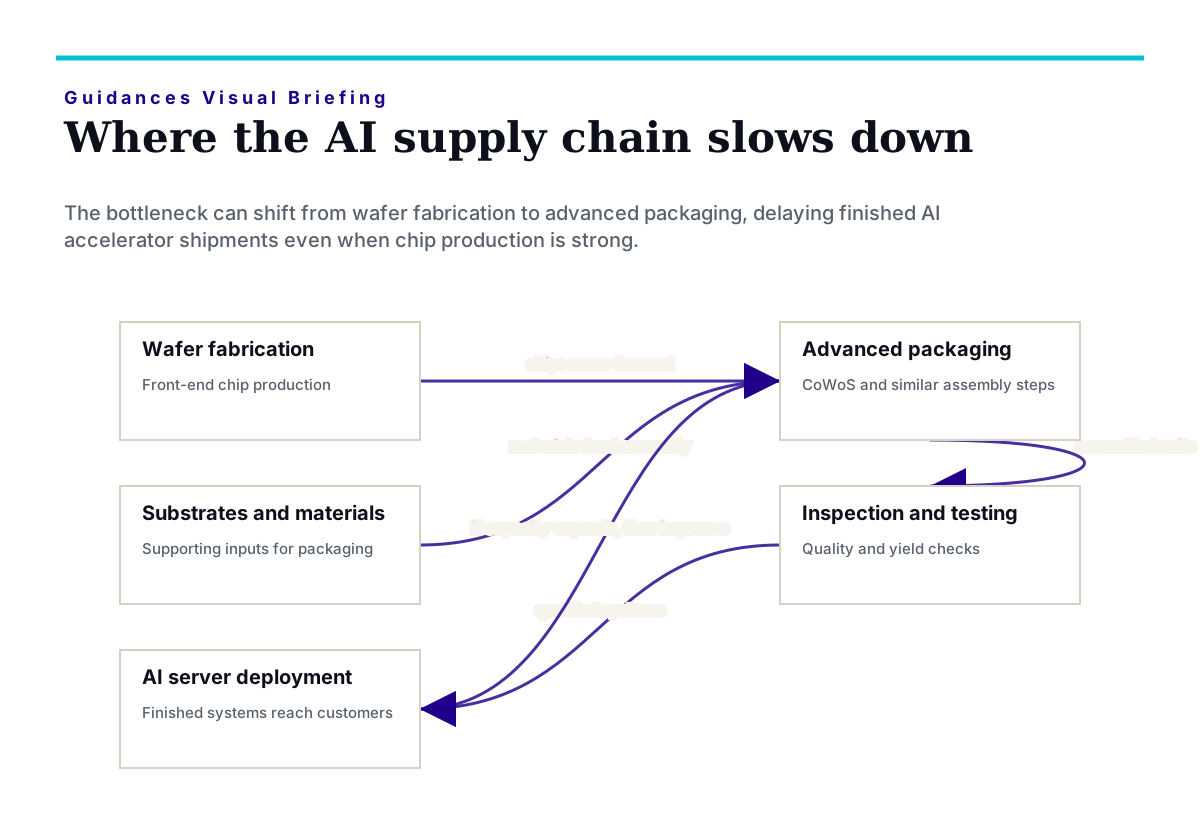
That distinction matters for operators and market readers alike. A foundry can add wafer capacity, but AI accelerators also need heterogeneous integration: chiplets, memory stacks, interposers, bonding, inspection, and substrate supply. CoWoS is one of the main industrial routes for that assembly. If packaging capacity is limited, finished accelerator shipments can lag even when front-end fabrication is available.
This is why the disclosure is still relevant. It points to a structural feature of the AI hardware cycle: the supply chain is not governed by silicon alone. It is governed by the slowest step in the chain, and in this case the slowest step was packaging.
Tech / policy link
The technology link is straightforward. AI compute systems increasingly depend on advanced packaging because performance gains now come from combining multiple dies and memory technologies rather than from a single monolithic chip. That makes packaging capacity a shared dependency across the AI ecosystem, not just a TSMC-specific operational detail.
The policy link is more cautious. Advanced packaging has become part of the broader semiconductor policy conversation because it is strategically important and geographically concentrated. The source does not show a policy change or a regulatory event. It does, however, show why policymakers and supply-chain planners pay attention to packaging capacity: if a critical step is concentrated in one region, it becomes part of the risk map for AI infrastructure.
Market Lens
Trigger: TSMC’s official Q3 2024 disclosure of AI revenue growth and a CoWoS capacity expansion roadmap.
Mechanism: When advanced packaging is constrained, AI accelerator shipments can be delayed even if wafer supply is available. That can affect customer rollout schedules, server deployment timing, and the pace at which hyperscale infrastructure converts chip demand into installed capacity. If the expansion plan is executed, the bottleneck may shift from packaging availability to customer qualification, integration, or procurement timing.
Affected assets and sectors: The direct exposure is TSMC (TSM). Secondary exposure sits with AI accelerator vendors, hyperscale cloud operators, and advanced packaging equipment and substrate suppliers. The source supports the packaging link, but it does not support a specific market reaction, ticker move, or price-based interpretation, so those links are left unverified.
Time horizon: The original roadmap ran through end-2025. The relevant question is whether that roadmap was met, delayed, or exceeded. That answer would shape AI chip supply conditions and the pace of downstream server deployment.
Next check: TSMC’s most recent official quarterly filing or presentation is the best checkpoint. Use the latest filing to verify current AI revenue mix, packaging capacity commentary, and any updated roadmap language.
This is market context only, not investment advice.
What to watch next
The first thing to verify is whether TSMC’s latest official materials still describe CoWoS as limited or whether the language has shifted to completed expansion, additional investment, or a different constraint. That wording matters because it tells readers whether packaging remains the binding step.
Second, compare the current AI revenue mix with the 18% figure from Q3 2024. The exact share will move with customer orders and product cycles, but the direction of travel is useful.
Third, watch for evidence from the broader advanced packaging supply chain. Equipment orders, substrate availability, and lead times can show whether capacity expansion is still in progress or has moved into a steadier operating phase.
Fourth, follow hyperscaler capex commentary and AI server deployment timing. If packaging constraints ease, the downstream effect should show up in how quickly customers can turn chip supply into installed infrastructure.
Uncertainty and constraints
The main limitation is age. The source is an older company disclosure, so it should not be read as a current operating update. It remains relevant because it established the mechanism: AI supply can be limited by packaging rather than by wafer fabrication. But the source alone cannot tell us the current state of CoWoS capacity.
Another limitation is that the 18% figure is a quarterly mix, not a permanent share. It reflects a specific period and can move materially as customer demand changes. The same is true of the more-than-30% sequential growth figure. It is a useful signal, but it is not a forecast.
The market-data figures are also context only. They help size the company and frame the market importance of the disclosure, but they do not justify a market call.