Finance
Developing · 0 updatesFact 9/10SpaceX Strengthens as Futures Turn Mixed, While Markets Watch Geopolitics and Central-Bank Calendars
Article language
English
A WSJ live market update pointed to SpaceX trading higher in premarket activity, mixed U.S. equity futures, lower oil, pending clarity on a U.S.-Iran memorandum of understanding, and upcoming decisions from the Bank of England and the Swiss National Bank. This article separates verified facts from open interpretation and explains why the combination matters to markets.
Open article · no sign-in required
Sources and disclosure
The article effectively uses the provided context to verify the core claims about SpaceX's premarket activity, mixed futures, lower oil, the U.S.-Iran MOU, and central bank decisions. It maintains a neutral, informational tone and explicitly avoids investment advice. The 'Market Lens' section is particularly strong in outlining triggers, mechanisms, affected assets, time horizon, and next checks while clearly marking unverified connections. The article also correctly identifies the limitations of a live market snippet for drawing strong causal conclusions, adhering to reputation safety and market-context guidelines.
Market lens
Separate infrastructure signal from investable outcome
Treat market-linked stories as context: identify the mechanism, then wait for evidence before treating it as an outcome.
Impact path
Signal first, outcome later
Signals to watch
- Primary-source guidance and filings
- Price, volume, margin, and renewal evidence
- Follow-up reporting that confirms or rejects the mechanism
Verification schedule
D+1 · Jun 17
Is the mechanism visible in primary data?
D+3 · Jun 19
Do follow-up sources confirm direction and magnitude?
D+7 · Jun 23
Did the initial read overstate the market effect?
Informational context only — not investment, legal, tax, or financial advice.
What happened
A WSJ live market update said SpaceX was trading higher in premarket activity, extending a move that would put the company on track for a third straight day of gains. At the same time, U.S. equity futures were mixed, oil prices were lower, and investors were waiting for more clarity on a memorandum of understanding involving the United States and Iran. The update also pointed to a busy week for central banks, with decisions due from the Bank of England and the Swiss National Bank.
Because this is a live coverage snippet rather than a full report, the factual base is narrow. The source does not explain what specifically drove the SpaceX move, whether it was tied to a filing, a contract, a financing event, or broader sentiment. It also does not provide the text of the U.S.-Iran memorandum, so any market interpretation must remain cautious. The most defensible reading is that several market-sensitive catalysts are converging at once: a strong single-name move, a softer oil tape, and policy events that can alter rate expectations and risk appetite.
Why the market cares
Markets care because the snippet combines three channels that often matter for equities and macro pricing even when the underlying facts are incomplete.
First, a move in a high-profile growth-linked name can influence sentiment beyond the stock itself. SpaceX is not a standard listed benchmark, but it sits at the intersection of private-market technology valuation, aerospace supply chains, satellite infrastructure, and defense-adjacent spending. When a company in that orbit rallies, investors often ask whether the move reflects idiosyncratic news or a broader re-rating of the space and communications stack. In this case, that link is not verified by the snippet; it is only a market question.
Second, lower oil prices matter because they feed into inflation expectations, transport costs, airline margins, industrial input costs, and the energy sector’s cash-flow outlook. If the decline in oil reflects a geopolitical easing narrative, the effect can extend to cyclicals and to rate-sensitive sectors through lower inflation expectations. If it reflects demand concerns, the read-through is different. The snippet does not establish which mechanism is dominant, so the market link should be treated as provisional.
Third, central-bank decisions can reprice the equity complex through the discount-rate channel. Even when the immediate policy move is small, guidance on inflation, labor markets, and the balance of risks can shift expectations for future rates. That matters for long-duration assets, including software, semiconductors, and other capital-intensive technology segments. It also matters for financials, housing, and currency-sensitive multinationals. The source only says decisions are due later in the week; it does not indicate the likely policy outcome.
Technology / policy link
The technology-policy connection here is indirect but important. SpaceX sits in a sector where private capital, government contracts, launch capacity, satellite deployment, and communications infrastructure overlap. That makes the company a useful signal for how investors are thinking about space infrastructure as an asset class, even if the specific catalyst is unknown. If the move is tied to business execution, the implications could extend to suppliers, launch services, satellite operators, and adjacent defense and telecom names. If the move is sentiment-driven, the broader read-through may be weaker.
The U.S.-Iran memorandum introduces a separate policy channel. Any shift in diplomatic posture can affect energy markets, shipping risk, insurance pricing, and the geopolitical premium embedded in oil. It can also influence defense spending expectations and the outlook for firms exposed to Middle East logistics. Yet the source does not say what the memorandum contains, whether it is binding, or whether it changes sanctions, trade, or security arrangements. Those details matter more than the headline itself.
The central-bank calendar is the clearest policy link in the snippet. The Bank of England and the Swiss National Bank can influence global rate expectations, foreign-exchange moves, and sector rotation. For technology investors, the key issue is not only the policy rate but also the tone of forward guidance. A more cautious stance can support duration-sensitive assets; a firmer inflation stance can do the opposite. That is a macro mechanism, not a prediction.
Market Lens
Trigger: SpaceX’s premarket strength, mixed U.S. futures, lower oil, pending clarity on the U.S.-Iran memorandum, and upcoming central-bank decisions.
Mechanism: A move in a prominent growth-linked name can lift sentiment toward adjacent private-market technology and aerospace themes. Lower oil can alter inflation expectations and sector margins. Central-bank decisions can shift discount rates and currency pricing. Geopolitical clarity can change the risk premium in energy and transport markets.
Affected assets / sectors: Space and satellite infrastructure, aerospace suppliers, defense-adjacent contractors, energy, airlines, transport, rate-sensitive technology, financials, and broad equity index futures. Direct effects on specific ETFs, indexes, or listed peers are unverified from the snippet alone.
Time horizon: Mostly near term, from intraday through the next several sessions. Central-bank decisions and any formal U.S.-Iran follow-up could extend the reaction window into the week. A structural re-rating of space-related assets would require additional evidence.
Next check: Central-bank statements, any official text or signing details related to the U.S.-Iran memorandum, oil and dollar follow-through, and any additional SpaceX-related disclosure or transaction data. Any stronger market linkage beyond these items should be labeled unverified until confirmed.
What to watch next
The first question is whether the SpaceX move has a company-specific catalyst or is simply part of a broader risk tone. The second is whether the oil decline persists after more details emerge on the U.S.-Iran memorandum. The third is how the Bank of England and Swiss National Bank frame inflation, growth, and financial conditions. The fourth is whether the mixed futures tape resolves into a clearer sector pattern once policy headlines are digested.
There are also important constraints. This is a live snippet, not a full report, so it does not support strong causal claims. SpaceX itself is not a conventional public-market proxy, which limits direct comparison with listed aerospace or internet names. And while the combination of geopolitics, oil, and central banks is market-relevant, the exact transmission path will depend on the details that are still missing.
This analysis is market context only, not investment advice.
Builder Implications
- Founders in space, satellite, defense-tech, and energy-adjacent infrastructure should expect headline-driven volatility to affect fundraising conversations and customer timing.
- AI and infrastructure builders should track central-bank weeks closely, because rate expectations can influence capex budgets, financing costs, and enterprise procurement cycles.
- Teams exposed to geopolitics or commodity inputs should prepare concise, evidence-based updates for investors and customers, since markets often reward clarity when the macro tape is noisy.
Want follow-up alerts? Subscribe by email after reading the public article.
Market lens
Separate infrastructure signal from investable outcome
Treat market-linked stories as context: identify the mechanism, then wait for evidence before treating it as an outcome.
Impact path
Signal first, outcome later
Signals to watch
- Primary-source guidance and filings
- Price, volume, margin, and renewal evidence
- Follow-up reporting that confirms or rejects the mechanism
Verification schedule
D+1 · Jun 17
Is the mechanism visible in primary data?
D+3 · Jun 19
Do follow-up sources confirm direction and magnitude?
D+7 · Jun 23
Did the initial read overstate the market effect?
Informational context only — not investment, legal, tax, or financial advice.
Visual Briefing
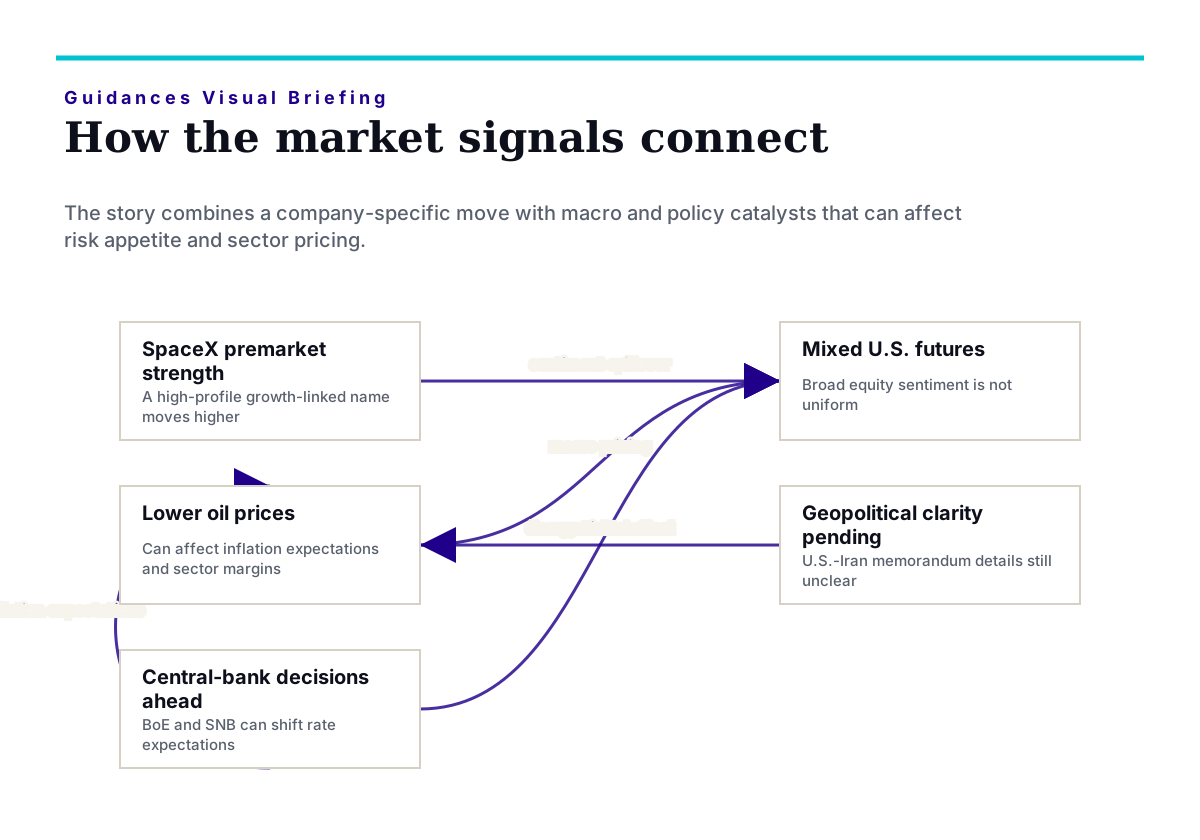
A live market update can bundle company news, commodity moves, geopolitics, and policy events into one trading narrative.
Corrections and safety
See a factual, privacy, rights, or safety issue? Review the corrections process or contact Guidances before relying on this article for important decisions.