What Happened
Several major index providers—including Nasdaq and FTSE Russell—are reported to be shortening the timeline for including large initial public offerings in benchmark indices. Under the revised approach, companies of sufficient scale could be added to major indices after as few as five trading days, a notable change from the conventional seasoning window that has historically stretched to twelve months. The development is relevant to SpaceX, the privately held aerospace and satellite-internet company, which has long been cited as one of the most anticipated potential public listings in technology and infrastructure markets. A portfolio manager at Acadian Asset Management, referenced in the source context, has publicly raised the question of whether a potential wave of large IPOs enabled by faster index inclusion could signal a new speculative phase.
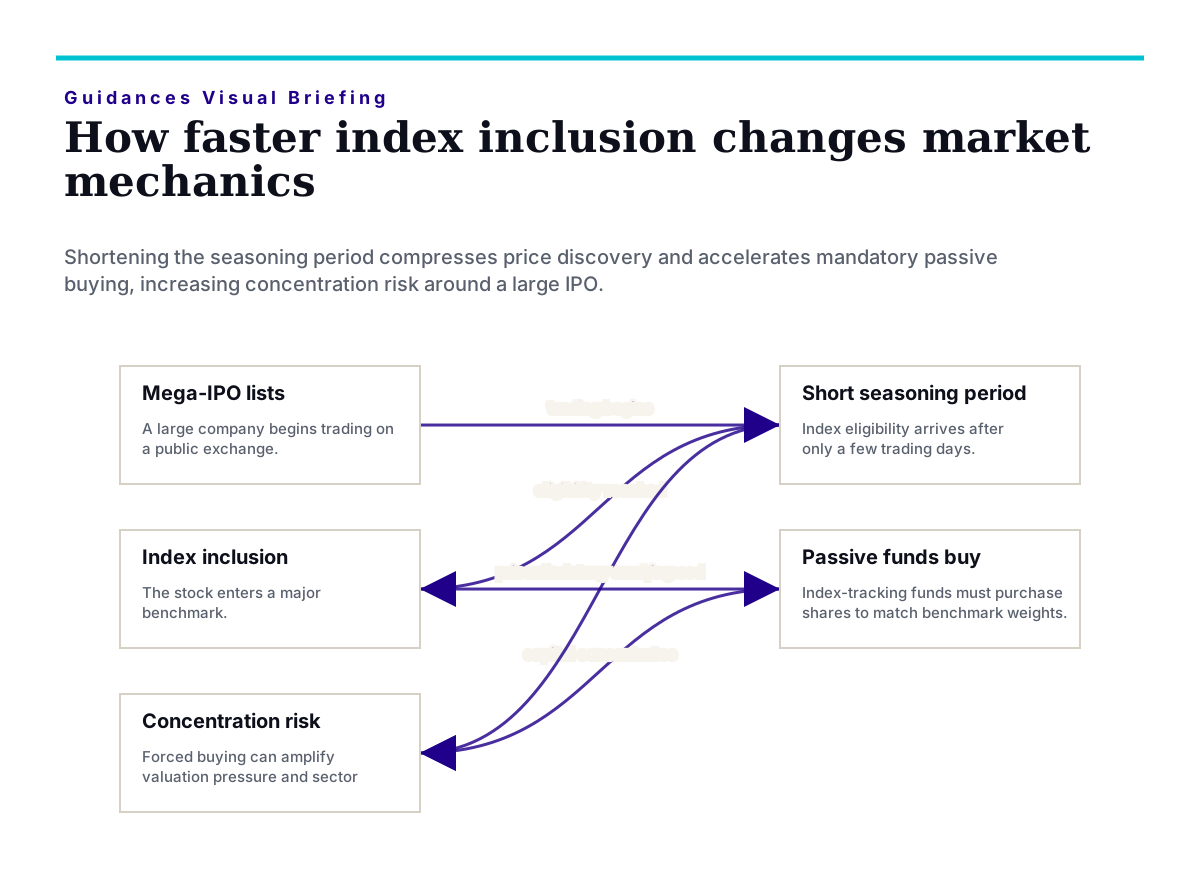
The seasoning period has served as a buffer in passive investing: it allows price discovery to develop, insider lock-up periods to expire, and financial disclosures to accumulate before index-tracking capital is required to buy shares. Compressing that window to five days could change the risk profile of passive ownership during the early stages of trading.
Why the Market Cares
The passive investing ecosystem now commands a substantial share of global equity assets. Index funds and ETFs tracking benchmarks such as the S&P 500, Russell 2000, MSCI World, and Nasdaq Composite collectively represent trillions of dollars in assets under management. When a company enters an index, funds tracking that benchmark buy shares in proportion to the company's weight.
For a company the scale of SpaceX—which has been valued in secondary markets at levels comparable to some of the largest publicly traded companies in the United States—early index inclusion could lead to rapid index-linked buying after listing. The size of that flow would depend on the assigned index weight.
The question raised by the Acadian portfolio manager is structurally relevant: if several large companies list in close succession and are quickly added to major indices, passive funds may end up holding assets with limited trading history and only a short record of public disclosures. That can shorten the period in which price discovery develops around the public valuation.
This dynamic is not unique to SpaceX. The broader IPO pipeline in technology, AI infrastructure, defense-adjacent aerospace, and satellite communications reflects the way private capital markets have supported high valuations over time. If index rule changes reduce the friction of public entry, the environment for late-stage private companies could change as well.
Technology and Policy Linkage
SpaceX sits at the intersection of commercial technology, national security infrastructure, and regulatory complexity. Its Starlink satellite internet service is used for military and emergency communications in multiple regions, and its launch services support NASA contracts and commercial satellite deployment. Those characteristics suggest that any public listing could attract review beyond the standard SEC disclosure framework.
From a technology-market perspective, SpaceX's potential index inclusion could also reweight the aerospace and defense technology segment within passive portfolios. Existing publicly traded peers in launch services, satellite communications, and space infrastructure are much smaller in market capitalization. A SpaceX listing at scale would not simply add a new name; it could alter the relative weights of an entire segment.
The index rule change also intersects with policy discussions about the governance of passive investment vehicles. Regulators in the United States and Europe have periodically examined whether the mechanical buying behavior of index funds can contribute to concentration risk, particularly when a small number of very large companies dominate benchmark weights. Accelerated IPO inclusion adds another dimension to that debate.
The competitive landscape for satellite internet already includes a major publicly traded participant. Amazon (NASDAQ: AMZN) is developing its Project Kuiper satellite constellation as a direct competitor to Starlink. Amazon reported annual revenue of approximately $717 billion and annual operating income of approximately $80 billion in its most recent fiscal year. These figures are included for sector-scale context only and do not imply a direct causal link between Amazon's financial results and any SpaceX listing outcome.
The policy dimension extends further. Index providers operate under varying degrees of oversight across jurisdictions. MSCI serves as a reference benchmark for a substantial portion of global institutional capital, and any change to its IPO inclusion methodology would have implications beyond the United States. Formal consultation processes typically precede rule changes at major index providers, and the absence of a published consultation document at this stage means the precise conditions of any accelerated inclusion remain unconfirmed.
Market Lens
Trigger: Index providers are reported to be shortening IPO seasoning periods to as few as five trading days for large listings, with SpaceX cited as a reference point in the policy discussion.
Mechanism: Shortened seasoning compresses the price-discovery window and brings forward the timing of passive-fund buying. For a mega-cap listing, that can concentrate index-linked inflows into a narrow post-IPO trading period when float is limited, lock-up periods have not expired, and financial disclosure history is short. The result is that passive funds may reflect index weight before the market has had much time to evaluate the company's public valuation.
Affected sectors and instruments: Passive equity funds and ETFs tracking Nasdaq, FTSE Russell, and MSCI benchmarks are the main structural exposure. Aerospace, satellite communications, and defense-adjacent technology sectors could be affected by a SpaceX listing. Existing publicly traded companies in adjacent segments—launch services, satellite internet, and space infrastructure—could see their relative weights change within sector indices. Amazon's Project Kuiper initiative provides a publicly observable reference point for the competitive landscape.
Time horizon: Near to medium term, contingent on SpaceX filing for a public offering. No confirmed IPO timeline has been reported in the available source metadata. The index rule change itself may precede any specific listing by months.
Next check: Monitor official announcements from Nasdaq, FTSE Russell, and MSCI regarding formal rule changes to IPO seasoning periods. Track any SpaceX S-1 or confidential IPO filing with the SEC. Watch for index provider consultation documents, which typically precede formal rule changes and invite public comment. SEC commentary on disclosure adequacy for companies entering indices before completing a full year of public financial reporting would also be a material signal.
Unverified links: Any specific price impact, index weight, or buying magnitude for a SpaceX listing is unverified at this stage. This analysis is market context only, not investment advice.
What to Watch Next
Several concrete developments would materially advance or change the analysis. First, formal rule-change announcements from Nasdaq, FTSE Russell, and MSCI would clarify the conditions under which accelerated inclusion applies, including minimum market capitalization thresholds, float requirements, and any carve-outs for companies with national security classifications. The wording of those conditions matters.
Second, any SEC response regarding disclosure adequacy for companies entering indices before a full year of public financial reporting would be significant. The SEC has historically focused on the quality and completeness of information available to investors at the time of major capital allocation events, and accelerated index inclusion creates a new category of such events.
Third, the broader IPO pipeline in AI infrastructure, defense technology, and satellite communications deserves monitoring. If multiple large private companies list within a compressed window, the cumulative effect on passive fund concentration could be more pronounced than any single listing.
Fourth, international index providers and regulators outside the United States may respond differently to the rule change. MSCI's methodology changes, for example, require formal consultation and typically attract comment from sovereign wealth funds, pension managers, and institutional allocators globally. A divergence between US and international index provider approaches could affect how companies choose their primary listing venue.
Whether accelerated index inclusion contributes to speculative excess is ultimately an empirical question. What is structurally observable now is that, if confirmed, the rule change would remove a friction that has historically served a risk-management function for passive investors.
Uncertainty and Constraints
The source metadata for this article is a snippet from a paywalled publication. The full analytical basis for the index provider decisions, the precise rule language, and the specific conditions attached to accelerated inclusion are not available in the provided context. The Acadian Asset Management portfolio manager's comments are attributed in the snippet but not quoted at length. Readers should treat this analysis as a structural framing of the reported development rather than a comprehensive account of the rule changes. All market read-throughs are analytical inferences grounded in publicly known mechanics of passive investing, not confirmed causal claims.