What Happened
On April 7, 2026, the National Institute of Standards and Technology (NIST) released a concept note outlining a new profile within its AI Risk Management Framework (AI RMF) specifically focused on trustworthy AI in critical infrastructure. The AI RMF itself is a voluntary instrument designed to help organizations consider trustworthiness factors—covering safety, security, explainability, fairness, and accountability—across the lifecycle of AI products, services, and systems, from design through deployment and ongoing evaluation.
This article is based on a source published on April 7, 2026, retrieved on June 16, 2026—approximately 75 days after publication. The source is an official NIST government page, classified as a primary official source. While it falls outside the preferred 30-day news window, the policy implications of a critical infrastructure AI profile may remain relevant for procurement decisions, enterprise product roadmaps, and regulatory positioning beyond the release date. The concept note stage also indicates that NIST is soliciting stakeholder input, so industry feedback opportunities may still be available.
Why the Market Cares
Critical infrastructure is not a narrow category. In U.S. policy terms, it encompasses sixteen sectors designated by the Department of Homeland Security, including energy, financial services, healthcare, transportation, water systems, and communications. Any AI system deployed within or adjacent to these sectors—whether for predictive maintenance, anomaly detection, automated decision support, or network optimization—may be reviewed in an environment where a NIST-aligned framework profile serves as a reference point.
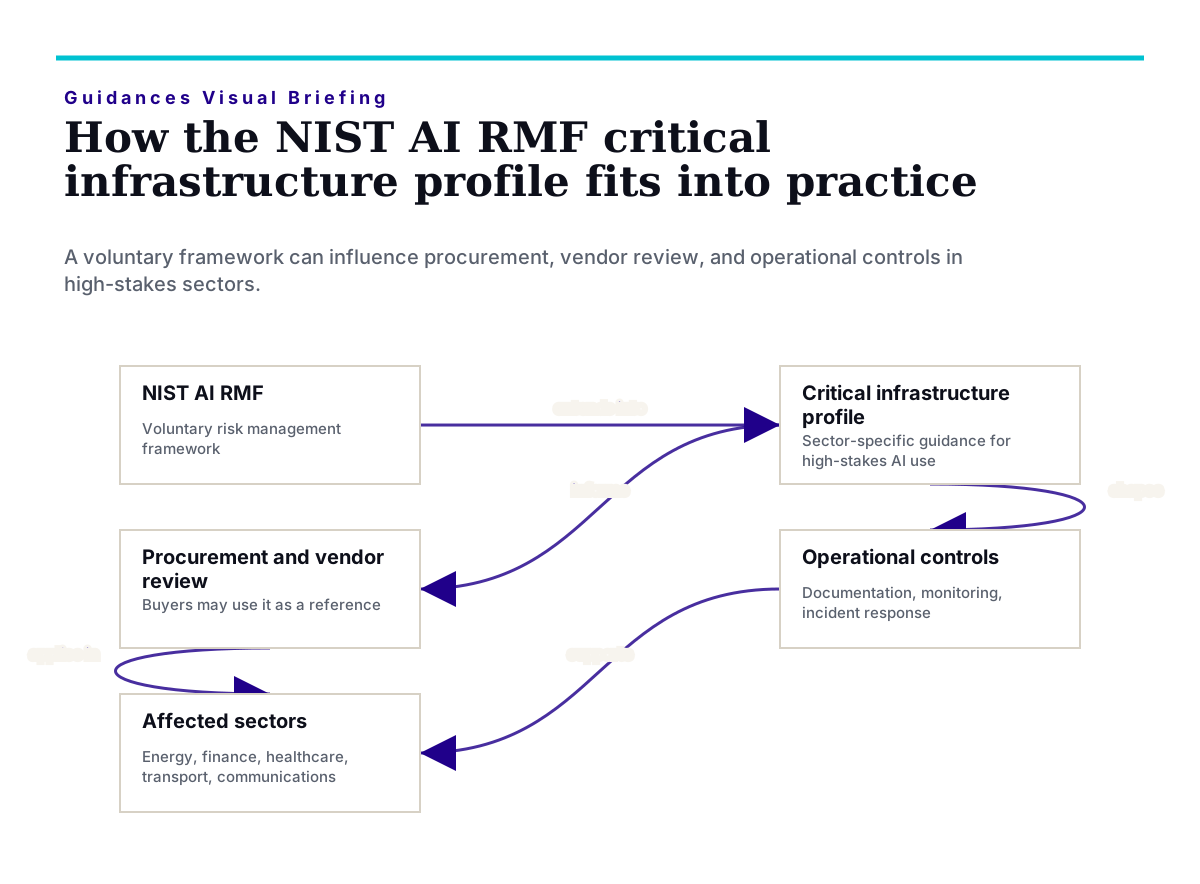
The voluntary nature of the AI RMF is frequently cited as a limitation, but it also illustrates how voluntary frameworks can connect to market requirements. Federal procurement officers may reference NIST standards in contract language. Large enterprise buyers in regulated industries may use NIST alignment as one factor in vendor review. Cyber insurance underwriting may also incorporate AI governance considerations. In these channels, a NIST critical infrastructure profile can move from optional guidance toward a practical reference standard.
For AI companies seeking government contracts, the implications are more direct. The Biden-era executive orders on AI and the subsequent Trump administration AI policy actions have both, in different ways, preserved NIST's role as a technical standards body for AI risk. A critical infrastructure profile from NIST may therefore carry weight across administrations, making it one of the more durable policy anchors in an otherwise changing regulatory environment.
Technology and Policy Linkage
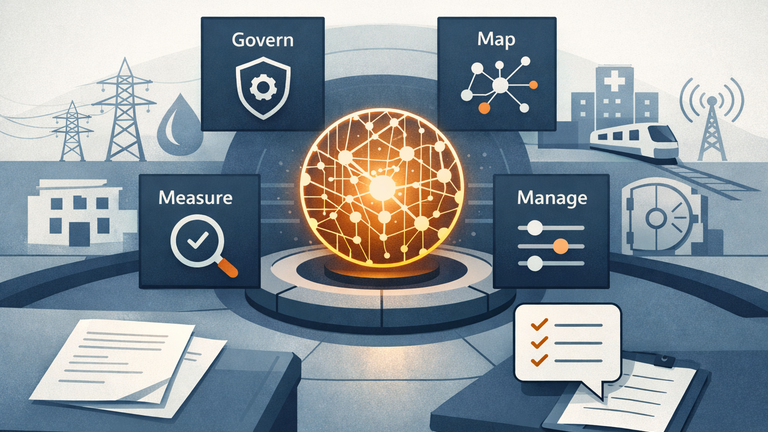
The AI RMF is structured around four core functions: Govern, Map, Measure, and Manage. The new critical infrastructure profile does not replace this architecture; it adds sector-specific guidance that translates general trustworthiness principles into the operational realities of high-stakes, often safety-critical environments.
For technology operators, the critical infrastructure profile raises several practical considerations. First, explainability requirements may become more demanding when AI outputs inform decisions about power grid load balancing, financial system integrity checks, or hospital network routing. Black-box models that perform adequately in consumer applications may face higher documentation and auditability expectations in critical infrastructure contexts. Second, the profile may address supply chain risk for AI components—a dimension that connects directly to semiconductor sourcing, cloud provider dependencies, and third-party model APIs. Third, incident response and continuous monitoring in critical infrastructure settings may require more operational preparation than general-purpose AI governance frameworks.
The concept note stage is also significant from a policy-process perspective. NIST concept notes are pre-draft instruments intended to gather structured feedback before a formal profile is written. Organizations that engage at this stage—through public comment, workshop participation, or direct stakeholder submissions—have an opportunity to shape the final document's scope, definitions, and compliance expectations. That window is time-sensitive and may narrow over time.
Market Lens
Trigger: NIST released a concept note extending the AI RMF to critical infrastructure on April 7, 2026.
Mechanism: NIST's voluntary frameworks may be used as reference points in federal procurement, enterprise vendor review, and cyber insurance underwriting. A critical infrastructure profile may help define review criteria for AI vendors operating in energy, finance, healthcare, transportation, and communications sectors.
Affected sectors and areas: Enterprise AI software vendors with government or regulated-industry exposure; cloud infrastructure providers whose platforms host critical infrastructure workloads; AI governance, risk, and compliance (GRC) tooling companies; semiconductor and hardware vendors whose products underpin critical infrastructure AI deployments. Specific tickers and ETFs are not cited here because the source does not support direct causal market linkages at this stage.
Time horizon: Medium-term, 12–24 months. The concept note must progress through NIST's drafting and public comment process before becoming a finalized profile. However, procurement and vendor review effects can begin earlier if buyers choose to reference it in advance.
Next check: Monitor NIST's AI RMF page for a formal draft profile release and associated public comment deadline. Watch for references to the critical infrastructure profile in federal agency AI procurement solicitations, particularly from DHS, DOE, and HHS. Earnings calls from enterprise AI software companies with government vertical exposure may reference NIST alignment as a competitive factor or compliance cost item.
This analysis is market context only and does not constitute investment advice.
What to Watch Next
Several near-term developments will influence how quickly the critical infrastructure profile moves from concept to operational reference. The first is NIST's own publication timeline: concept notes typically precede formal drafts by six to eighteen months, but the pace can change if stakeholder engagement is strong or if a high-profile AI incident in critical infrastructure increases pressure for faster action.
The second is the legislative environment. Congressional interest in AI regulation for critical infrastructure has been bipartisan, with proposals ranging from mandatory incident reporting to sector-specific licensing. A finalized NIST profile could serve as a technical reference point for such legislation.
The third is international alignment. The European Union's AI Act explicitly designates certain critical infrastructure applications as high-risk, triggering mandatory conformity assessments. If NIST's critical infrastructure profile converges with EU AI Act requirements—even partially—it could inform compliance planning for companies operating in both markets.
Uncertainty and Constraints
The source is a snippet from an official NIST government page, not the full concept note text. The specific technical requirements, sector scope, and compliance expectations within the profile are not available from the snippet alone. Analysis here is therefore grounded in the AI RMF's publicly known structure, NIST's established policy process, and the general regulatory dynamics of critical infrastructure AI governance. Readers should consult the full NIST concept note directly for authoritative detail.
Additionally, the voluntary nature of the framework means that market impact is indirect and depends on how quickly procurement officers, enterprise buyers, and insurers incorporate the profile into their requirements. That translation process may vary across sectors and geographies.