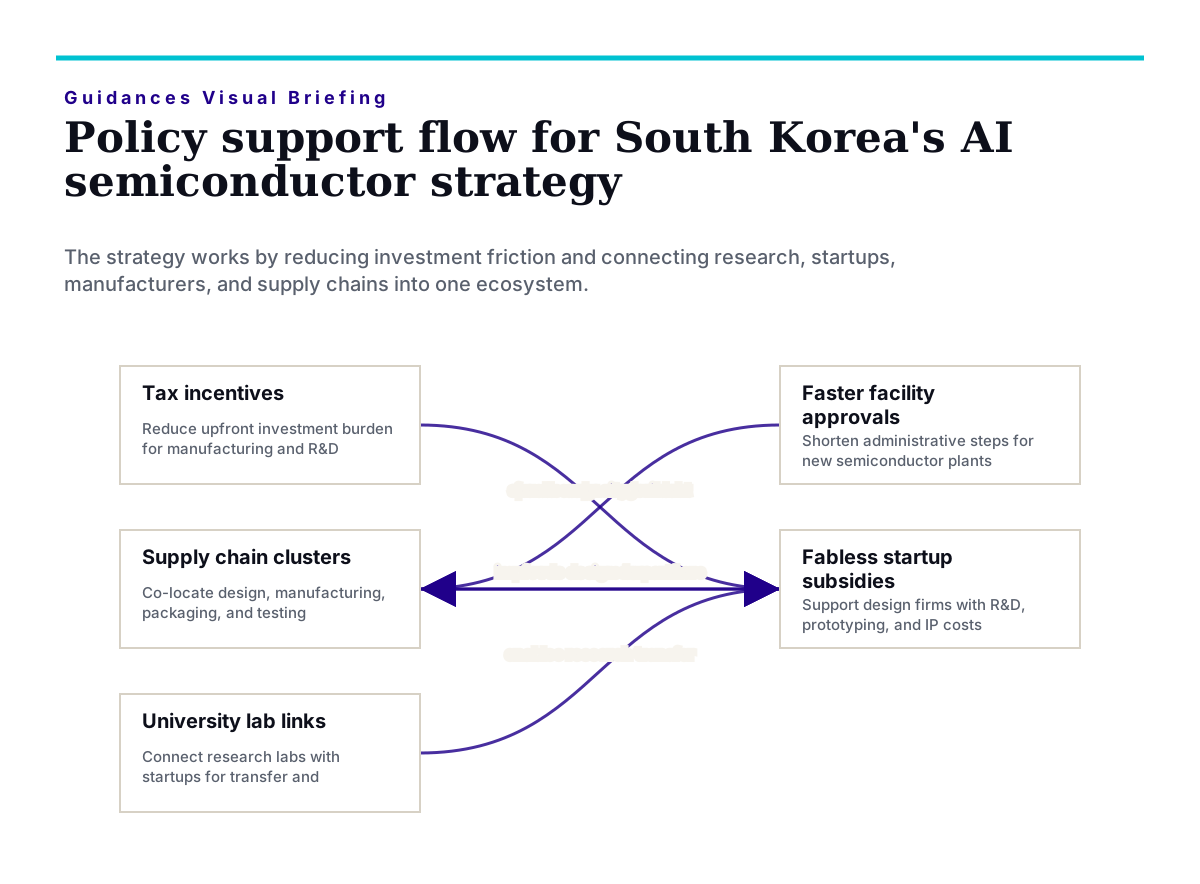
The South Korean government is pursuing a multi-layered support framework to strengthen global competitiveness in the artificial intelligence (AI) semiconductor industry. This strategy comprises policies spanning the industrial lifecycle—including tax incentives, regulatory streamlining, supply chain integration, startup support, and industry-academia collaboration—and reflects a commitment to expand the country's semiconductor manufacturing capabilities for the AI era.
Tax Incentives and Expedited Facility Approvals
A cornerstone of the policy is tax support. The government is offering tax deductions for semiconductor manufacturing and research and development (R&D) investments, encouraging companies to expand AI semiconductor production capacity and advance technological development. These tax benefits help reduce the initial capital burden inherent to the capital-intensive semiconductor industry and can support long-term technology investment.
Simultaneously, the government has implemented measures to shorten the approval process for semiconductor manufacturing facilities. Previously, facility construction required multiple administrative stages—environmental assessments, building permits, and power supply contracts—but the transition to an integrated review system now enables companies to respond more rapidly to market shifts. This is a factor that may help Korean firms secure production capacity amid global semiconductor supply chain realignment.
Supply Chain Cluster Support and Ecosystem Integration
The South Korean government is pursuing a cluster strategy that increases efficiency and collaboration through geographic concentration of the semiconductor supply chain. This strategy operates by concentrating companies across the value chain—design, manufacturing, packaging, and testing—in specific regions and providing shared infrastructure and logistics networks. Within clusters, inter-company technology exchange and joint research are supported, and supply chain management and quality control become more feasible.
Cluster support extends beyond physical concentration, focusing on building a collaborative ecosystem between materials, components, and equipment (MCE) firms and large-scale manufacturers. The government provides matching programs and funding to enable small and medium-sized enterprises (SMEs) within clusters to participate in technology collaboration and joint development projects with major corporations.
Fabless Startup Subsidies and Entrepreneurial Ecosystem Support
Direct subsidy support for fabless startups—AI semiconductor design specialists—is another key component of the strategy. Fabless companies adopt a business model focused on design and development without manufacturing facilities, and they develop specialized semiconductor solutions such as AI accelerators, neural network processors, and edge computing chips. The government supports these companies with R&D costs, prototype production expenses, and intellectual property filing fees.
Alongside subsidies, the government operates intermediary platforms and technology validation programs to facilitate collaboration between fabless startups and global foundries (contract manufacturers) as well as domestic manufacturers. This enables startups to conduct design verification, mass production testing, and quality certification more efficiently, shortening time to market.
University Lab and Startup Linkage Programs
The South Korean government is expanding industry-academia collaboration programs to combine the fundamental research capabilities of university labs with the commercialization abilities of startups. These programs support joint research projects between university semiconductor labs and emerging companies, and are structured to promote technology transfer and licensing of research outcomes. University labs provide accumulated knowledge in advanced technology areas such as AI algorithm optimization, low-power circuit design, and novel material applications to startups, which then apply this knowledge to product development and market validation.
To encourage such collaboration, the government provides joint research funding, personnel exchange programs, and support for joint laboratory operations. It is also expanding institutional flexibility to allow university researchers to participate directly in startup founding or serve as technical advisors.
Global Competitive Environment and Policy Context
This South Korean strategy is being pursued in a global environment where major countries and regions—including the United States, China, Japan, and the European Union—are expanding large-scale investments and policy support to secure semiconductor self-sufficiency and strengthen technological capabilities. AI semiconductors, in particular, have emerged as core components of strategic industries such as data centers, autonomous driving, robotics, and defense, prompting governments to approach domestic firms' competitiveness from national security and economic security perspectives.
South Korea has strong manufacturing capabilities in memory semiconductors, but its market share in AI accelerators and system semiconductors remains relatively lower compared to U.S. and Taiwanese firms. This policy aims to narrow that gap and strengthen the position of Korean companies in the global AI semiconductor market by building an integrated ecosystem spanning design, manufacturing, and packaging.
Uncertainty and Implementation Considerations
The effectiveness of this strategy depends on policy execution consistency and private sector participation. For tax incentives and subsidies to translate into actual corporate investment, regulatory adjustments and administrative streamlining must be tangible at the operational level, and cluster formation and supply chain integration may not yield visible results in the short term. Additionally, for collaboration between university labs and startups to result in substantive technology transfer and commercialization, institutional details such as intellectual property management, revenue sharing, and workforce mobility must be clearly established.
In a context of ongoing global supply chain realignment and geopolitical tension, the extent to which this South Korean strategy can enhance the structural competitiveness of the domestic semiconductor industry will be assessed through policy execution and market response over the coming years.