Policy
Developing · 1 updateFact 10/10OECD Assesses AI's Dual Impact: Productivity Gains Alongside Automation and Bias Risks
Article language
English
The Organisation for Economic Co-operation and Development (OECD) has assessed that artificial intelligence can raise productivity, improve job quality, and strengthen occupational safety and health, while also presenting risks including automation-related job changes, reduced worker agency, algorithmic bias, privacy concerns, and limited transparency. The evaluation reflects the international body's position that the complex labor-market effects of AI require balanced policy management.
Open article · no sign-in required
Sources and disclosure
All key factual claims in the article are directly and strongly supported by the provided web-search context. The article accurately reflects the OECD's assessment of AI's dual impact on the labor market, outlining both potential benefits and associated risks, as well as the organization's stance on policy management. The language used is neutral and adheres to reputation safety guidelines.
Market lens
AI governance becomes an operating checklist buyers can audit
The market effect depends on whether policy language turns into required logs, evaluations, incident-response records, and launch gates.
Impact path
Policy memo → ops checklist
Signals to watch
- Draft rules specifying retention or audit evidence
- Enterprise RFPs requiring AI operation logs
- Product launches centered on governance workflows
Verification schedule
D+1 · Jun 15
Do rules move from principles into required artifacts?
D+3 · Jun 17
Do RFPs ask for evidence before model benchmarks?
D+7 · Jun 21
Do vendors ship audit workflows as core product?
Informational context only — not investment, legal, tax, or financial advice.
The Organisation for Economic Co-operation and Development (OECD) has issued a comprehensive assessment of artificial intelligence's impact on labor markets, identifying both positive effects—such as productivity gains, improved job quality, and enhanced occupational safety and health—and a range of risks including automation-related job changes, reduced worker agency, algorithmic bias, privacy concerns, and limited transparency. The evaluation forms part of the OECD's ongoing policy analysis on the future of work, aimed at member-state governments and policymakers, and underscores the international body's position that the complex labor-market effects of AI require balanced and proactive policy management.
The OECD recognizes AI's potential to raise productivity by automating repetitive and data-intensive tasks, thereby enabling workers to focus on more creative and strategic activities. Improvements in job quality may arise when AI-based tools support worker decision-making, reduce workload burdens, and expand access to training and upskilling opportunities. In the realm of occupational safety and health, AI systems capable of monitoring hazardous work environments and predicting accidents can contribute to safer workplaces. These benefits reflect the technology's capacity to augment human capabilities and improve working conditions when deployed thoughtfully.
However, the OECD identifies several risk factors that accompany AI adoption. First, automation-related job changes may affect employment in specific occupations and industries, potentially accelerating structural shifts in labor markets. Second, reduced worker agency can emerge when AI systems dominate workflow and decision-making processes, leaving workers with less control over their tasks and relying more heavily on algorithmically determined instructions. Third, algorithmic bias can entrench or amplify discrimination in hiring, performance evaluation, promotion, and other human-resource functions, disproportionately affecting certain demographic groups. Fourth, privacy concerns may arise as AI systems collect and analyze extensive data on worker behavior, performance, and health. Fifth, limited transparency in AI decision-making processes can make it difficult for workers to understand or challenge decisions that affect their employment and livelihoods.
The OECD's assessment signals that the labor-market impact of AI is neither uniformly positive nor negative, but contingent on policy design and governance frameworks. The organization has long advocated for member governments to proactively manage labor-market transitions driven by AI, balancing worker protection with technological innovation through robust policy frameworks. This analysis is expected to serve as foundational evidence for such policy directions.
International discourse on AI and labor has expanded rapidly in recent years. The International Labour Organization (ILO) and the European Union are also evaluating AI's labor-market effects and developing norms and guidelines to protect worker rights. The OECD's assessment contributes to this broader international dialogue by systematically outlining the key issues that policymakers and enterprises must consider when deploying AI.
The labor-market impact of AI is likely to vary significantly across industries and occupations. In manufacturing and logistics, automation-related job changes may be more pronounced, whereas in healthcare, education, and creative industries, AI is more likely to augment worker capabilities and enhance productivity. This heterogeneity suggests that policy responses must be tailored to the characteristics of specific sectors and job functions.
The OECD has emphasized that the rapid pace of AI development and its wide-ranging effects require policy authorities to continuously collect and analyze labor-market data and to adjust regulations and support measures swiftly as needed. The current assessment provides an analytical framework to underpin such policy responses.
Empirical research on AI's labor-market impact remains at an early stage, and long-term effects are difficult to predict with precision. The OECD's evaluation synthesizes accumulated research findings and member-state policy experience, but further analysis and policy adjustments will be necessary as technology and labor markets evolve.
The assessment also highlights the importance of transparency and accountability in AI systems used in workplace settings. When workers cannot understand how algorithmic decisions are made, their ability to contest outcomes or seek redress is reduced. This concern is particularly relevant in contexts where AI systems influence hiring, task assignment, performance monitoring, and termination decisions. The OECD's emphasis on transparency aligns with broader regulatory trends in member states, where explainability and auditability of AI systems are increasingly seen as important considerations for deployment.
From a policy perspective, the OECD's dual framing—acknowledging both opportunities and risks—reflects a pragmatic stance. It avoids technological determinism, recognizing that outcomes depend on choices made by governments, employers, and technology developers. This framing is intended to guide policymakers toward interventions that maximize AI's benefits while mitigating its risks, such as investing in worker retraining, strengthening social safety nets, enforcing anti-discrimination laws, and mandating transparency in algorithmic management.
For technology developers and enterprises deploying AI in workplace contexts, the OECD's assessment serves as a signal that regulatory scrutiny and stakeholder expectations around labor impacts are intensifying. Companies that proactively address concerns related to worker agency, bias, privacy, and transparency are likely to face fewer regulatory obstacles and enjoy greater market acceptance. Those that do not address these issues may encounter reputational risk, legal challenges, and resistance from workers and labor organizations.
The OECD's analysis also underscores the need for multi-stakeholder dialogue. Effective governance of AI in the workplace requires input from governments, employers, workers, trade unions, technology providers, and civil society. Such dialogue can help identify context-specific risks, develop practical safeguards, and ensure that AI deployment aligns with societal values and labor standards.
In summary, the OECD's assessment provides a balanced and evidence-informed perspective on AI's labor-market implications. It acknowledges the technology's potential to enhance productivity, job quality, and safety, while clearly delineating the risks of automation, reduced agency, bias, privacy concerns, and opacity. This dual perspective is intended to inform policy development and corporate strategy, ensuring that AI's integration into the workplace proceeds in a manner that is economically beneficial and socially responsible.
Builder Implications
- AI product development must incorporate worker agency, algorithmic transparency, and bias-mitigation mechanisms from the outset, as these are important not only for regulatory compliance but also for earning the trust of enterprise customers and end users.
- Including labor-market impact assessments in product roadmaps, transparently discussing automation-related job changes with clients, and proposing linkages to retraining and transition support programs can enhance long-term market acceptance.
- Establishing clear data governance frameworks and consent procedures for worker data collection and use, along with explainability features, helps align with OECD member-state policy priorities and strengthens product differentiation in regulated markets.
Want follow-up alerts? Subscribe by email after reading the public article.
Market lens
AI governance becomes an operating checklist buyers can audit
The market effect depends on whether policy language turns into required logs, evaluations, incident-response records, and launch gates.
Impact path
Policy memo → ops checklist
Signals to watch
- Draft rules specifying retention or audit evidence
- Enterprise RFPs requiring AI operation logs
- Product launches centered on governance workflows
Verification schedule
D+1 · Jun 15
Do rules move from principles into required artifacts?
D+3 · Jun 17
Do RFPs ask for evidence before model benchmarks?
D+7 · Jun 21
Do vendors ship audit workflows as core product?
Informational context only — not investment, legal, tax, or financial advice.
Visual Briefing
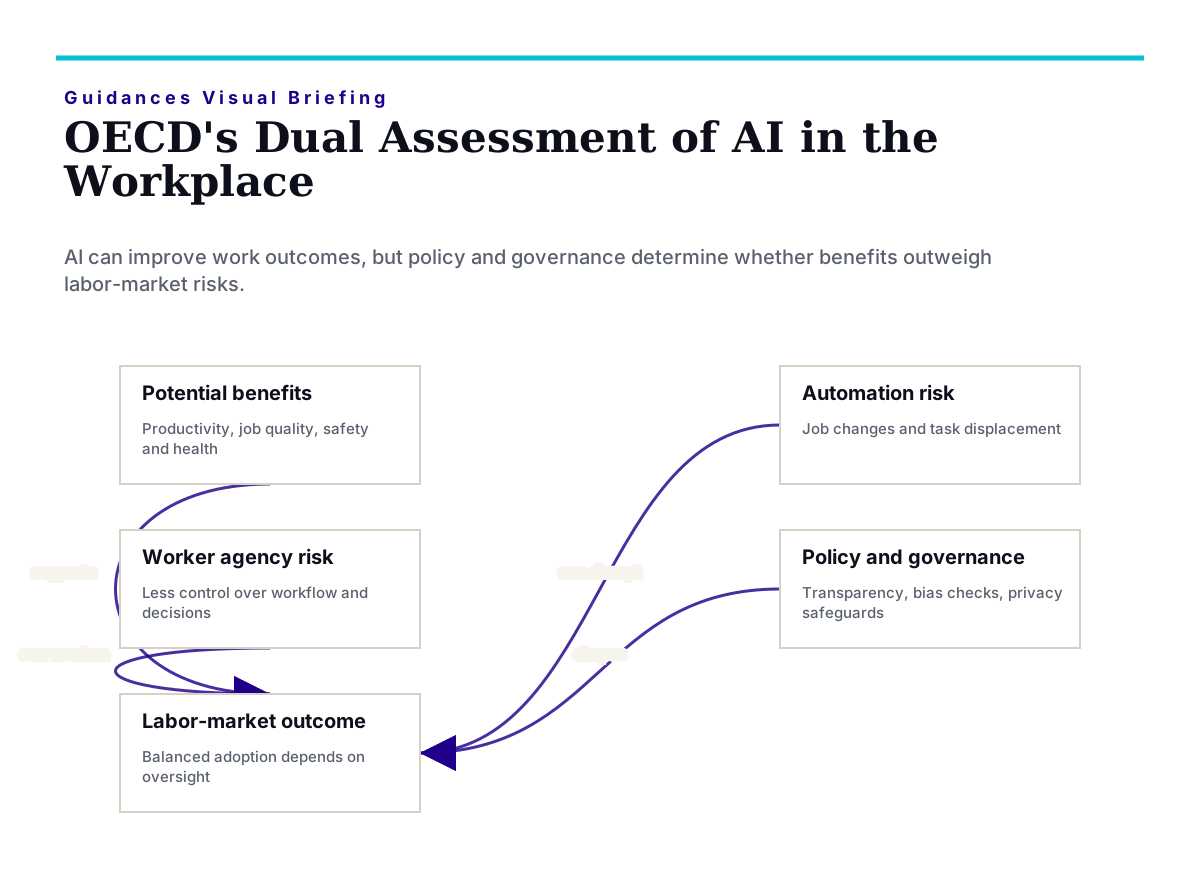
A simple policy map showing how AI's workplace benefits and risks converge on labor-market outcomes.
Corrections and safety
See a factual, privacy, rights, or safety issue? Review the corrections process or contact Guidances before relying on this article for important decisions.