What happened
A CNBC video snippet says Meta is now one year into the AI leadership bet associated with Alexandr Wang, yet the company still faces a familiar set of execution questions. According to the snippet, Meta has introduced its first proprietary AI model, Muse Spark, but remains behind OpenAI, Anthropic, and Google in the competitive landscape. It also says developer participation has been limited, morale has weakened after broad layoffs, and changes to trust-and-safety functions have drawn attention. The central business question, as framed in the snippet, is whether Meta can turn AI into revenue beyond advertising.
Because the available material is only a short snippet and a headline, this should be treated as a cautious market read rather than a substitute for the original report. There is no verified detail here on model benchmarks, user growth, revenue contribution, or internal metrics. The most responsible interpretation is that Meta is being judged not on AI ambition alone, but on whether that ambition can be translated into measurable product traction and monetization.
Why the market cares
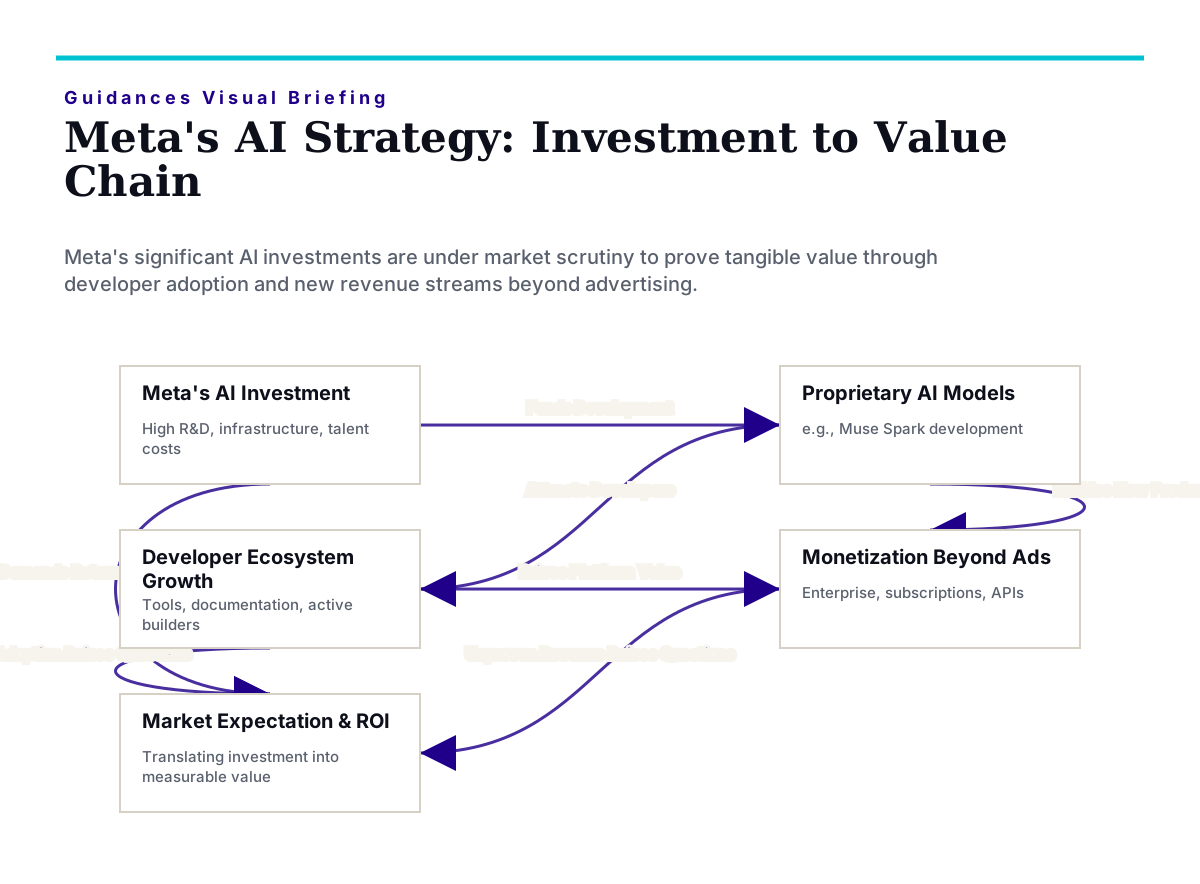
For public markets, Meta’s AI story is not simply about technology leadership. It is about capital allocation. Large AI programs consume research spending, infrastructure outlays, talent costs, and integration work across product lines. Investors generally want to know whether those costs improve the economics of the core advertising business, create new recurring revenue streams, or both. The snippet points directly at the harder second question: can AI generate real revenue beyond ads?
That matters because Meta is still widely understood as an advertising-led platform. In such a model, AI can serve two different financial roles. First, it can improve ad targeting, ranking, and conversion efficiency, which supports the existing cash engine. Second, it can become a new product layer with enterprise, developer, or subscription-like monetization. The snippet suggests the second path remains unproven. If that is the case, the market may continue to treat AI spending as a cost center until management shows a clearer revenue bridge.
The developer participation issue is also important. In platform markets, the value of a model is not only its raw capability. It is also the surrounding ecosystem: tools, documentation, reliability, integration ease, and the willingness of developers to build on top of it. If developer participation remains limited, the platform may struggle to create the network effects that often justify large AI investments. That is a business problem as much as a technical one.
Tech / policy link
Technically, the snippet highlights three linked challenges: model competitiveness, ecosystem pull, and operational trust. A proprietary model can exist without becoming a meaningful platform if it does not attract builders or fit cleanly into workflows. In AI markets, the gap between “we have a model” and “the market is building on it” can be large. That gap often determines whether a company can move from internal experimentation to external monetization.
The snippet also mentions layoffs and trust-and-safety changes. On their own, those are operational facts, not conclusions. But they matter because enterprise buyers, developers, and regulators tend to watch whether AI products are supported by stable governance, predictable controls, and clear product stewardship. A platform that is perceived as changing too quickly can face slower adoption, even if the underlying model is competitive. That is especially true when AI is being positioned for broader commercial use.
Policy risk is present in the background, although the snippet does not identify any specific rule or deadline. For large AI platforms, the policy environment can affect data use, model deployment, content handling, and platform responsibility. None of those effects can be inferred directly from this snippet, so any policy linkage should be treated as general context only, not as a verified catalyst.
Market Lens
Trigger: CNBC’s snippet frames a one-year checkpoint for Meta’s AI leadership effort and emphasizes the gap between investment and visible commercial traction.
Mechanism: Markets typically translate AI spending into valuation through a simple chain: higher capex and operating expense must eventually produce either stronger core monetization or a new revenue line. If developer participation is limited, the mechanism from model launch to ecosystem growth is impaired. If trust and safety functions are changed, some buyers may wait for clearer governance signals before committing. These are plausible mechanisms, but the exact financial effect is unverified from the snippet alone.
Affected sectors / companies / indexes: Meta is the direct company in view. Indirectly, the story touches AI infrastructure, cloud, semiconductor demand, and the broader large-cap technology complex. It may also matter for software platforms competing for developer mindshare. Any specific ETF or index reaction is unverified because the source does not provide market data or a confirmed price move.
Time horizon: The relevant horizon is medium term, not intraday. The next few earnings cycles, product updates, and capex disclosures are more likely to matter than a single news cycle. If Meta can show AI-driven ad efficiency or a clearer non-ad revenue path, the market read could change over quarters rather than days.
Next check: Watch Meta earnings, capex guidance, commentary on AI monetization, developer participation metrics if disclosed, and any product updates tied to Muse Spark or related models. Those are the concrete checks that can validate or weaken the current narrative. Until then, any direct market impact should be labeled unverified.
What to watch next
The most important question is whether Meta can present AI as a measurable business system rather than a strategic aspiration. That means evidence in three areas: product usage, revenue contribution, and developer participation. If AI is only described as an internal capability, the market may continue to view it as an expensive support function for the ad business. If management can show that AI is improving monetization or opening a new commercial channel, the narrative becomes more durable.
A second issue is organizational stability. The snippet suggests morale and trust concerns after layoffs and trust-and-safety changes. Those are sensitive operational signals because AI products depend on fast iteration, but also on dependable execution. A company can move quickly and still lose adoption if builders do not trust the platform to remain stable, well-documented, and commercially supported.
A third issue is competitive positioning. The snippet says Meta remains behind OpenAI, Anthropic, and Google. That is a relative statement, not a quantified one, but it matters because AI markets often reward perceived leadership with developer attention and partner interest. If Meta cannot narrow that gap, the company may still benefit from AI internally without fully capturing the broader platform economics that investors often look for.
Uncertainty and constraints
This analysis is necessarily limited by the source format. The available material is a headline and a short snippet from a CNBC video page, not the full report. That means there is no verified detail on model quality, user adoption, revenue, or internal metrics. It also means the later text in the snippet about SpaceX appears to be unrelated page content or recommendation material, not part of the Meta story. It should not be folded into the analysis of Meta’s AI strategy.
Accordingly, this article should be read as market context only, not investment advice. It is also not a product endorsement or a judgment on any company’s capabilities. The only defensible conclusion from the snippet is that Meta’s AI program is now being judged on execution, monetization, and ecosystem traction rather than on investment size alone.