What Happened
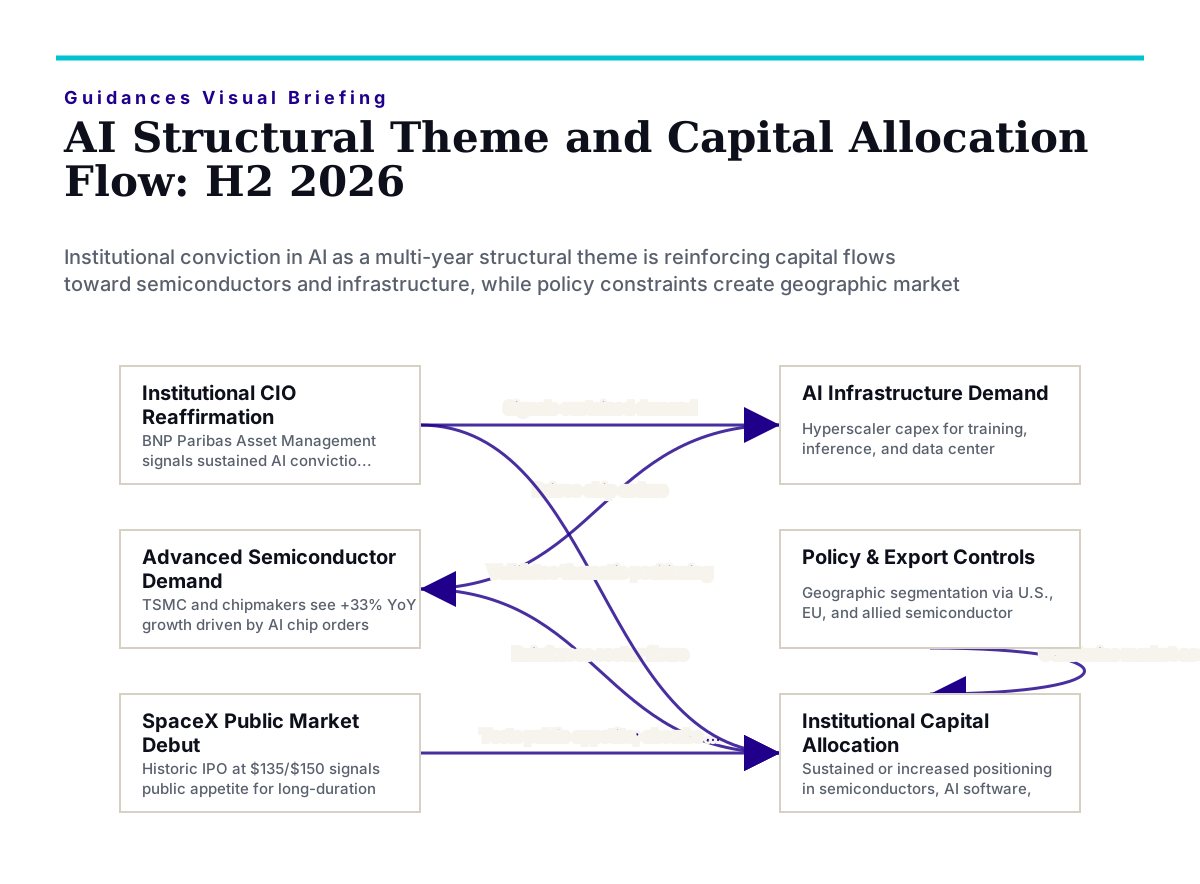
Ecaterina Bigos, Chief Investment Officer for Asia ex-Japan at BNP Paribas Asset Management's AXA IM Core unit, said in a CNBC interview that investors should pay attention to thematic alpha opportunities, citing artificial intelligence as a key structural growth driver for the second half of 2026. Her remarks came as market risk appetite appeared to improve following recent geopolitical developments. Bigos said the near-term backdrop may support risk sentiment, but argued that more durable opportunities are likely to come from structural, multi-year themes such as AI.
The interview also coincided with SpaceX's Nasdaq listing. SpaceX began trading at a $135 offering price and opened at $150, with accompanying coverage describing the debut as a historic IPO. Board member Antonio Gracias said he intended to hold his stake for as long as possible, while Nasdaq President Nelson Griggs described the listing as an important market debut. Early investor Gavin Baker also commented on the new public-market environment facing the company.
Together, the CIO's comments on AI and SpaceX's Nasdaq debut created a notable moment for technology-sector capital allocators.
Why the Market Cares
The simultaneous appearance of these signals has drawn attention to capital allocation across technology and innovation sectors in the second half of 2026.
For institutional allocators, the CIO's framing matters because large asset managers can influence sector flows. When AI is described as a structural theme rather than a short-term trade, it can support continued interest in AI-related infrastructure, semiconductors, and software platforms. That makes the signal more relevant to institutional positioning than to retail sentiment.
SpaceX's listing adds a separate dimension. A debut at $150 versus a $135 pricing level indicates active initial price discovery and provides a reference point for how public markets are valuing long-duration, capital-intensive technology platforms. The size of the listing may also absorb some market liquidity, which can affect flows into other technology names in the short term. A board member's stated intention to hold shares for the long term reflects a public expression of conviction, though it does not guarantee future performance.
In semiconductors, AI infrastructure demand remains a central variable. Taiwan Semiconductor Manufacturing Company (TSMC) is often used as a public-market reference point for AI chip demand. The figures included in this article come from market-data enrichment and should be verified against official investor relations disclosures and SEC filings. While institutional commentary that reinforces AI as a structural theme can support interest in advanced-node semiconductors, the exact magnitude of any incremental demand effect cannot be determined from the source snippet alone.
Technology and Policy Linkage
The AI structural theme highlighted by Bigos is closely tied to policy conditions. Governments in the United States, the European Union, South Korea, Japan, and Taiwan are shaping the competitive landscape through export controls, subsidy frameworks, and national AI strategies. These policy variables can create both support and constraints for the theme.
On the supportive side, investment in domestic semiconductor manufacturing and AI research can provide a multi-year demand backdrop that is less sensitive to short-term economic cycles. The CHIPS Act framework in the United States, along with similar industrial policies in South Korea and Japan, has helped create longer-term capital spending plans across the semiconductor ecosystem.
On the constraint side, export controls on advanced AI chips can create geographic segmentation in the addressable market, which institutional allocators may need to consider when building thematic positions. In practical terms, AI infrastructure investment is not evenly accessible across all regions, and the regulatory environment continues to evolve.
SpaceX's move into public markets also introduces a new policy dimension. As a listed company, it will face disclosure, shareholder communication, and regulatory requirements that differ from its prior private structure. Its contracts with NASA and the U.S. Department of Defense may also attract broader public-market attention.
Market Lens
Trigger: A senior institutional CIO reiterated AI as a core structural theme for H2 2026, while SpaceX listed on Nasdaq at a $135 pricing level and opened at $150.
Mechanism: Institutional reaffirmation of thematic priorities can influence sector flows. If large asset managers maintain interest in AI infrastructure, capital allocation toward semiconductors, AI software platforms, and data center infrastructure may remain elevated. SpaceX's listing can also serve as a reference point for public-market demand for long-duration technology platforms and may temporarily affect liquidity across the broader technology sector.
Affected Sectors and Scale Context: Semiconductors remain central to AI infrastructure investment. TSMC is a widely watched public-market proxy for AI chip demand at scale. The financial figures cited here come from market-data enrichment and should be cross-referenced with official investor relations disclosures and SEC filings. AI software, cloud infrastructure, and space technology may also be affected by the framing in the source, though direct financial linkage beyond the TSMC context is not established in the snippet.
Time Horizon: The CIO's framing points to the second half of 2026, suggesting a medium-term horizon. Structural AI themes can extend beyond a single half-year, but earnings reports, capex guidance updates, and policy announcements will serve as interim checkpoints.
Next Check: TSMC's next earnings disclosure, quarterly results from major AI chipmakers, SpaceX's first public financial disclosures after the IPO, and updates to U.S. and allied semiconductor export policy are the most concrete near-term verification points. Geopolitical developments could also affect the risk-appetite backdrop.
This section is market context only, not investment advice.
What to Watch Next
Several developments warrant monitoring in the weeks ahead.
First, SpaceX's post-IPO trading and first public financial disclosures will show how public markets price a company with government contract revenue, commercial launch operations, and long-duration capital needs. The gap between the offering price and opening trade suggests strong initial demand, but sustained price discovery will depend on the company's reported financials.
Second, the AI infrastructure capex cycle remains a key variable for semiconductor demand. Earnings from major hyperscalers and their data center spending guidance can affect chip orders and, in turn, TSMC's revenue trajectory. Any slowdown in hyperscaler capex guidance would be an important checkpoint for the structural AI thesis.
Third, the geopolitical backdrop referenced by Bigos remains fluid. Changes in that environment could alter the risk-appetite recovery and affect Asia-Pacific allocations.
Finally, policy developments in South Korea, Japan, and the United States related to AI governance and semiconductor supply chains will continue to shape the structural investment thesis. The degree of regulatory clarity in these jurisdictions may influence how institutional allocators size their thematic positions and which geographies they prioritize.
Uncertainty and Constraints
The source for this analysis is a search-provider snippet from a CNBC video interview. The full transcript and detailed reasoning behind Bigos's views are not available. As a result, the specific asset classes, geographies, or instruments she may have referenced cannot be verified here. The SpaceX listing details cited in the snippet should be checked against official exchange filings and company disclosures.
The TSMC figures cited in this article come from market-data enrichment and should be cross-referenced with official investor relations disclosures and SEC filings. This analysis is market context only and does not constitute investment advice.