Startups
Developing · 0 updatesFact 7/10Global Ad Spend Hits Record Share of GDP as AI Reshapes Competitive Entry Points
Article language
English
WPP Media data shows global advertising revenue has reached its highest share of nominal GDP on record, even amid geopolitical instability. AI is lowering barriers for startups and foreign entrants, while marketers demonstrate growing resilience to macroeconomic disruption.
Open article · no sign-in required
Sources and disclosure
What Happened
New data released by WPP Media, the intelligence arm of the world's largest advertising holding group, indicates that global advertising revenue has climbed to its highest share of nominal GDP ever recorded. The finding is notable precisely because it arrives against a backdrop of sustained geopolitical instability — including supply chain concerns linked to the Iran conflict — and a macroeconomic environment that most forecasters would characterize as unpredictable. WPP Media's global president of business intelligence, Kate Scott-Dawkins, framed continued investment through disruption as a strategic imperative, particularly as artificial intelligence reduces the cost and complexity of entering new markets.
The United States retains its position as the largest advertising economy by a significant margin, but China has begun to close the gap, according to the snippet. The precise trajectory of that convergence is not available from the source metadata alone, but the directional signal is consistent with broader trends in digital platform monetization and domestic consumption growth in China.
Why the Market Cares
Advertising spend is one of the more sensitive leading indicators of corporate confidence. When companies maintain or increase ad budgets during periods of geopolitical stress, it typically signals that revenue expectations remain intact and that management teams are prioritizing market share over short-term cost reduction. The fact that ad spend as a share of GDP has reached a record high — not merely in absolute dollar terms, but as a proportion of total economic output — suggests that the advertising industry's structural importance to the modern economy is expanding, not contracting.
For technology operators and founders, this matters for several reasons. First, the advertising ecosystem is increasingly intertwined with AI infrastructure. Programmatic buying, creative generation, audience targeting, and performance measurement are all undergoing rapid AI-driven transformation. Platforms that can offer AI-native advertising tools are capturing a disproportionate share of incremental budget. Second, the observation that AI is lowering barriers for startups and foreign firms entering new markets has direct implications for competitive dynamics across virtually every consumer-facing sector. A startup that can deploy AI-generated localized creative at a fraction of the historical cost is a meaningfully different competitive threat than one that cannot.
Microsoft, with a market capitalization of $2.81T and annual revenue of $281.7B, is one of the most directly exposed large-cap technology companies to the intersection of AI infrastructure and advertising-adjacent services. The company's cloud and productivity platforms underpin a significant portion of the enterprise marketing technology stack, and its Copilot and Azure AI services are increasingly embedded in the workflows of advertising agencies, brand teams, and media buyers. Microsoft reported year-over-year revenue growth of +14.9%, a pace that reflects the broader acceleration in enterprise AI adoption that is also driving advertising technology investment. These figures are provided as scale context only and do not constitute investment advice.
Technology and Policy Linkage
The AI dimension of this story deserves careful unpacking. WPP Media's framing — that AI lowers the barrier for startups and foreign firms to break into new markets — is not merely a product-marketing observation. It represents a structural shift in how advertising budgets are allocated and who competes for them. Historically, large incumbent brands benefited from scale advantages in media buying: they could negotiate better rates, afford more sophisticated measurement tools, and sustain longer-term brand campaigns. AI is compressing those advantages.
For policy observers, this creates a new set of regulatory questions. If AI-enabled foreign firms can enter domestic advertising markets more easily, questions about data sovereignty, platform access, and competitive fairness become more acute. The European Union's AI Act, the United States' evolving approach to AI governance, and China's own AI regulation framework all have indirect implications for how advertising technology can be deployed across borders. Founders building in the ad-tech space need to track these regulatory developments as carefully as they track platform API changes.
Supply chain disruption concerns — specifically those tied to the Iran conflict referenced in the source — have not, according to WPP Media's analysis, materially dampened advertiser confidence. This resilience is itself a data point worth noting. It suggests that the advertising industry has internalized a higher baseline of geopolitical risk and is no longer treating every disruption as a reason to pull budgets. That behavioral shift has compounding effects: if advertisers are less reactive to macro shocks, the volatility of ad revenue as a business input decreases, which in turn makes advertising-dependent platforms more predictable as revenue sources.
Market Lens
Trigger: WPP Media data showing global ad spend at a record share of nominal GDP, with AI cited as a structural driver of competitive entry.
Mechanism: Higher and more resilient ad spend supports revenue visibility for digital advertising platforms, marketing technology vendors, and AI-native creative tools. AI-driven cost reduction in market entry expands the total addressable market for advertising services by bringing in previously underserved small and mid-size advertisers.
Affected sectors: Digital advertising platforms, marketing technology (martech) software, cloud AI infrastructure providers, and media holding companies. The US remains the largest single market; China's growth trajectory is a secondary variable to monitor.
Time horizon: The GDP-share metric is a structural, multi-year signal rather than a short-cycle trading catalyst. Near-term implications are most visible in quarterly earnings from major digital platforms and martech vendors.
Next check: Quarterly earnings disclosures from major digital advertising platforms and cloud AI providers; WPP's own revenue guidance updates; any policy developments affecting cross-border AI-enabled advertising; and macroeconomic data on nominal GDP growth, which is the denominator in the GDP-share calculation.
Note: Specific ticker-level market reactions are not supported by the source snippet. The Microsoft figures cited above ($2.81T market cap, $281.7B annual revenue, +14.9% revenue growth) are provided as scale and context only. This analysis is market context, not investment advice.
What to Watch Next
Several variables will determine whether the record GDP-share reading for advertising is a durable structural shift or a cyclical peak. First, nominal GDP growth itself matters: if economic output slows while ad spend holds steady, the ratio rises mechanically without implying genuine advertising strength. Analysts should watch for whether real advertising volume is growing alongside the GDP-share metric.
Second, the China convergence story warrants close attention. If Chinese platforms and advertisers are contributing meaningfully to the global total, that introduces currency, regulatory, and geopolitical variables that are distinct from the US-centric advertising cycle. Any escalation in US-China technology or trade tensions could affect cross-border advertising flows.
Third, the AI-driven democratization of advertising access is still early-stage. The cost curves for AI creative generation and audience targeting are declining rapidly, but measurement standards, brand safety frameworks, and regulatory guardrails are still catching up. Founders building in this space should expect the competitive landscape to shift materially over the next 12 to 24 months as these standards solidify.
Uncertainty and Constraints
This analysis is based on a search snippet from Axios citing WPP Media data. The full WPP Media report is not available in the source metadata, and specific figures for the GDP-share percentage, regional breakdowns, or year-over-year comparisons are not confirmed from the snippet alone. Readers should consult the primary WPP Media report for precise data. The Iran conflict supply chain reference is noted but not elaborated in the available metadata. All market linkages beyond the directly stated WPP findings are analytical inference, clearly labeled as such.
Market lens
Compliance copilots can turn regulatory pain into a vertical SaaS wedge
The signal is whether review-assist tools become budgeted workflow systems rather than experimental AI add-ons.
Impact path
Compliance pain → SaaS wedge
Signals to watch
- Regulated teams buying citation and policy-lineage features
- Pilots expanding from legal review into operating workflows
- Vertical SaaS vendors packaging domain-specific compliance copilots
Verification schedule
D+1 · Jun 19
Do pilots name budget owners?
D+3 · Jun 21
Do products move from assistant UI to workflow records?
D+7 · Jun 25
Do vertical vendors show repeatable templates?
Informational context only — not investment, legal, tax, or financial advice.
Builder Implications
- AI-native ad tools are a genuine wedge, not a feature: WPP Media's explicit acknowledgment that AI lowers market-entry barriers for startups means that founders building AI-powered creative, targeting, or measurement tools are operating in a market where the structural tailwind is now documented at the GDP level. Prioritize interoperability with major platforms and compliance with emerging cross-border data rules.
- Resilience to macro shocks is a new advertiser baseline: If brands are maintaining budgets through geopolitical disruption, martech and ad-tech platforms should design for sustained engagement rather than crisis-mode churn. Product roadmaps that assume advertisers will cut at the first sign of instability may be miscalibrated.
- China's closing gap creates both opportunity and complexity: Founders targeting global advertising markets need to build with regulatory and platform fragmentation in mind from day one, particularly as Chinese platforms increase their share of global ad spend and cross-border AI deployment faces evolving policy scrutiny.
Want follow-up alerts? Subscribe by email after reading the public article.
Market lens
Compliance copilots can turn regulatory pain into a vertical SaaS wedge
The signal is whether review-assist tools become budgeted workflow systems rather than experimental AI add-ons.
Impact path
Compliance pain → SaaS wedge
Signals to watch
- Regulated teams buying citation and policy-lineage features
- Pilots expanding from legal review into operating workflows
- Vertical SaaS vendors packaging domain-specific compliance copilots
Verification schedule
D+1 · Jun 19
Do pilots name budget owners?
D+3 · Jun 21
Do products move from assistant UI to workflow records?
D+7 · Jun 25
Do vertical vendors show repeatable templates?
Informational context only — not investment, legal, tax, or financial advice.
Visual Briefing
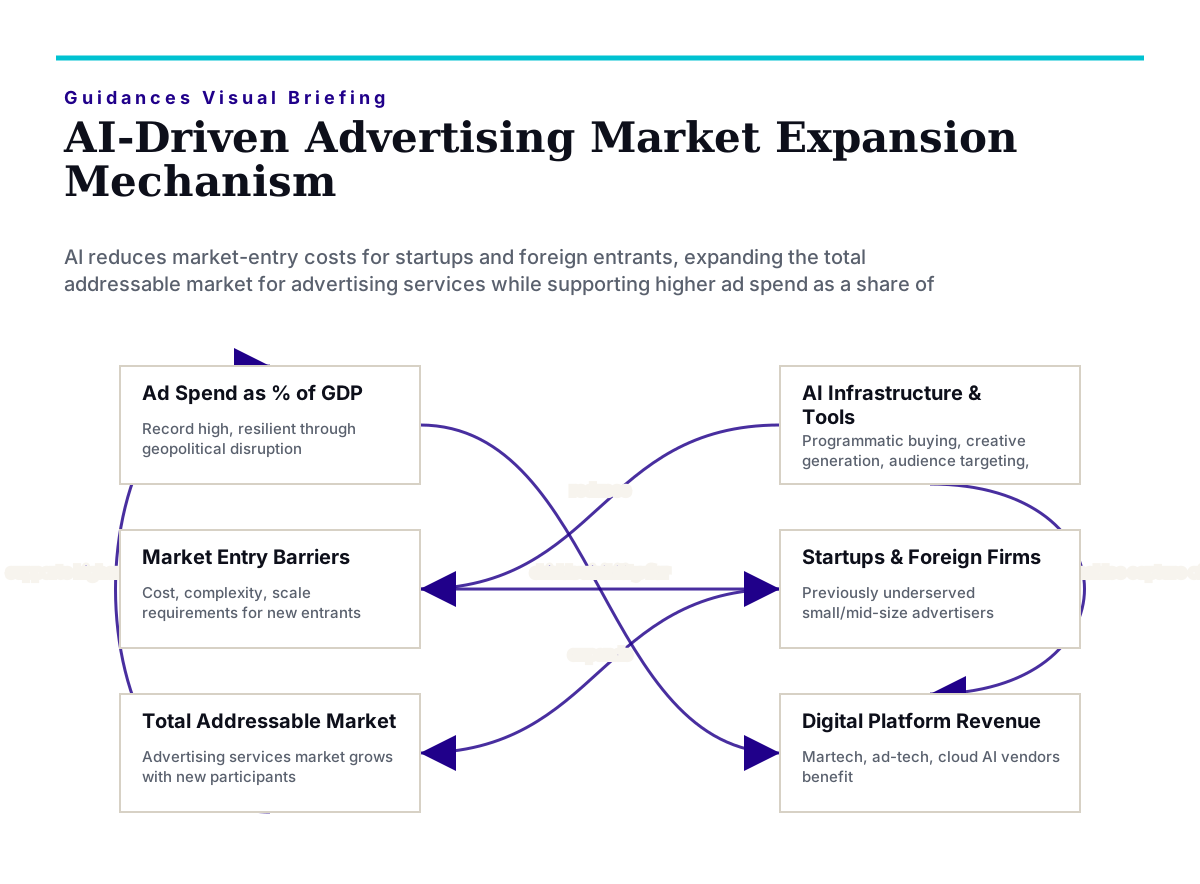
As AI lowers barriers to market entry, new advertisers enter the ecosystem, expanding total ad spend and benefiting AI-native platform providers.
Corrections and safety
See a factual, privacy, rights, or safety issue? Review the corrections process or contact Guidances before relying on this article for important decisions.