Semiconductors
Developing · 0 updatesFact 9/10How AI Demand Is Reaching Into Materials: What a Market Note on Mitsubishi Gas Chemical Suggests
Article language
English
A WSJ market note says Nomura sees Mitsubishi Gas Chemical as potentially benefiting from AI-related demand and related packaging-material tailwinds. The verified detail is limited, but the note points to a broader pattern: the AI build-out is reaching beyond chips and models into substrates, packaging, and materials supply chains.
Open article · no sign-in required
Sources and disclosure
The article is well aligned with the provided WSJ snippet. It accurately frames the piece as a market note about Mitsubishi Gas Chemical, packaging materials, and chip scale package substrates, and it correctly treats the analyst forecast revision as a sourced market expectation rather than a confirmed operating result. The article also stays within a neutral, informational tone and includes appropriate caution about the limited source depth. No unsupported price claims, ticker claims, or investment-advice language are central to the piece.
Market lens
On-device AI shifts attention from data-center chips to memory allocation and device margins
The useful read is whether local AI features create measurable pressure on memory mix, pricing, and product release schedules.
Impact path
Device AI → memory pressure
Signals to watch
- LPDDR and HBM allocation commentary
- AI PC and phone memory configurations
- Supplier lead times, spot pricing, and margin guidance
Verification schedule
D+1 · Jun 16
Do OEM launches raise baseline memory specs?
D+3 · Jun 18
Do suppliers change allocation or pricing language?
D+7 · Jun 22
Do device margins absorb or pass through memory cost?
Informational context only — not investment, legal, tax, or financial advice.
What happened
A market note carried by the WSJ says Nomura analyst Daiki Ban sees Mitsubishi Gas Chemical as likely to benefit from artificial intelligence demand and other supportive trends. The snippet also says the brokerage raised its forecast for the company’s recurring profit this fiscal year to 82.0 billion yen from 69.5 billion yen. Those are the only concrete facts available in the provided material, and they matter precisely because they are narrow: the note is not about a headline chipmaker, a model developer, or a cloud platform. It is about a materials company and the packaging layer beneath the AI boom.
That distinction is important. In technology coverage, AI demand is often discussed in terms of compute, software, and capital expenditure. Yet the snippet points to a different part of the stack: packaging materials, including chip scale package substrates. In other words, the market is not only asking who trains the models or sells the accelerators. It is also asking who supplies the physical components that make advanced chips usable at scale.
Because the source is a short snippet rather than the full article, the proper reading is cautious. This is an analyst view, not a full operating update from the company. The available information supports an interpretation about market expectations, not a definitive statement about realized demand. That limitation should shape how founders and investors use the signal.
Why the market cares
The broader significance is that AI is increasingly a supply-chain story, not only a software story. The public conversation tends to focus on frontier models, GPUs, and data-centre build-outs. But every additional layer of compute depends on a set of industrial inputs: substrates, packaging, thermal management, chemicals, testing, and manufacturing capacity. When an analyst links a materials company to AI demand, the market is effectively acknowledging that the AI cycle reaches far deeper into industrial supply chains than many headlines suggest.
For founders, this matters because it changes where opportunity can appear. The most visible AI companies may capture the most attention, but the infrastructure around them can also create durable demand. A company that supplies packaging-related materials may not be a household name, yet it can still sit in a critical position if advanced packaging becomes more important as chips become more complex. The snippet’s reference to chip scale package substrates is a reminder that the AI build-out is not abstract. It is built from physical layers that must be sourced, qualified, and scaled.
For investors, the note is a reminder to look beyond the obvious beneficiaries. AI spending can lift not only semiconductor designers and cloud providers, but also firms that sit one or two steps removed from the end application. That does not mean every company with a materials exposure will benefit equally. It does mean that the market may increasingly reward businesses with credible links to advanced packaging and other enabling technologies.
Technology and policy linkage
The note also illustrates how technology change and industrial structure interact. As AI systems become more capable, the density, heat, reliability, and assembly complexity of high-performance chips rise as well. That increases the importance of packaging and materials. The snippet’s pairing of packaging materials with chip scale package substrates suggests that AI demand can influence not only compute demand, but also manufacturing processes and material choices.
From a policy perspective, this matters because many governments now treat semiconductor supply-chain resilience and advanced manufacturing capacity as strategic priorities. Materials and packaging are therefore not peripheral categories. They are part of the broader industrial base that supports reliable computing. The provided material does not support a claim about any specific policy outcome, but it does show how AI expansion pushes attention toward the lower layers of the stack.
Market Lens
From a market lens, the note shows how widely the AI theme can be reinterpreted across listed companies. Investors often frame AI as a story about model developers or cloud operators, but capital markets also evaluate the broader supply chain. When a materials company is linked to AI demand, the market is effectively reassessing its earnings context and industrial relevance.
That said, this is a market interpretation, not a confirmed operating result. The snippet does not provide order growth, customer names, segment revenue, or a quantified contribution from AI-related sales. It also does not show whether the forecast revision reflects a broad improvement across the business or a narrower assumption about one product line. The correct use of the signal is directional, not definitive.
Operating implications
The practical implication for technology builders is that supply-chain resilience becomes more central as AI workloads expand. If packaging materials and related substrates are in higher demand, then procurement, lead times, and qualification cycles become more consequential. For companies building AI hardware, data-centre systems, or adjacent industrial tools, the question is not only whether demand exists, but whether the supporting materials ecosystem can keep pace.
This also has implications for product strategy. Startups often frame their value proposition in terms of software differentiation or model performance. Yet the AI economy is increasingly shaped by constraints in the physical stack. A founder building tools for semiconductor manufacturing, packaging inspection, thermal optimisation, or materials traceability may find that the market is more receptive than it would have been a year or two ago. The reason is simple: as AI systems scale, the bottlenecks move downstream.
There is also a capital-markets dimension. The snippet shows a brokerage raising profit expectations for a materials company on the basis of AI-related demand and packaging tailwinds. That is a reminder that market narratives can influence access to capital, customer perception, and strategic partnerships. Companies that can credibly connect their products to AI infrastructure may find it easier to explain growth to investors and counterparties. For founders, that does not mean forcing an AI label onto every product. It means understanding where the product genuinely fits in the stack and communicating that fit with precision.
What to watch next
The most useful follow-up questions are straightforward. First, is the forecast revision tied to a specific product family or to a broader improvement in the business environment? Second, how directly does AI demand translate into packaging materials and chip scale package substrates? Third, is the higher recurring-profit forecast a one-time adjustment or part of a more durable change in analyst expectations?
Additional detail on customer mix and product mix would improve the quality of interpretation. But the current material does not provide that level of granularity. The most conservative reading is that the market is re-evaluating the lower layers of the AI supply chain, rather than declaring a fully established earnings step-up.
Constraints and uncertainty
The main constraint here is the thinness of the source. The snippet does not provide customer names, order volumes, segment revenue, or evidence of direct AI-linked sales. It does not show whether the forecast revision reflects a broad improvement across the business or a narrower assumption about one product line. It also does not tell us how much of the company’s future depends on AI-related packaging demand versus other end markets.
That uncertainty matters. A market note can be directionally useful without being comprehensive. It can indicate where analysts see momentum, but it cannot substitute for a full operating review. Founders and investors should therefore avoid over-reading the signal. The correct conclusion is not that AI demand has transformed the company’s economics overnight. The correct conclusion is that analysts are now willing to incorporate AI-linked packaging demand into their valuation and earnings models.
Another limitation is definitional. The phrase “AI demand” is broad. In this context, the snippet suggests a connection to packaging materials and chip scale package substrates, but it does not fully separate AI server demand from broader electronics demand. That ambiguity is common in market commentary, and it is one reason to remain conservative. The safest interpretation is that AI is contributing to a more favourable demand backdrop for certain materials used in advanced semiconductor packaging.
Builder Implications
The strategic lesson is that AI infrastructure is becoming more layered. The companies that win may not always be the ones closest to the user interface. Some will sit in the industrial middle: the firms that make advanced chips manufacturable, reliable, and scalable. That is where materials, packaging, and process tooling become commercially relevant.
For founders, this creates two practical paths. One is to build directly for the AI hardware supply chain, where the customer problem is often operational and measurable. The other is to build software that helps industrial suppliers manage complexity: quality control, forecasting, traceability, qualification, and workflow automation. Both paths benefit from the same macro trend, but they require different sales motions and technical credibility.
For developers, the takeaway is equally concrete. If your product touches semiconductor manufacturing, packaging, or materials workflows, the market may now be more attentive to efficiency gains and reliability improvements than it was before the current AI cycle. That does not remove execution risk. It does, however, increase the value of tools that reduce friction in a supply chain under pressure.
In short, the WSJ snippet is modest in length but meaningful in implication. It suggests that AI demand is no longer confined to the visible layers of the technology sector. It is reaching into the industrial base that supports advanced computing. For builders, that is where some of the most durable opportunities may now be forming.
Builder Implications
- AI infrastructure opportunities extend into packaging, substrates, and materials, so founders should map the full stack before choosing a market wedge.
- Products that improve qualification, traceability, forecasting, or process reliability in semiconductor-adjacent supply chains may gain relevance as AI demand broadens.
- Teams seeking enterprise customers should be prepared to explain exactly how their offering reduces bottlenecks in the physical AI supply chain, not just how it relates to AI in general.
- This article is not medical advice and not investment advice.
Want follow-up alerts? Subscribe by email after reading the public article.
Market lens
On-device AI shifts attention from data-center chips to memory allocation and device margins
The useful read is whether local AI features create measurable pressure on memory mix, pricing, and product release schedules.
Impact path
Device AI → memory pressure
Signals to watch
- LPDDR and HBM allocation commentary
- AI PC and phone memory configurations
- Supplier lead times, spot pricing, and margin guidance
Verification schedule
D+1 · Jun 16
Do OEM launches raise baseline memory specs?
D+3 · Jun 18
Do suppliers change allocation or pricing language?
D+7 · Jun 22
Do device margins absorb or pass through memory cost?
Informational context only — not investment, legal, tax, or financial advice.
Visual Briefing
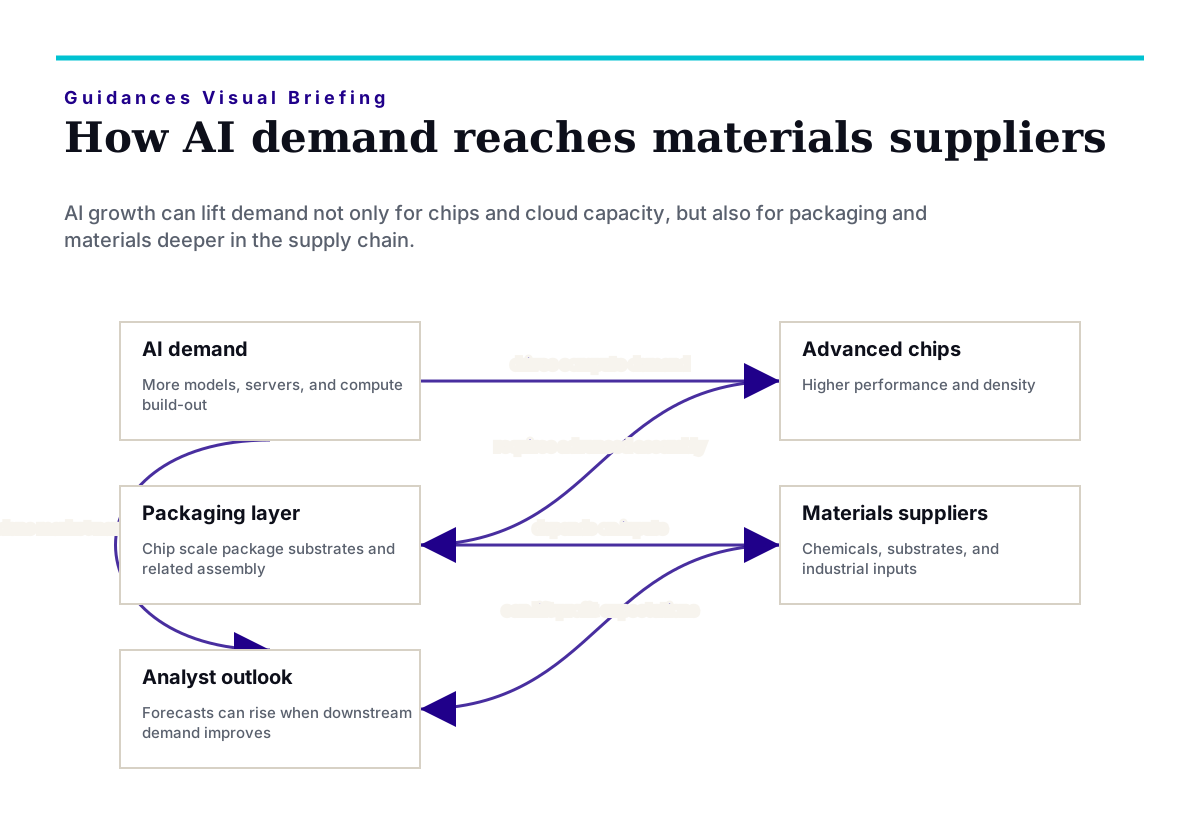
A simplified view of how AI demand can flow from compute growth into packaging and materials suppliers.
Corrections and safety
See a factual, privacy, rights, or safety issue? Review the corrections process or contact Guidances before relying on this article for important decisions.