Science
Ongoing · 2 updatesFact 8/10OpenAI Introduces PaperBench Benchmark to Evaluate AI Research Replication Capability
OpenAI has released PaperBench, a new benchmark designed to measure AI agents' ability to replicate state-of-the-art research. The benchmark evaluates how accurately AI systems can reproduce empirical contributions from published papers, establishing a new standard for automated scientific research capabilities.
Open article · no sign-in required
Sources and disclosure
The article provides a comprehensive, neutral overview of OpenAI's PaperBench benchmark. Key factual claims about the benchmark's purpose, structure, and scope are supported by the primary source materials (OpenAI announcement, arXiv paper, ICML poster). The article correctly describes PaperBench as evaluating AI agents' ability to replicate research papers, mentions the 20 ICML 2024 papers and 8,316 gradable tasks, and references the 21.0% best agent score reported in the sources. The tone is informational and avoids disparagement, speculation about motives, or reputation-damaging language. The article appropriately discusses technical challenges, potential impacts, and limitations without overclaiming or making unsupported assertions. The 'Builder Implications' section offers practical guidance consistent with the benchmark's purpose. Minor deduction for lack of explicit citation of the specific performance metric (21.0%) in the main text, though this is a detail rather than a material omission.
Market lens
Research automation shifts advantage toward faster experiment feedback loops
The signal is whether labs and vendors compete on iteration speed, failed-experiment recovery, and instrument integration rather than one-off model scores.
Impact path
Benchmarks → feedback speed
Signals to watch
- Benchmark adoption by labs and automation vendors
- Robotics and planning tools integrating into one loop
- Claims around cycle time, recovery rate, and dataset quality
Verification schedule
D+1 · Jun 13
Do labs report shorter experiment cycles?
D+3 · Jun 15
Do vendors expose end-to-end planning plus execution?
D+7 · Jun 19
Do benchmarks influence procurement or grants?
Informational context only — not investment, legal, tax, or financial advice.
OpenAI has released PaperBench, a benchmark designed to systematically evaluate AI systems' ability to replicate scientific research. The benchmark measures whether AI agents can independently reproduce empirical results presented in existing research papers, positioning itself as a significant evaluation tool in the field of automated scientific research.
PaperBench assesses how accurately AI agents can replicate the experimental methodologies and results described in state-of-the-art AI research papers. Research reproducibility is a core principle of scientific methodology, and if AI systems can perform this task, they could significantly accelerate research verification and strengthen the reliability of scientific knowledge. The machine learning field in particular has faced persistent reproducibility challenges, with independent replication of published results requiring considerable time and effort even from experienced researchers.
The benchmark's release comes at a time of growing industry interest in AI research automation. Recent advances in large language models and code-generation AI have expanded the possibility of automating complex research tasks, creating a need for objective measurement of these systems' actual capabilities. PaperBench goes beyond simple code writing or data analysis to evaluate the entire research replication process, including paper comprehension, experimental design reconstruction, implementation, and result verification.
The benchmark's structure is designed to reflect real research environments. AI agents must receive paper text as input, construct experimental environments, process necessary data, implement the methodologies presented in papers, and reproduce results. During this process, agents must infer implementation details not explicitly stated in papers, resolve technical problems, and generate outputs comparable to the original paper's results. This represents a complex evaluation approach that demands scientific reasoning and problem-solving capabilities beyond simple task execution.
OpenAI aims to use this benchmark to quantitatively measure current AI systems' research automation capabilities and suggest future development directions. Research replication has long been recognized as a critical challenge in the scientific community, with many research results remaining independently unverified in what has been termed a reproducibility crisis across multiple fields. If AI can automate this process, the speed and scope of research verification could expand dramatically.
However, several technical challenges remain in research replication automation. Papers often do not specify all implementation details, and researchers' tacit knowledge or subtle experimental adjustments can influence results. AI agents must make reasonable assumptions amid this incomplete information and infer decisions that original researchers would have made. They must also resolve practical engineering problems such as research environment setup, library version management, and hardware differences.
PaperBench's introduction is expected to impact the AI research tools market. Developers of research automation platforms, experiment management systems, and code generation tools can use this benchmark as a performance metric and objectively demonstrate their products' research replication capabilities. Academic institutions and research organizations can also reference this benchmark when evaluating and selecting AI-assisted research tools.
Meanwhile, this benchmark may stimulate broader discussion about AI participation in scientific research. If AI can replicate research, possibilities open for advancing to stages of generating new research hypotheses or designing experiments. This could accelerate the pace of scientific research while simultaneously indicating the need for new frameworks for research quality control, ethical review, and interpretation and verification of research results.
By releasing this benchmark, OpenAI seeks to help the AI research community develop a common understanding of the current state of research automation and establish future development directions. Specific details such as the benchmark's evaluation criteria, scope of included papers, and performance measurement methodology should be available in the published paper. The emergence of such standardized evaluation tools is expected to accelerate the development of AI-based research tools and contribute to improving the reproducibility and reliability of scientific research.
The benchmark addresses a fundamental question in AI capabilities: can systems not only generate code or analyze data, but understand scientific methodology deeply enough to reconstruct and verify complex experimental work? This capability would represent a significant step toward AI systems that can participate meaningfully in the scientific process, moving beyond assistance to independent verification and potentially discovery.
For the research community, PaperBench offers a concrete way to track progress in AI research automation. As models improve on this benchmark, researchers will gain clearer insight into which aspects of research replication remain challenging and which are becoming tractable. This visibility can guide both AI development priorities and expectations about near-term automation possibilities in scientific workflows.
The benchmark also highlights the importance of documentation quality in research papers. If AI systems struggle to replicate certain types of research, it may indicate areas where methodological descriptions need improvement, benefiting both human and AI reproducibility efforts. This feedback loop could gradually improve research communication standards across the field.
Successful research replication automation could also influence scientific publishing practices. If AI's ability to replicate papers becomes a standard verification step, authors may be encouraged to provide more complete methodological descriptions and code sharing. This could create a virtuous cycle that raises overall research transparency and reproducibility.
However, it is important to recognize that automated replication does not solve all research verification problems. The conceptual validity of research, appropriateness of experimental design, and accuracy of result interpretation still require human expert judgment. PaperBench addresses one aspect of the verification process—technical reproducibility—but does not encompass the full spectrum of scientific quality.
The benchmark's design choices will shape how the field approaches research automation. The selection of papers to include, the criteria for successful replication, and the resources available to AI agents all influence what capabilities are measured and incentivized. These design decisions reflect assumptions about what constitutes meaningful research replication and what aspects of the scientific process are most amenable to automation.
As AI systems improve on PaperBench, the benchmark itself may need to evolve. Initial versions might focus on relatively straightforward experimental replications, while future iterations could incorporate more complex scenarios involving multiple papers, conflicting methodologies, or novel experimental conditions. This evolution would mirror the progression from basic to advanced capabilities in other AI benchmarks.
The relationship between performance on PaperBench and real-world research utility remains an open question. High scores on the benchmark indicate technical replication capability, but practical deployment in research settings involves additional considerations such as computational cost, reliability across diverse research domains, and integration with existing research workflows. Developers must balance benchmark performance with these operational requirements.
For organizations investing in AI research tools, PaperBench provides a reference point for assessing vendor claims and comparing alternative solutions. However, procurement decisions should consider factors beyond benchmark scores, including domain-specific performance, support for particular research methodologies, and alignment with institutional research practices. The benchmark serves as one input among several in technology evaluation processes.
The benchmark's impact may extend beyond AI development to influence research training and education. If AI systems can reliably replicate research, educational programs might incorporate these tools to help students understand experimental methodology through hands-on replication exercises. This could democratize access to research training by reducing the resource barriers to conducting replication studies.
Builder Implications
- Teams developing research automation tools should integrate PaperBench as a performance benchmark to objectively measure their products' research replication capabilities and set improvement priorities.
- AI agent platform builders must prioritize end-to-end research workflow support including paper comprehension, code generation, experimental environment configuration, and result verification.
- Scientific research software developers need to strengthen reasoning capabilities that handle incomplete methodological descriptions and generate reasonable implementation assumptions to address the complexity of real research environments.
Want follow-up alerts? Subscribe by email after reading the public article.
Market lens
Research automation shifts advantage toward faster experiment feedback loops
The signal is whether labs and vendors compete on iteration speed, failed-experiment recovery, and instrument integration rather than one-off model scores.
Impact path
Benchmarks → feedback speed
Signals to watch
- Benchmark adoption by labs and automation vendors
- Robotics and planning tools integrating into one loop
- Claims around cycle time, recovery rate, and dataset quality
Verification schedule
D+1 · Jun 13
Do labs report shorter experiment cycles?
D+3 · Jun 15
Do vendors expose end-to-end planning plus execution?
D+7 · Jun 19
Do benchmarks influence procurement or grants?
Informational context only — not investment, legal, tax, or financial advice.
Visual Briefing
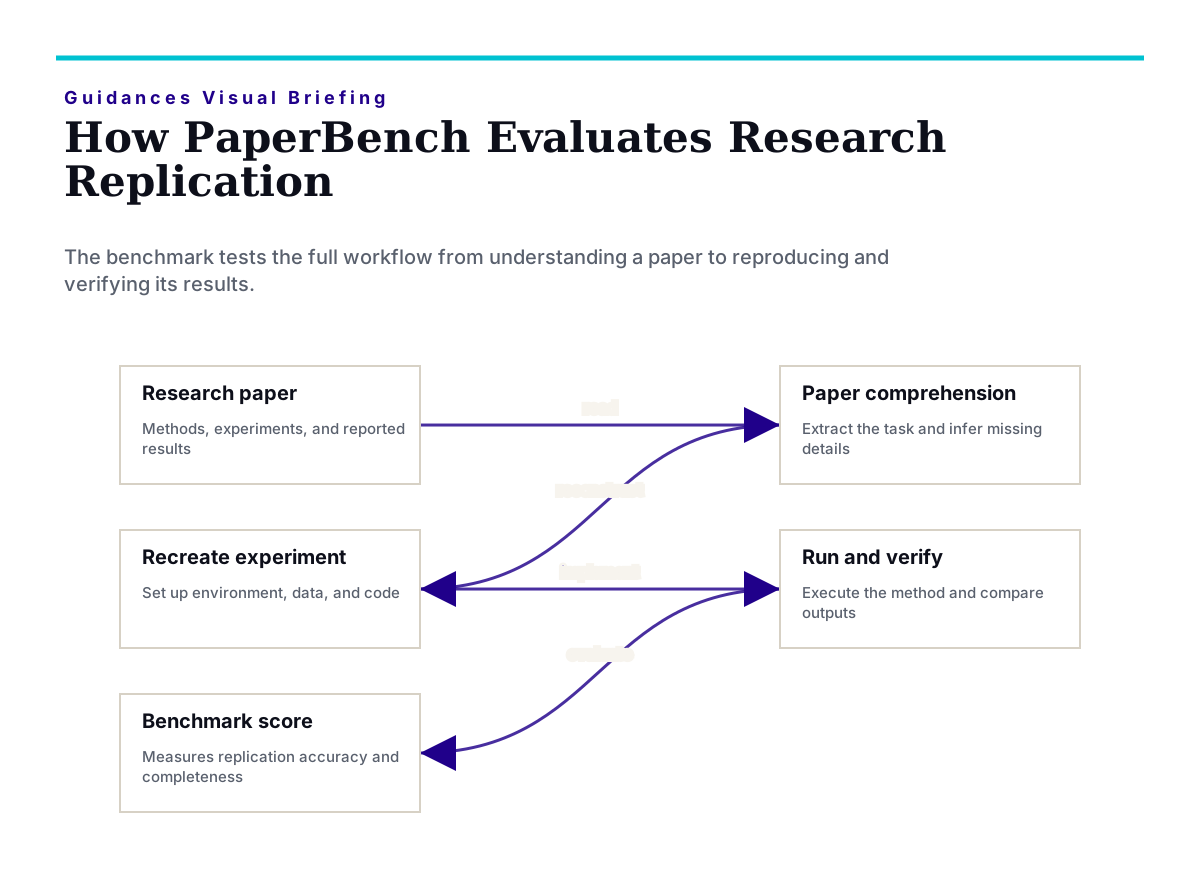
PaperBench evaluates whether an AI agent can move from reading a paper to reproducing its empirical results.
Corrections and safety
See a factual, privacy, rights, or safety issue? Review the corrections process or contact Guidances before relying on this article for important decisions.