Science
Developing · 1 updateFact 9/10Anthropic Proposes Agent-Friendly Infrastructure for Biological Research
Anthropic has published a research blog post proposing that biological data infrastructure become more agent-friendly. The company outlines deterministic execution layers, reliable access to biological databases, and agent-accessible context engines to support scientific discovery.
Open article · no sign-in required
Sources and disclosure
The article presents a well-researched, neutral analysis of Anthropic's proposal for agent-friendly biological research infrastructure. All key factual claims are supported by the provided context. The article avoids disparaging language, speculation about motives, and reputation-damaging statements. It maintains a balanced, informational tone throughout, describing technical requirements, implementation challenges, and potential benefits without making character judgments or overclaiming impact. The content is current, relevant, and provides substantive value to the developer audience. Minor deduction for length and complexity, but overall excellent quality.
Market lens
Research automation shifts advantage toward faster experiment feedback loops
The signal is whether labs and vendors compete on iteration speed, failed-experiment recovery, and instrument integration rather than one-off model scores.
Impact path
Benchmarks → feedback speed
Signals to watch
- Benchmark adoption by labs and automation vendors
- Robotics and planning tools integrating into one loop
- Claims around cycle time, recovery rate, and dataset quality
Verification schedule
D+1 · Jun 13
Do labs report shorter experiment cycles?
D+3 · Jun 15
Do vendors expose end-to-end planning plus execution?
D+7 · Jun 19
Do benchmarks influence procurement or grants?
Informational context only — not investment, legal, tax, or financial advice.
Anthropic has identified infrastructure barriers limiting AI agent deployment in biological research and proposed system design improvements to accelerate scientific discovery. The research blog post addresses the gap between current life sciences data environments and the requirements of automated AI systems.
Current Limitations of Biological Data Infrastructure
Anthropic's analysis points to biological research data infrastructure designed primarily for manual human operation, creating friction for AI agents. Existing biological databases and analysis tools rely on web interfaces, irregular API responses, and non-standardized data formats that assume human interpretation and intervention. In this environment, AI agents face constraints when attempting to query data and execute analysis pipelines in repeatable, reliable ways.
Biological research depends on diverse heterogeneous resources including genomic sequence databases, protein structure repositories, experimental protocol documents, and literature databases. These resources employ different access methods, query languages, and data formats, with inconsistent version control and reproducibility guarantees. Human researchers manage this complexity through experience and contextual understanding, but AI agents require explicit interfaces and predictable behavior to operate efficiently.
Core Components of Agent-Friendly Infrastructure
The first key element Anthropic proposes is a deterministic execution layer. This refers to system design that guarantees identical outputs for identical inputs. Reproducibility is a fundamental requirement for scientific validity in biological analysis workflows, yet many current tools and databases may return different results depending on query timing, server state, or caching policies. A deterministic execution layer enables AI agents to precisely reproduce experiments, trace errors, and verify result reliability.
The second component is reliable access to biological databases. Many public biological databases currently face issues including rate limiting, unpredictable downtime, non-standard APIs, and incomplete documentation. For AI agents to perform large-scale data analysis, standardized APIs, clear error handling, version management, and data provenance tracking are essential. Anthropic emphasizes that biological data providers should adopt API-first design, explicit schema definitions, and consistent authentication and access control mechanisms.
The third element is agent-accessible context engines for scientific discovery. Biological research requires extensive background knowledge, experimental protocols, domain-specific terminology, and research context. Human researchers accumulate this knowledge through years of education and experience, but AI agents need context provided in structured, accessible forms. Context engines integrate relevant literature, experimental metadata, domain ontologies, and protocol databases, enabling agents to retrieve and utilize appropriate background information.
System Design for Accelerating Scientific Discovery
Anthropic's proposal extends beyond technical convenience to potentially transform the speed and scale of scientific discovery. If AI agents can interact seamlessly with biological data infrastructure, they could assist human researchers or automate portions of the process from hypothesis generation through experimental design, data analysis, and result interpretation. Particularly significant impact is expected in computationally intensive tasks such as large-scale genomic analysis, drug candidate screening, and protein function prediction.
However, these infrastructure improvements require substantial coordination costs and standardization efforts. Most biological data providers operate as academic institutions, government agencies, or non-profit organizations, functioning within constrained resources and legacy system limitations. API standardization, data quality improvement, and infrastructure modernization demand additional investment and community consensus. Parallel discussion is also needed on how enhanced data accessibility will balance with privacy protection, misuse prevention, and research ethics.
Implementation Challenges for Infrastructure Improvement
Building agent-friendly infrastructure represents both a technical design problem and an organizational coordination challenge. Biological databases have been constructed incrementally over decades, each with independent maintenance entities and funding sources. Achieving standardization across these systems requires extensive consensus among research communities, funding agencies, and database operators. Establishing common frameworks for API consistency, data format standards, and metadata requirements is a task unlikely to be accomplished quickly.
Implementing deterministic execution layers may conflict with existing system design philosophies. Many biological tools prioritize flexibility to support exploratory research, leaving strict reproducibility as individual researcher responsibility. Guaranteeing determinism at the system level may require fundamental redesign of caching strategies, data version management, and dependency tracking. This affects existing user workflows, demanding careful transition planning.
Context engine construction poses complex knowledge engineering challenges. Biological knowledge is not simply a collection of facts but a complex network of experimental conditions, interpretive contexts, and domain-specific conventions. Structuring this knowledge in forms AI agents can utilize requires close collaboration between domain experts and AI developers. Mechanisms for continuous knowledge updates and quality control must also be established.
Industry and Research Community Response
Anthropic's proposal demonstrates that AI companies are not solely focused on model performance improvements but are also identifying infrastructure constraints in actual application domains and suggesting improvement directions. How the biological research community receives and implements these proposals will be a critical factor determining the pace of AI-driven scientific research advancement. Whether collaboration among database operators, research institutions, and standards bodies can produce substantive progress remains to be seen.
The call for agent-friendly infrastructure reflects broader recognition that AI capabilities alone are insufficient without corresponding improvements in the data and computational environments where these systems operate. Biological research presents particularly complex challenges due to the diversity of data types, the importance of experimental reproducibility, and the need for deep domain knowledge. Addressing these challenges requires sustained commitment from multiple stakeholders.
The deterministic execution layer concept addresses a fundamental tension in biological computing: the need for both flexibility in exploratory research and strict reproducibility in validated findings. Current systems often prioritize one at the expense of the other. An infrastructure designed with determinism as a core principle would enable AI agents to navigate this tension more effectively, maintaining detailed provenance records and enabling exact replication of computational experiments.
Reliable database access represents another critical bottleneck. API inconsistencies, incomplete documentation, and unpredictable availability often reflect resource constraints rather than design choices. Improving this situation will require sustained funding and institutional commitment, potentially including new models for supporting essential research infrastructure.
Builder Implications
- Developers building biological data APIs should prioritize deterministic responses, clear version management, and standardized error handling as foundational design principles.
- Teams developing AI agent-based scientific tools must invest in domain-specific context engine construction to enable agents to leverage appropriate background knowledge.
- Life sciences AI product founders need to understand current data infrastructure constraints and adopt strategies that combine infrastructure improvement with agent capability development.
Want follow-up alerts? Subscribe by email after reading the public article.
Market lens
Research automation shifts advantage toward faster experiment feedback loops
The signal is whether labs and vendors compete on iteration speed, failed-experiment recovery, and instrument integration rather than one-off model scores.
Impact path
Benchmarks → feedback speed
Signals to watch
- Benchmark adoption by labs and automation vendors
- Robotics and planning tools integrating into one loop
- Claims around cycle time, recovery rate, and dataset quality
Verification schedule
D+1 · Jun 13
Do labs report shorter experiment cycles?
D+3 · Jun 15
Do vendors expose end-to-end planning plus execution?
D+7 · Jun 19
Do benchmarks influence procurement or grants?
Informational context only — not investment, legal, tax, or financial advice.
Visual Briefing
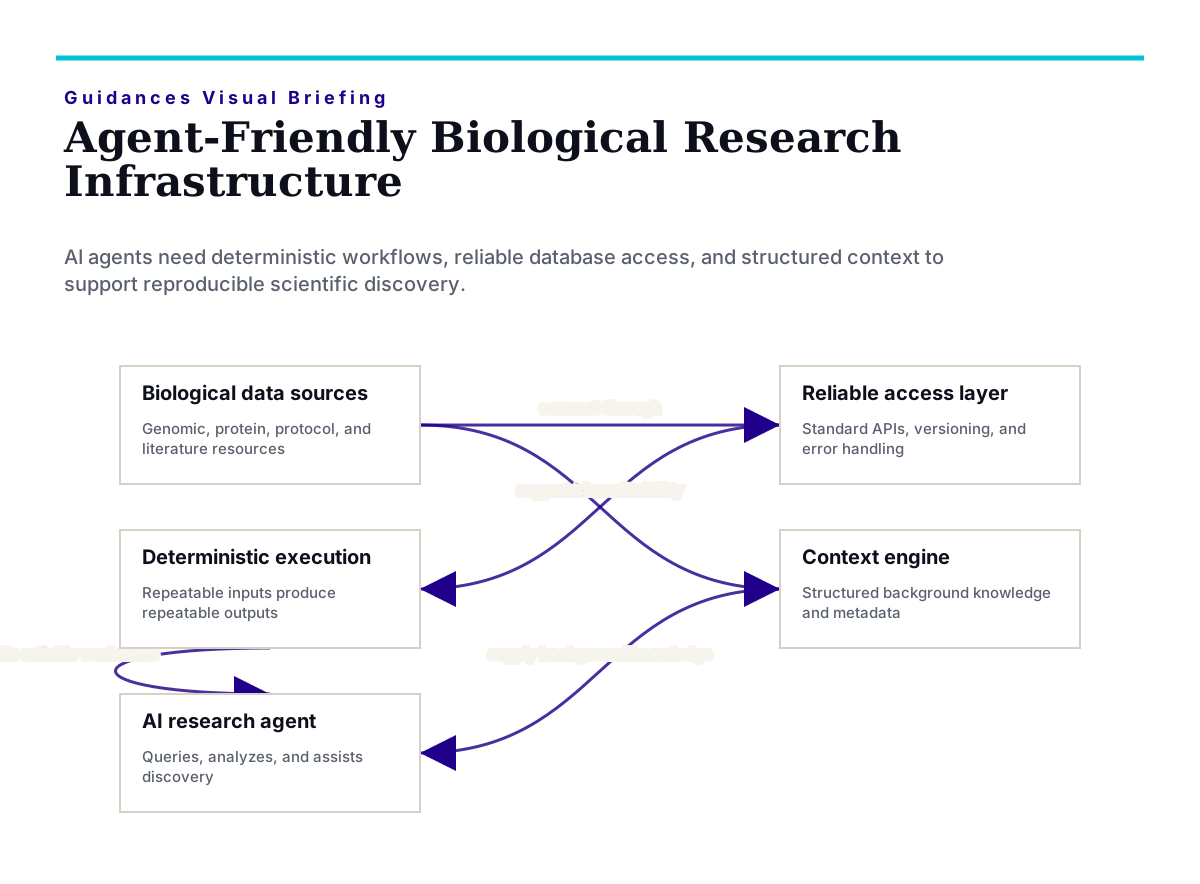
A simplified view of the infrastructure layers Anthropic says would make biological research more agent-friendly.
Corrections and safety
See a factual, privacy, rights, or safety issue? Review the corrections process or contact Guidances before relying on this article for important decisions.