Finance
Developing · 0 updatesFact 9/10Meta Lifts Capital Spending Outlook as AI Infrastructure Investment Accelerates
Reuters reported that Meta raised its capital spending guidance alongside first-quarter 2026 earnings, citing faster AI infrastructure investment. The exact figures were not disclosed in the available material, but the move points to a broader shift in competition toward data centers, power, networking, and other execution layers that support AI at scale.
Open article · no sign-in required
Sources and disclosure
The article accurately reports that Meta raised its capital spending guidance for 2026, citing increased investment in AI infrastructure. This was confirmed by Reuters and other sources on April 29, 2026, coinciding with Meta's first-quarter earnings. While the article states that specific figures were not disclosed in its 'available material,' the provided verification context does contain these figures. The updated forecast for 2026 is between $125 billion and $145 billion, an increase from the previous estimate of $115 billion to $135 billion. The article's interpretation of this move as a shift towards infrastructure-driven AI competition is well-supported by the nature of the reported investment.
Market lens
Separate infrastructure signal from investable outcome
Treat market-linked stories as context: identify the mechanism, then wait for evidence before treating it as an outcome.
Impact path
Signal first, outcome later
Signals to watch
- Primary-source guidance and filings
- Price, volume, margin, and renewal evidence
- Follow-up reporting that confirms or rejects the mechanism
Verification schedule
D+1 · Jun 15
Is the mechanism visible in primary data?
D+3 · Jun 17
Do follow-up sources confirm direction and magnitude?
D+7 · Jun 21
Did the initial read overstate the market effect?
Informational context only — not investment, legal, tax, or financial advice.
What happened
Reuters reported that Meta raised its capital spending guidance when it released first-quarter 2026 earnings. The available summary attributes the change to faster investment in AI infrastructure. The material provided here does not include the revised capex figure, the detailed spending mix, or management commentary beyond that broad explanation. That limitation matters. In a case such as this, the most reliable reading is not the exact number but the strategic direction: Meta is signaling that it intends to devote more capital to the physical and operational base required to run AI at scale.
This is not a minor accounting adjustment. Capital spending guidance is one of the clearest indicators of what a company expects to build, buy, or expand over the coming quarters. For a platform company of Meta’s size, that guidance shapes expectations about product delivery, service reliability, and the degree to which the company wants to depend on outside infrastructure. The Reuters report therefore points to a broader operational choice: AI is being treated less as a feature layer and more as a long-term infrastructure program.
Why it matters
The AI race is increasingly defined by infrastructure rather than by model announcements alone. Large AI systems require compute, data center capacity, power supply, cooling, and network connectivity. Those are not optional extras. They are the conditions that determine whether a model can be trained, deployed, and refreshed at scale. A higher capex outlook therefore has implications that extend well beyond the finance department. It can affect how quickly products ship, how consistently services perform, and how much control a company has over its own roadmap.
For Meta, the strategic logic is especially relevant. The company operates across a broad set of consumer and advertising products, and AI can be embedded across many of them at once: recommendation systems, ad ranking, messaging, search-adjacent features, and creation tools. As AI use expands across those surfaces, the underlying infrastructure becomes a strategic asset rather than a back-office expense. Markets often focus on model quality or feature launches, but the more durable advantage may come from the ability to operate those systems with predictable economics and sufficient headroom.
The broader industry context also matters. AI has often been discussed as a software story, but the economics increasingly resemble those of heavy industry. A model can be impressive in a demonstration and still be difficult to run economically at scale. The gap between prototype and production is where infrastructure becomes decisive. Meta’s reported guidance change is a reminder that the cost of AI is not limited to research and development. It also includes the capital required to sustain the service once it is live.
Operating implications
Higher capital spending can create short-term pressure on cash flow, but it can also reduce bottlenecks and expand strategic flexibility. A company that invests in its own infrastructure may gain more control over latency, capacity planning, and deployment timing. That can be particularly valuable when AI workloads are growing quickly and when external cloud capacity is expensive, constrained, or not aligned with internal product priorities. In that sense, capex is not only a cost item. It is also a way to buy optionality.
The trade-off is that these investments are slow to pay back and can become inefficient if demand does not develop as expected. Data centers, power contracts, networking equipment, and related systems are difficult to scale down once committed. That means execution discipline matters as much as budget size. The most important questions are not only how much is being spent, but how quickly the assets can be brought online, how well they are utilized, and whether the company can match capacity growth to actual product demand.
For developers and operators, the practical effects can be indirect but meaningful. More infrastructure can improve latency, increase throughput, and support more ambitious product features. It can also change the economics of API access, internal tooling, and partnership arrangements. If a large platform expands its own AI stack, some workloads may move in-house, which can alter dependency patterns for external vendors and integrators. If capacity remains tight, product launches may be sequenced more carefully, and some features may be delayed, narrowed, or limited to certain markets or user groups.
There is also a workforce dimension, although the Reuters summary does not address it directly. Large infrastructure programs tend to shift internal priorities toward systems engineering, site planning, power procurement, reliability, and operations. That does not mean model research becomes less important. It means the organization must coordinate research, product, and infrastructure more tightly than before. In AI, the bottleneck is often not a single discipline but the interface between them.
Uncertainty and constraints
The source material is limited. It does not specify how much Meta increased capex guidance, what share of the spending is directly tied to AI, or over what time frame the revised outlook applies. It also does not indicate whether this is a one-quarter adjustment or part of a longer investment cycle. Those details are not trivial. A modest near-term revision would carry a different meaning from a sustained multi-quarter buildout.
Because the available information is sparse, the most responsible interpretation is cautious. The report supports a conclusion about direction, not about magnitude. It shows that Meta is prioritizing AI infrastructure more heavily, but it does not allow a precise assessment of return on investment, competitive positioning, or the eventual effect on margins. Those judgments require more data than the current summary provides.
Even so, the structural signal is clear. AI competition is moving from a contest over model quality into a capital-intensive contest over the infrastructure that supports those models. That shift has consequences for product strategy, vendor relationships, and the economics of the broader AI stack. Meta’s reported capex guidance change is best understood as evidence of that transition rather than as an isolated financial event.
Builder Implications
- AI teams should treat compute, power, latency, and reliability as core product constraints, not as secondary infrastructure issues.
- Changes in large-platform capex can affect API availability, pricing, and partnership leverage, so dependency and procurement plans should be reviewed regularly.
- Capital-intensive AI strategies require disciplined demand forecasting and phased deployment; product roadmaps and infrastructure plans should be developed together.
Want follow-up alerts? Subscribe by email after reading the public article.
Market lens
Separate infrastructure signal from investable outcome
Treat market-linked stories as context: identify the mechanism, then wait for evidence before treating it as an outcome.
Impact path
Signal first, outcome later
Signals to watch
- Primary-source guidance and filings
- Price, volume, margin, and renewal evidence
- Follow-up reporting that confirms or rejects the mechanism
Verification schedule
D+1 · Jun 15
Is the mechanism visible in primary data?
D+3 · Jun 17
Do follow-up sources confirm direction and magnitude?
D+7 · Jun 21
Did the initial read overstate the market effect?
Informational context only — not investment, legal, tax, or financial advice.
Visual Briefing
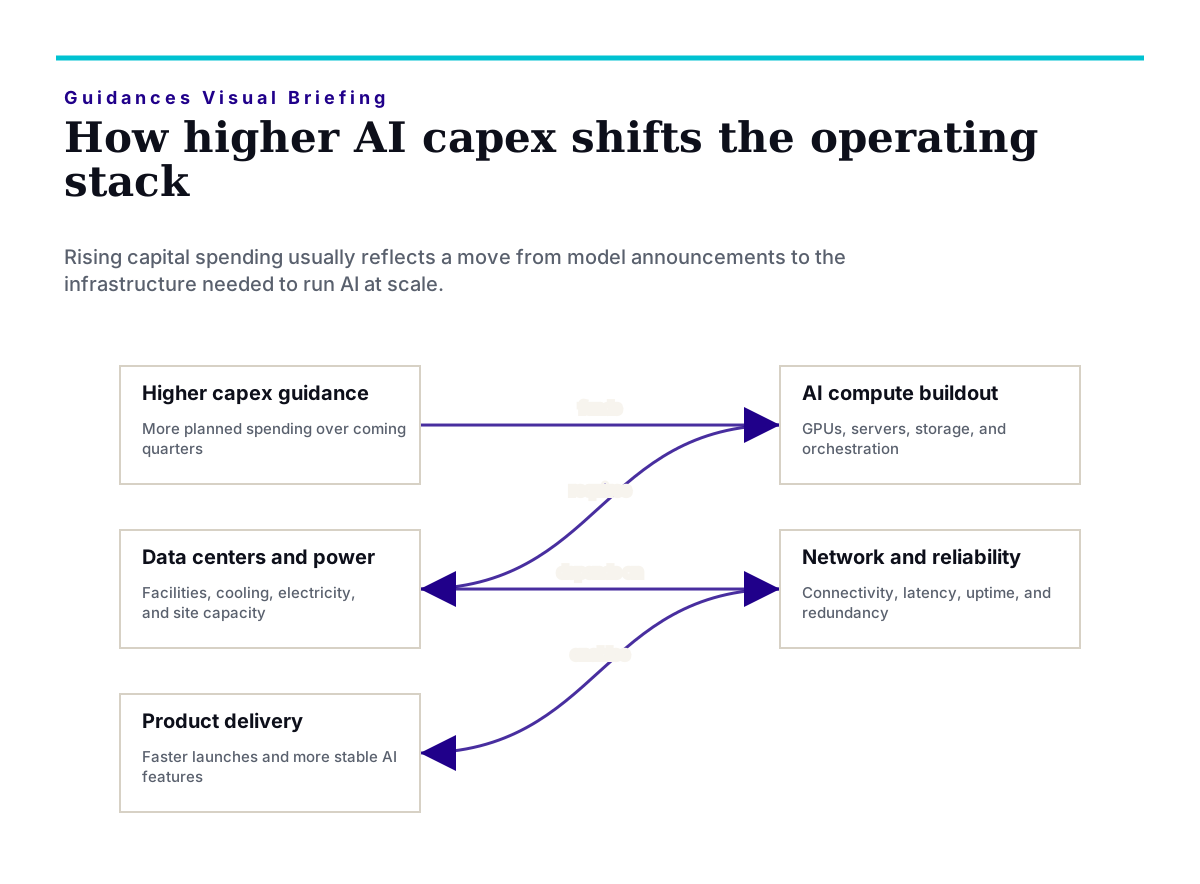
A capex increase often signals investment across the full AI infrastructure stack, not just model development.
Corrections and safety
See a factual, privacy, rights, or safety issue? Review the corrections process or contact Guidances before relying on this article for important decisions.