Finance
Ongoing · 1 updateFact 9/10NVIDIA Unveils Framework for Transaction-Based Foundation Models in Finance
NVIDIA has introduced a framework for building foundation models that learn customer behavior from transaction sequences. Using masked prediction and next-item forecasting techniques, the approach enables financial institutions to understand behavioral patterns and improve predictive accuracy from transactional data.
Open article · no sign-in required
Sources and disclosure
The core claim is directly supported by the provided NVIDIA news release context. The article’s main description of a framework for transaction-based foundation models in finance, using masked prediction and next-item forecasting, is verified. Some extended discussion in the article goes beyond the source and is framed as analysis or implications rather than source-confirmed fact, but it does not materially conflict with the verified announcement.
Market lens
Separate infrastructure signal from investable outcome
Treat market-linked stories as context: identify the mechanism, then wait for evidence before treating it as an outcome.
Impact path
Signal first, outcome later
Signals to watch
- Primary-source guidance and filings
- Price, volume, margin, and renewal evidence
- Follow-up reporting that confirms or rejects the mechanism
Verification schedule
D+1 · Jun 14
Is the mechanism visible in primary data?
D+3 · Jun 16
Do follow-up sources confirm direction and magnitude?
D+7 · Jun 20
Did the initial read overstate the market effect?
Informational context only — not investment, legal, tax, or financial advice.
NVIDIA has unveiled a methodology for building next-generation foundation models tailored to the financial industry, proposing a new direction for artificial intelligence development using transactional data. The framework focuses on learning behavioral patterns from customer transaction sequences, adopting masked prediction and next-item forecasting techniques as core training methods.
Financial institutions have long held vast repositories of customer transaction data, yet systematic approaches to training this data in a manner analogous to large language models have been limited. NVIDIA's framework treats transaction records as sequence data and applies pre-training techniques validated in natural language processing to the financial domain. Masked prediction involves obscuring portions of a transaction sequence and training the model to infer the missing information, while next-item forecasting develops the model's ability to predict future transactional behavior based on historical patterns.
This approach carries practical significance given the characteristics of financial data. Transaction data exhibits clear temporal ordering, each transaction possesses structured attributes such as amount, category, and timestamp, and thousands to tens of thousands of records accumulate per customer. This provides learning potential similar to text sequences, yet financial domains present unique challenges including sparsity, imbalance, and privacy constraints. NVIDIA's framework appears to offer a structure capable of effective learning within these constraints.
The core advantage of the foundation model approach resides in its generality and transfer learning capability. A model pre-trained on transaction data can be fine-tuned for diverse downstream tasks including credit scoring, risk detection, personalized recommendations, and churn prediction. Traditional methods required building separate models for each task and securing labeled data, but foundation models can first learn from large-scale transaction data through unsupervised learning, then adapt to specific tasks with small amounts of labeled data. This provides substantial benefits in data efficiency and development velocity.
For financial institutions, this framework offers a pathway to maximize the value of existing data assets. Banks, card issuers, and payment platforms possess transaction records accumulated over years, and leveraging these for foundation model training can secure competitive advantage. If models can automatically learn subtle patterns in customer behavior, seasonality, and lifestyle changes, far more sophisticated predictions become possible compared to manually designed rule-based systems.
However, practical deployment entails several considerations. First, transaction data contains sensitive personal information, making privacy-preserving technologies essential. Techniques such as federated learning, differential privacy, and secure multi-party computation must be combined to meet regulatory requirements while maintaining model performance. Second, the distribution of transaction data shifts over time, necessitating continuous retraining and monitoring of models. Third, financial decision-making demands explainability and auditability, requiring additional work to ensure interpretability rather than deploying black-box models directly.
NVIDIA's framework disclosure signals a directional shift in financial AI development while potentially influencing the broader hardware and software ecosystem. Transaction data learning demands large-scale sequence processing and parallel computation, making GPU-based infrastructure and optimized training libraries critical. NVIDIA appears to be pursuing a strategy to accelerate AI adoption in financial institutions by optimizing its hardware and software stack for the financial domain.
This announcement reflects the financial industry's movement beyond general-purpose language models toward domain-specific foundation models. While text-based models prove useful for analyzing financial documents or news, understanding and predicting actual customer behavior requires models trained directly on transaction data. NVIDIA's framework provides a concrete methodology to meet this need and is expected to serve as a reference for institutions preparing the next phase of financial AI.
The framework's emphasis on masked prediction and next-item forecasting aligns with proven techniques from language modeling, adapted to the unique structure of financial transactions. Unlike text, where tokens represent words or subwords, transaction sequences encode discrete events with multiple attributes—merchant category, transaction amount, location, time of day, and payment method. The model must learn not only sequential dependencies but also the relationships between these attributes and their predictive power for future behavior.
One key challenge in applying foundation models to financial data is the long-tail distribution of transaction types. While common categories such as groceries, fuel, and utilities appear frequently, rare but significant events—such as large purchases, international transactions, or unusual merchant interactions—carry disproportionate predictive value for tasks like risk detection or credit risk assessment. The framework must balance learning general patterns from frequent transactions with capturing the signal from rare events, a problem that requires careful attention to loss functions, sampling strategies, and model architecture.
Another consideration is the temporal granularity of transaction data. Unlike text, where word order is strictly sequential, transactions occur at irregular intervals with varying gaps between events. A customer may make multiple transactions in a single day, then none for a week. The model must encode not only the sequence of transactions but also the timing and spacing between them, as these temporal patterns carry information about customer behavior, financial stability, and risk. Techniques such as time-aware embeddings or positional encodings adapted for irregular time series may be necessary.
The framework's potential extends beyond individual customer modeling to institutional-level applications. Financial institutions can use transaction foundation models to understand aggregate trends, detect emerging risk patterns, optimize merchant networks, and inform product development. By learning representations of customer segments, transaction types, and behavioral clusters, the model can support strategic decision-making at multiple levels of the organization.
NVIDIA's involvement in this space also highlights the infrastructure requirements for training and deploying transaction foundation models. Large-scale sequence models demand substantial computational resources, and financial institutions may need to invest in GPU clusters, distributed training frameworks, and efficient data pipelines. NVIDIA's hardware and software offerings, including GPUs optimized for transformer architectures and libraries such as NeMo and Triton, position the company to capture value from this emerging application domain.
The framework's success will depend on collaboration between AI researchers, financial domain experts, and regulatory stakeholders. Building effective transaction models requires not only technical expertise in machine learning but also deep understanding of financial products, customer behavior, and compliance requirements. Institutions that can integrate these perspectives and invest in the necessary infrastructure are positioned to gain significant advantages in customer understanding, risk management, and operational efficiency.
Builder Implications
- Institutions with access to transaction data can build proprietary foundation models using masked prediction and next-item forecasting, then transfer-learn these models to downstream tasks such as credit scoring, risk detection, and recommendation systems, reducing reliance on labeled data.
- Privacy-preserving techniques including differential privacy and federated learning must be integrated from the initial design phase to ensure regulatory compliance while maintaining model performance, particularly when handling sensitive financial data.
- Leveraging GPU-based infrastructure and sequence model optimization libraries can improve the efficiency of large-scale transaction data training, and establishing continuous retraining pipelines is essential to adapt to shifting data distributions over time.
Want follow-up alerts? Subscribe by email after reading the public article.
Market lens
Separate infrastructure signal from investable outcome
Treat market-linked stories as context: identify the mechanism, then wait for evidence before treating it as an outcome.
Impact path
Signal first, outcome later
Signals to watch
- Primary-source guidance and filings
- Price, volume, margin, and renewal evidence
- Follow-up reporting that confirms or rejects the mechanism
Verification schedule
D+1 · Jun 14
Is the mechanism visible in primary data?
D+3 · Jun 16
Do follow-up sources confirm direction and magnitude?
D+7 · Jun 20
Did the initial read overstate the market effect?
Informational context only — not investment, legal, tax, or financial advice.
Visual Briefing
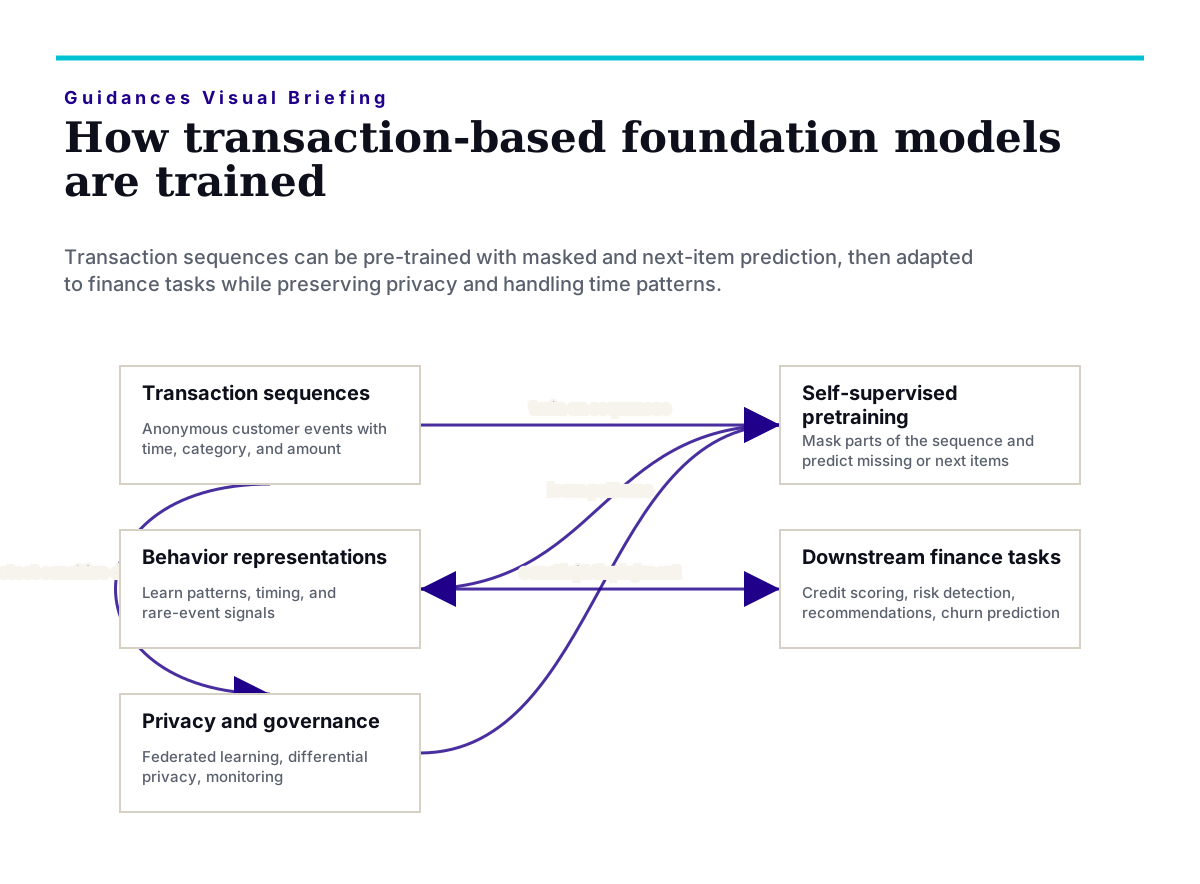
A simple workflow showing how financial transaction data can be turned into a reusable foundation model.
Corrections and safety
See a factual, privacy, rights, or safety issue? Review the corrections process or contact Guidances before relying on this article for important decisions.