Semiconductors
Developing · 0 updatesFact 8/10NVIDIA Uses Its AI Factory Concept to Emphasise Integrated Data-Centre Design
Article language
English
NVIDIA has presented its “AI factory” concept on its solutions page, describing energy, chips, infrastructure, models and applications as one system. The available material is limited, but it shows NVIDIA’s framing of AI infrastructure as an integrated design problem rather than a set of separate components.
Open article · no sign-in required
Sources and disclosure
The article stays within a neutral, informational framing and is broadly supported by the provided source context. It correctly treats the source as a solutions page rather than a news event, avoids unsupported price, customer, or market-share claims, and includes appropriate uncertainty about adoption and implementation details. The healthcare boundary is not implicated. One caution: the piece should continue to avoid implying market impact beyond positioning unless additional evidence is provided.
Market lens
On-device AI shifts attention from data-center chips to memory allocation and device margins
The useful read is whether local AI features create measurable pressure on memory mix, pricing, and product release schedules.
Impact path
Device AI → memory pressure
Signals to watch
- LPDDR and HBM allocation commentary
- AI PC and phone memory configurations
- Supplier lead times, spot pricing, and margin guidance
Verification schedule
D+1 · Jun 16
Do OEM launches raise baseline memory specs?
D+3 · Jun 18
Do suppliers change allocation or pricing language?
D+7 · Jun 22
Do device margins absorb or pass through memory cost?
Informational context only — not investment, legal, tax, or financial advice.
What NVIDIA has put on the table
NVIDIA is using its solutions page to advance a specific view of how AI infrastructure should be built and operated. Based on the available snippet, the company describes “AI factories” as systems that aim to reduce the time to intelligence at scale through pre-engineered rack-level designs, security, and an integrated software stack. The same material says these factories unify five critical layers: energy, chips, infrastructure, models, and applications. The intended workloads include agentic AI, physical AI, and high-performance computing.
That framing matters because the source is not a news release with a narrow event date, nor is it a detailed technical paper. It is a product and platform narrative. In other words, the verified fact here is not a specific shipment, customer win, or benchmark result. The verified fact is that NVIDIA is presenting a systems-level model for AI data centres and asking buyers to think in terms of integrated production environments rather than isolated servers or accelerators.
The wording also signals a shift in emphasis. The company is not merely talking about faster chips. It is talking about the entire stack around them: power, rack design, infrastructure, software, and the applications that sit on top. For developers and founders, that is a meaningful distinction. It suggests that the next phase of AI competition may be shaped as much by deployment architecture as by model architecture.
Why the market cares
The AI infrastructure market has been moving toward systems thinking for some time, but NVIDIA’s “AI factory” language gives that trend a more explicit industrial frame. The metaphor is deliberate. A factory is not a collection of parts; it is a coordinated process designed to produce output repeatedly, predictably, and at scale. Applied to AI, that implies a focus on throughput, reliability, energy use, and operational consistency, not only on raw compute.
This is especially relevant for agentic AI, physical AI, and HPC. Those categories are broad, but they share a common trait: they are operationally demanding. Agentic systems can require persistent inference, orchestration, and low-latency responses. Physical AI often interacts with real-world environments where timing and reliability matter. HPC workloads bring their own constraints around scheduling, memory, networking, and power density. By grouping these under one infrastructure story, NVIDIA is arguing that the same underlying design principles can serve multiple demanding workloads.
The five-layer model is also important from a procurement perspective. If energy, chips, infrastructure, models, and applications are treated as one system, then the bottleneck is no longer just the accelerator. The bottleneck can sit in power delivery, cooling, rack density, software orchestration, or application integration. That is a useful message for enterprise buyers because it reframes the conversation away from component shopping and toward end-to-end capacity planning.
For founders, the implication is more strategic. AI product teams often begin with model selection and application design, then discover that deployment costs, latency, and infrastructure complexity shape the product almost as much as the model itself. NVIDIA’s framing reinforces that lesson. It suggests that the infrastructure layer is not a passive utility; it is part of the product system.
Technology and policy linkage
The source also highlights how technical design and policy conditions are increasingly linked. By placing energy and infrastructure among the five critical layers, NVIDIA is implicitly acknowledging that AI scale depends on physical resources, site planning, cooling capacity, and operational coordination. Large AI deployments are not only software projects. They are also capital-intensive infrastructure programmes that depend on power availability, data-centre location, and procurement planning.
From a policy perspective, that matters because public-sector buyers and large enterprises often evaluate infrastructure through a mix of technical, operational, and compliance requirements. A system that is easier to deploy may still need to fit local energy constraints, procurement rules, and interoperability expectations. The available material does not specify how open the stack is, how portable workloads are, or how easily a buyer can mix components from different suppliers. Those are important details. For a startup or enterprise architecture team, portability and interoperability affect long-term negotiating power, migration costs, and the ability to adapt as workloads change.
Market Lens
From a market lens, the announcement is best read as a positioning statement rather than a measurable commercial event. It shows NVIDIA trying to define the category around integrated AI infrastructure, not around isolated hardware components. That is relevant for public-market observers because category framing can influence how investors, customers, and competitors discuss the sector, even when no immediate financial outcome is disclosed.
At the same time, the available evidence does not support claims about market share changes, revenue effects, or broad adoption. There is no confirmed pricing, no named customer, no benchmark, and no rollout schedule in the provided material. The prudent interpretation is that NVIDIA is reinforcing a systems-level narrative that may shape procurement language and product evaluation criteria, but the extent of adoption remains unverified.
The same caution applies to competition. A more integrated message does not by itself establish a new market standard. It does, however, indicate where the company wants the market conversation to move: from component performance to system integration, from chip specifications to operational throughput, and from isolated deployments to repeatable production environments.
Operating implications for builders
The most practical takeaway is that AI infrastructure decisions are becoming product decisions. If a vendor offers a pre-engineered, rack-level system with an integrated software stack, the immediate benefit is reduced assembly complexity. Teams may be able to move faster from procurement to deployment, and operations teams may face fewer integration tasks at the outset.
However, the same integration can create trade-offs. The available material does not specify how open the stack is, how portable workloads are, or how easily a buyer can mix components from different suppliers. Those are important details. For a startup or enterprise architecture team, portability and interoperability affect long-term negotiating power, migration costs, and the ability to adapt as workloads change.
That is why the “AI factory” concept should be read as both an opportunity and a constraint. It may simplify the first deployment. It may also encourage a tighter coupling between hardware, software, and operations. Builders should therefore ask not only whether a system is performant, but also whether it preserves architectural flexibility. The source material does not answer that question, so any serious evaluation must remain cautious.
There is also a planning implication around energy. NVIDIA places energy among the five critical layers, which is a reminder that AI scale is increasingly bounded by physical resources. For companies building or hosting AI services, this means that power availability, rack density, and thermal design are central to product delivery. A model that is technically feasible but operationally difficult to power or cool may not be commercially practical at scale.
The same logic applies to software. An integrated stack can reduce friction, but only if the software layer is mature enough to manage deployment, observability, and orchestration across the system. The snippet does not provide technical detail on those capabilities. That absence is itself informative: the public message is about the system vision, not about verifiable performance claims. Builders should treat it accordingly.
What to watch next
Because the source is a solutions page and the available text is only a short snippet, the evidentiary base is thin. There is no confirmed pricing, no named customer, no benchmark, no region-specific rollout, and no timeline for adoption. It would be inappropriate to infer market traction from this material alone.
The scope is also broad enough to invite over-reading. “Agentic AI,” “physical AI,” and “HPC” are not single markets. They represent different technical and commercial environments. A data-centre design that is attractive for one workload may not be optimal for another. The source does not provide enough detail to determine how NVIDIA is balancing those differences, or whether the AI factory concept is meant as a universal template or a family of reference architectures.
The next useful signals would be concrete product descriptions, clearer interoperability details, and evidence of how customers apply the concept in practice. Until then, the safest conclusion is that NVIDIA is trying to define a more integrated language for AI infrastructure, not that the market has already converged on one model.
Uncertainty and constraints
Because the source is a solutions page and the available text is only a short snippet, the evidentiary base is thin. There is no confirmed pricing, no named customer, no benchmark, no region-specific rollout, and no timeline for adoption. It would be inappropriate to infer market traction from this material alone.
The scope is also broad enough to invite over-reading. “Agentic AI,” “physical AI,” and “HPC” are not single markets. They represent different technical and commercial environments. A data-centre design that is attractive for one workload may not be optimal for another. The source does not provide enough detail to determine how NVIDIA is balancing those differences, or whether the AI factory concept is meant as a universal template or a family of reference architectures.
That uncertainty matters for founders and technical leaders because it limits how far the announcement can be operationalised. The safest conclusion is not that every team should adopt this model, but that the market is moving toward more integrated infrastructure narratives. Buyers will increasingly be asked to evaluate systems, not just parts.
Builder Implications
- Treat infrastructure architecture as part of product strategy, not as a later-stage procurement issue.
- Evaluate integrated AI stacks for portability, observability, and migration cost, not only for speed of deployment.
- Plan for power, cooling, and rack density early if the product roadmap depends on large-scale inference or agentic workloads.
- Use the AI factory framing as a prompt to review whether your current architecture can support repeatable deployment at scale.
This article is not medical advice and not investment advice.
Want follow-up alerts? Subscribe by email after reading the public article.
Market lens
On-device AI shifts attention from data-center chips to memory allocation and device margins
The useful read is whether local AI features create measurable pressure on memory mix, pricing, and product release schedules.
Impact path
Device AI → memory pressure
Signals to watch
- LPDDR and HBM allocation commentary
- AI PC and phone memory configurations
- Supplier lead times, spot pricing, and margin guidance
Verification schedule
D+1 · Jun 16
Do OEM launches raise baseline memory specs?
D+3 · Jun 18
Do suppliers change allocation or pricing language?
D+7 · Jun 22
Do device margins absorb or pass through memory cost?
Informational context only — not investment, legal, tax, or financial advice.
Visual Briefing
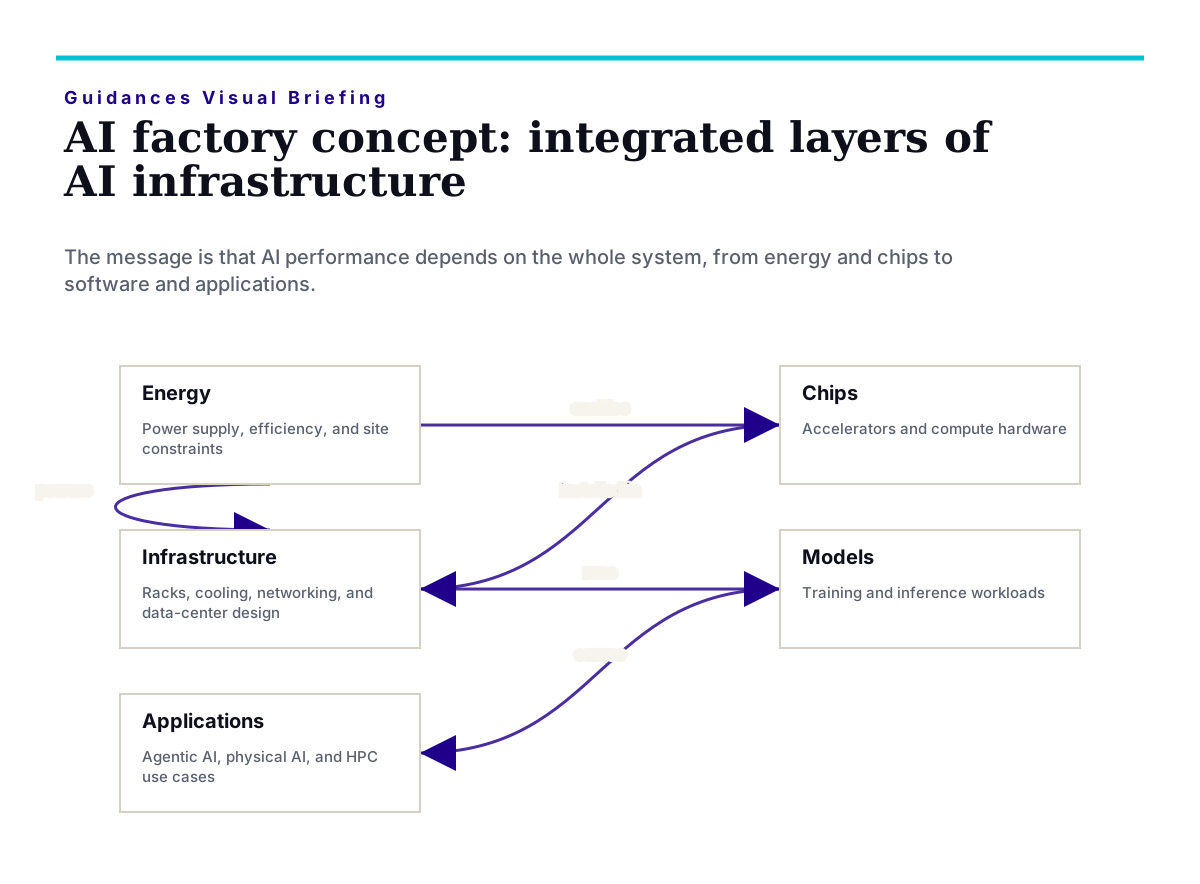
A simplified view of NVIDIA’s AI factory framing: multiple layers work together as one production system.
Corrections and safety
See a factual, privacy, rights, or safety issue? Review the corrections process or contact Guidances before relying on this article for important decisions.