AI
Developing · 0 updatesFact 8/10Tesla’s European FSD Approval Push Puts Safety-Data Verification and Regulatory Trust in Focus
Article language
English
Reuters reported, based on correspondence obtained through public-records requests, that Tesla submitted self-published safety statistics to regulators in Sweden and the Netherlands as part of its push for European approval of Full Self-Driving (FSD). Independent traffic-safety researchers said the presentation of the figures could be misleading, while the Dutch vehicle authority RDW said it relies on its own testing and analysis rather than marketing claims or outside statistics. The episode puts regulatory approval, data-verification standards, and the software-monetization path for autonomous driving back in focus.
Open article · no sign-in required
Sources and disclosure
What Happened
Reuters reported, based on correspondence obtained through public-records requests, that Tesla submitted self-published safety statistics on its Full Self-Driving (FSD) system to regulators in Sweden and the Netherlands as part of its effort to secure broader European approval. Independent traffic-safety researchers, according to the report, said the way the figures were presented amounted to misleading marketing. The Dutch vehicle authority RDW did not comment on the specific issues Reuters identified, but said it does not rely on marketing claims or outside statistics when making decisions and instead performs its own tests and analysis.
The immediate significance is not that a single data point was disputed, but that the dispute sits at the center of how autonomous-driving systems are judged. FSD is not merely a feature; it is part of Tesla’s broader attempt to turn software capability into a regulated, monetizable product. In Europe, that path depends on approval processes that are more institutionally layered than a company presentation or a product demo. The report suggests that regulators are treating Tesla’s own safety narrative as input, not as proof.
The source is limited. It does not disclose the exact statistics Tesla submitted, the methodology behind them, or the specific critique made by the independent researchers. That matters. Safety claims in autonomous driving can shift materially depending on the comparison baseline, the road conditions included, the time period sampled, and whether the data are normalized for exposure. Without those details, the prudent reading is not to infer a definitive regulatory outcome, but to note that the approval process itself is being tested by a dispute over evidence standards.
Tesla is seeking wider approval of FSD in Europe at a time when it is also trying to regain market share in the region. That makes the regulatory conversation commercially relevant even before any formal decision is announced. In a sector where software differentiation is increasingly tied to vehicle demand, the credibility of safety data can influence how quickly a feature moves from marketing claim to approved product.
Why the Market Cares
The market cares because autonomous-driving approval is one of the few levers that can change the economics of an automaker without requiring a new factory or a new vehicle platform. If a company can expand the use case for software-driven features, it can potentially deepen customer engagement, support recurring revenue, and strengthen product differentiation. That is especially important for Tesla, whose valuation has long reflected expectations that software and autonomy will matter as much as, or more than, unit sales alone.
FMP market-data context places Tesla’s scale at roughly $1.52 trillion in market capitalization, with annual revenue of about $94.8 billion and net income of about $3.8 billion. Revenue was down roughly 2.9% year over year and net income down about 46.8% in the provided context. Those figures are not the source of this report, but they help explain why a regulatory issue around FSD matters: when growth is under pressure, investors and operators pay closer attention to any product line that could alter the revenue mix or margin profile.
The mechanism is straightforward. If European regulators accept Tesla’s safety case, the company can continue building a commercial path for FSD in a major market. If regulators demand more evidence, the timeline for broader deployment can lengthen. That does not automatically change vehicle sales, but it can affect how much optionality the market assigns to Tesla’s software stack. In public markets, optionality is often priced before revenue is visible; that is why the quality of the evidence matters.
The issue also extends beyond Tesla. European approval standards for driver-assistance and autonomous systems shape the operating environment for other automakers and technology companies. If regulators become more skeptical of self-published safety statistics, firms seeking approval may need to invest more in third-party validation, transparent methodology, and regulator-specific testing. That can raise compliance costs, but it can also reduce ambiguity around what counts as acceptable evidence.
Technology / Policy Link
This report sits at the intersection of AI, automotive software, and regulatory policy. FSD depends on machine-learning models, sensor interpretation, and over-the-air software updates. Those are classic AI-adjacent capabilities, but they are deployed in a safety-sensitive environment where the burden of proof is higher than in consumer software. A model that performs well in one dataset or one geography may still face scrutiny if the regulator wants evidence under different road conditions, traffic patterns, or operational assumptions.
Policy matters because Europe does not treat manufacturer claims as self-validating. The RDW statement that it does not rely on marketing claims or external statistics is important not because it resolves the dispute, but because it clarifies the institutional logic. Regulators are signaling that they will use their own tests and analysis. For builders, that means the approval process is not just about product performance; it is about evidence design, documentation, and reproducibility.
There is also a broader AI infrastructure angle. Autonomous driving is one of the most capital-intensive forms of applied AI because it requires data pipelines, compute, simulation, validation, and continuous software iteration. Any tightening of approval standards can affect how companies allocate capex between model development, testing fleets, and compliance infrastructure. That is a sector-level consideration, not a Tesla-only issue.
At the same time, the source does not support a claim that this report will change semiconductor demand, cloud spending, or the economics of the wider AI stack. Those links remain unverified here. The defensible policy read-through is narrower: regulators may demand more transparent evidence before allowing a safety-sensitive AI system to scale in public roads.
Market Lens
Trigger: Reuters reported that Tesla submitted self-published FSD safety statistics to regulators in Sweden and the Netherlands, and that independent traffic-safety researchers viewed the presentation of those figures as misleading.
Mechanism: In autonomous driving, regulatory approval is a gating function for commercialization. If the evidence package is questioned, regulators can slow approval, ask for more testing, or narrow the scope of deployment. That affects the timing of software monetization and the credibility of the product narrative. The market link is therefore not a direct operating shock, but a possible change in the approval timeline and in how investors assess Tesla’s autonomy roadmap. Any broader market reaction is unverified from the source alone.
Affected Assets and Sectors: Tesla (TSLA) is the direct reference point. The report also matters for the broader EV and advanced driver-assistance systems ecosystem, including automakers pursuing autonomy-related features in Europe. Sector ETFs and autonomy-focused baskets could be sensitive if the story develops into a wider regulatory tightening, but that connection is unverified at this stage because the source does not identify a specific fund or index reaction.
Time Horizon: Near term, the key horizon is days to weeks, as regulators, Tesla, and independent researchers may add detail. Medium term, the relevant horizon is the approval cycle itself, which can stretch across months. Long term, the issue is whether Europe standardizes a stricter evidentiary bar for autonomous-driving claims.
Next Check: Watch for official comments from Tesla, RDW, and Swedish regulators; any follow-up documentation or methodology disclosure; and whether the issue appears in Tesla filings, investor communications, or future regulatory correspondence. Those are the concrete checks that can convert a reporting dispute into a measurable policy or commercial development.
This is market context only, not investment advice.
What to Watch Next
The first question is whether Tesla responds with a clearer explanation of how its safety statistics were constructed. If the company provides methodology, comparison baselines, and testing conditions, the debate may shift toward whether those inputs satisfy regulators rather than whether the data were presented appropriately. If it does not, the story may remain a credibility issue rather than a technical one.
The second question is whether the Dutch RDW or Swedish authorities issue any follow-up statements. The source indicates that RDW performs its own tests and does not rely on external statistics, but it does not show whether the agency sees a need for additional review. That distinction matters. A regulator can reject a company’s framing without escalating the matter, or it can use the episode to justify tighter scrutiny for future applications.
The third question is whether this becomes relevant to Tesla’s European commercial strategy. Europe is a region where Tesla is trying to regain market share, but the source does not provide evidence of a direct sales impact from this report. It would be premature to infer a demand effect. The more defensible view is that the approval process itself is part of Tesla’s competitive positioning in the region.
A final point of uncertainty is that the report does not identify the independent researchers in detail. Without that, it is difficult to assess whether the critique reflects a formal methodological review, a public-interest analysis, or a narrower technical objection. That limits how far the market should extrapolate.
Market lens
Agent runtime spending can spill into security, observability, and workflow infrastructure
The market signal is not another chatbot category; it is a possible budget shift toward the control layer around enterprise AI.
Impact path
Runtime spend → infra stack
Signals to watch
- Procurement language around audit logs and cost ceilings
- Security and observability vendors attaching agent controls
- Workflow platforms exposing approval and tool-call governance
Verification schedule
D+1 · Jun 18
Do buyers repeat audit/cost-control requirements?
D+3 · Jun 20
Do vendors publish runtime-control SKUs or partnerships?
D+7 · Jun 24
Do budgets move from pilots into operating infrastructure?
Informational context only — not investment, legal, tax, or financial advice.
Builder Implications
- Teams building autonomy or AI systems should assume that self-published performance data will be tested against regulator-specific standards, not just product marketing standards.
- Methodology transparency matters as much as headline metrics. Comparison baselines, data-collection conditions, and exposure normalization should be documented early, not retrofitted after scrutiny begins.
- For founders planning European expansion, approval strategy should be treated as a product function, not only a legal one. Evidence design, testing architecture, and compliance workflows can shape time to market as much as engineering performance does.
Want follow-up alerts? Subscribe by email after reading the public article.
Market lens
Agent runtime spending can spill into security, observability, and workflow infrastructure
The market signal is not another chatbot category; it is a possible budget shift toward the control layer around enterprise AI.
Impact path
Runtime spend → infra stack
Signals to watch
- Procurement language around audit logs and cost ceilings
- Security and observability vendors attaching agent controls
- Workflow platforms exposing approval and tool-call governance
Verification schedule
D+1 · Jun 18
Do buyers repeat audit/cost-control requirements?
D+3 · Jun 20
Do vendors publish runtime-control SKUs or partnerships?
D+7 · Jun 24
Do budgets move from pilots into operating infrastructure?
Informational context only — not investment, legal, tax, or financial advice.
Visual Briefing
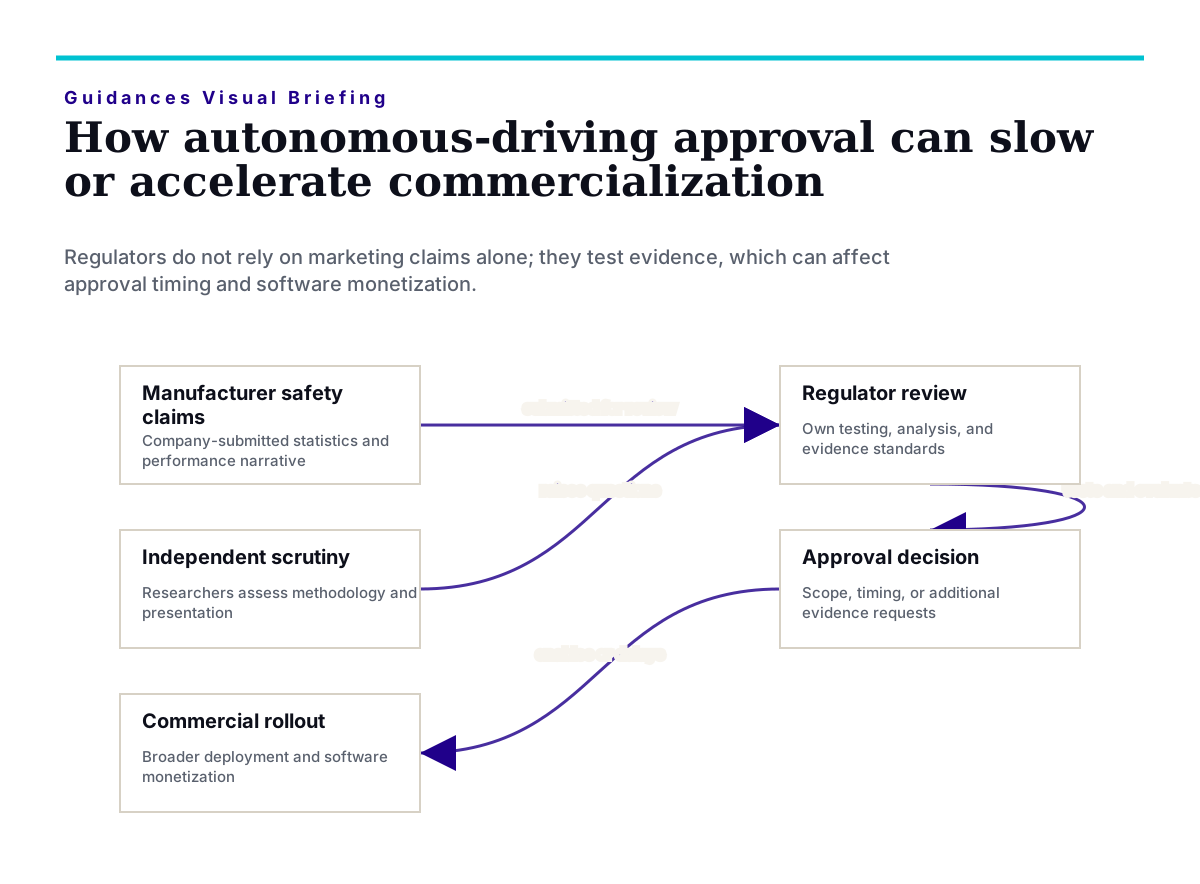
A simplified workflow showing how safety-data disputes can move from claims to review, then affect approval and rollout.
Corrections and safety
See a factual, privacy, rights, or safety issue? Review the corrections process or contact Guidances before relying on this article for important decisions.