Semiconductors
Developing · 0 updatesFact 8/10AI Capital Hunger Drives Near-Record Convertible Bond Issuance
Article language
English
Artificial intelligence companies are tapping the convertible bond market at near-record volumes to fund infrastructure ambitions, introducing a financing mechanism that links equity conversion rights to debt capital and reshapes how AI capex risk is distributed across fixed-income and equity markets.
Open article · no sign-in required
Sources and disclosure
What Happened
Artificial intelligence companies in the United States are issuing convertible bonds at volumes approaching historical records, according to reporting flagged by The Wall Street Journal. Convertible bonds are debt instruments that allow holders to exchange their bonds for equity if the issuing company's share price reaches a predetermined threshold. The surge in this financing channel reflects the extraordinary capital demands of AI infrastructure build-outs—data centers, GPU clusters, networking hardware, and the energy systems that power them—at a moment when conventional equity issuance and bank lending carry their own structural constraints.
The mechanism is structurally distinct from standard corporate bonds. Issuers typically accept a lower coupon rate in exchange for granting investors an embedded equity option. For AI companies, many of which carry elevated valuations and volatile share prices, this trade-off can be operationally attractive: they preserve cash by paying below-market interest while investors accept the lower yield in exchange for participation in any future equity conversion event.
Why the Market Cares
The scale of convertible issuance matters for several interconnected reasons that extend well beyond the bond market itself.
First, it signals the depth of capital demand in the AI sector. When companies move beyond conventional credit facilities and equity offerings into specialized instruments like convertibles, it typically indicates that the volume of required financing exceeds what standard channels can absorb efficiently. Near-record issuance volumes suggest that AI infrastructure spending is not a cyclical blip but a sustained, capital-intensive commitment with a multi-year horizon.
Second, convertible bonds create a direct mechanical link between debt markets and equity markets. As AI company share prices fluctuate, the conversion probability embedded in outstanding convertibles changes, affecting how bond investors hedge their positions—often through short-selling the underlying equity. This dynamic, known as delta hedging, can amplify equity price movements in both directions and introduces a feedback loop between fixed-income positioning and stock market behavior that is not present with ordinary corporate bonds. Market participants who track equity flow data may observe unusual short-interest patterns in AI stocks that are partly attributable to this hedging activity rather than to fundamental bearish sentiment.
Third, the choice of convertibles over straight debt or equity reveals something about how AI companies and their advisers perceive current market conditions. Convertibles are most structurally attractive to issuers when equity volatility is elevated—because high volatility increases the value of the embedded option, allowing issuers to offer a lower coupon—and when companies prefer not to dilute shareholders immediately through a direct equity offering. The current environment, characterized by elevated AI sector valuations and meaningful uncertainty about long-term monetization timelines, fits that structural profile closely.
Fourth, for fixed-income investors, near-record convertible issuance from AI companies represents a new category of credit exposure. Traditional bond investors who do not typically hold technology equity are now, through convertibles, acquiring indirect exposure to AI equity conversion events. This broadens the investor base funding AI infrastructure but also distributes AI-specific risk into portfolios that may not have been originally designed to carry it. Pension funds, insurance companies, and multi-asset managers absorbing this paper are taking on a form of technology sector exposure that sits outside their conventional equity allocation frameworks.
Technology and Policy Linkage
The convertible bond surge is inseparable from the policy and regulatory environment shaping AI infrastructure investment. U.S. export controls on advanced semiconductors, ongoing debates over data center energy permitting, and the evolving regulatory posture toward large AI model developers all affect the risk profile of the underlying businesses whose bonds are being issued.
For semiconductor-adjacent companies—those supplying chips, memory, networking equipment, and cooling systems to AI data centers—the convertible issuance wave among their customers is a leading indicator of sustained procurement intent. If AI companies are locking in multi-year capital commitments through bond markets, they are implicitly signaling confidence in continued hardware spending, which flows through to order books at chip designers and equipment manufacturers. This is not a guarantee of procurement, but it is a corroborating signal that sits alongside direct capex guidance from AI hyperscalers.
The policy dimension also includes interest rate dynamics. The Federal Reserve's rate trajectory directly affects the attractiveness of convertible bonds relative to other instruments. In a higher-for-longer rate environment, the below-market coupon on convertibles becomes more costly to issuers in relative terms, but the equity option component retains structural value as long as AI sector growth expectations remain elevated. Any shift in Fed policy that materially compresses equity valuations could simultaneously reduce the structural appeal of convertibles and tighten the broader financing conditions for AI infrastructure.
Export control policy adds a further layer of complexity. If restrictions on advanced chip exports tighten further, the capital efficiency of AI infrastructure spending could deteriorate, increasing the volume of financing required to achieve equivalent compute capacity. That dynamic would, paradoxically, increase demand for instruments like convertibles even as it raised the risk premium investors might demand.
Market Lens
Trigger: Near-record convertible bond issuance by AI-focused U.S. companies, as reported by The Wall Street Journal.
Mechanism: AI companies are using convertible instruments to access large volumes of capital at below-market coupon rates by granting investors an embedded equity option. This links fixed-income capital flows to AI equity performance and introduces delta-hedging dynamics that can affect equity price behavior independently of fundamental news flow.
Affected sectors: Technology and AI infrastructure broadly; semiconductor supply chains as downstream beneficiaries of sustained capex commitments signaled by bond issuance; fixed-income markets absorbing new AI-linked credit risk; equity markets subject to convertible-related hedging flows.
Time horizon: The issuance trend is observable in the near term. Effects on equity hedging flows and semiconductor order books are near-term to medium-term. Conversion events and their dilutive impact on equity are longer-dated, contingent on share price trajectories at the time of conversion windows.
Next check: Quarterly earnings disclosures from major AI infrastructure companies detailing capital structure changes and debt issuance; Federal Reserve communications for rate signals that affect convertible economics; semiconductor company order guidance for evidence that AI customer capex commitments are translating into hardware procurement; prospectus filings and SEC disclosures for specific deal terms and issuer identities.
Note: Specific ticker-level market reactions are not supported by the available source snippet. The above represents sector-level context only and is not investment advice.
What to Watch Next
Several developments will clarify whether the convertible issuance surge represents a durable structural shift or a cyclical response to current market conditions.
The trajectory of AI company revenue growth is the most critical variable. Convertible bonds are ultimately repaid or converted based on the issuer's financial performance and share price at the time of conversion windows. If AI monetization—through cloud services, enterprise software, API pricing, and advertising—accelerates to match infrastructure spending, conversion becomes more structurally plausible and dilution risk is absorbed by a growing equity base. If monetization lags, companies face the prospect of repaying large bond obligations from operating cash flows that have not yet materialized at scale, a scenario that would affect credit quality assessments across the AI convertible universe.
Regulatory developments around AI model governance, data privacy, and energy permitting for data centers could affect the risk premium investors assign to AI-linked convertibles. A significant adverse regulatory event could widen credit spreads on AI-linked debt and reduce the structural value of the equity option embedded in outstanding convertibles.
The behavior of institutional fixed-income investors—pension funds, insurance companies, and dedicated convertible arbitrage funds—will determine how much additional issuance the market can absorb at current terms. Near-record volumes suggest appetite remains strong, but the marginal investor's willingness to accept AI credit risk at prevailing coupon levels is a constraint that could tighten without advance warning, particularly if broader credit market conditions shift.
Finally, the maturity profile of the convertible bonds being issued now will create a future refinancing calendar. If a large cohort of AI convertibles matures within a narrow window, the refinancing demand could create concentrated pressure on capital markets at that future date, a dynamic worth tracking as deal terms become publicly available through regulatory filings.
Uncertainty and Constraints
The available source metadata is a snippet-level summary without full article access. Specific issuance volumes, named issuers, deal terms, and investor composition are not available for citation in this analysis. The analysis above is grounded in the structural mechanics of convertible bonds and the publicly understood capital demands of AI infrastructure, applied to the factual premise reported in the WSJ headline and snippet. Readers seeking precise deal data should consult primary filings, prospectuses, and financial data providers directly. This analysis is market context only and does not constitute investment advice.
Market lens
On-device AI shifts attention from data-center chips to memory allocation and device margins
The useful read is whether local AI features create measurable pressure on memory mix, pricing, and product release schedules.
Impact path
Device AI → memory pressure
Signals to watch
- LPDDR and HBM allocation commentary
- AI PC and phone memory configurations
- Supplier lead times, spot pricing, and margin guidance
Verification schedule
D+1 · Jun 18
Do OEM launches raise baseline memory specs?
D+3 · Jun 20
Do suppliers change allocation or pricing language?
D+7 · Jun 24
Do device margins absorb or pass through memory cost?
Informational context only — not investment, legal, tax, or financial advice.
Builder Implications
- Capital structure awareness for AI founders: If your company is approaching a scale where infrastructure costs require nine-figure financing, convertible instruments are increasingly normalized in the AI sector. Understanding the equity dilution mechanics and delta-hedging dynamics that accompany convertible issuance is essential before engaging investment banks on deal structure, as those dynamics affect your public market behavior independently of operating results.
- Semiconductor and hardware vendors: Near-record convertible issuance by AI companies is a corroborating signal for sustained capex intent. Vendors building sales pipelines or capacity plans around AI customer demand can treat this financing activity as one supporting indicator—though not a guarantee—of multi-year procurement commitments, and should cross-reference it against direct customer capex guidance.
- Developers building on AI infrastructure: The cost of AI compute is partly a function of how the underlying infrastructure was financed. If AI infrastructure companies carry substantial debt service obligations, pricing dynamics on API and cloud services may shift over time as those obligations approach maturity, affecting the unit economics of AI-native applications and warranting attention to the capital structure of key infrastructure providers.
Want follow-up alerts? Subscribe by email after reading the public article.
Market lens
On-device AI shifts attention from data-center chips to memory allocation and device margins
The useful read is whether local AI features create measurable pressure on memory mix, pricing, and product release schedules.
Impact path
Device AI → memory pressure
Signals to watch
- LPDDR and HBM allocation commentary
- AI PC and phone memory configurations
- Supplier lead times, spot pricing, and margin guidance
Verification schedule
D+1 · Jun 18
Do OEM launches raise baseline memory specs?
D+3 · Jun 20
Do suppliers change allocation or pricing language?
D+7 · Jun 24
Do device margins absorb or pass through memory cost?
Informational context only — not investment, legal, tax, or financial advice.
Visual Briefing
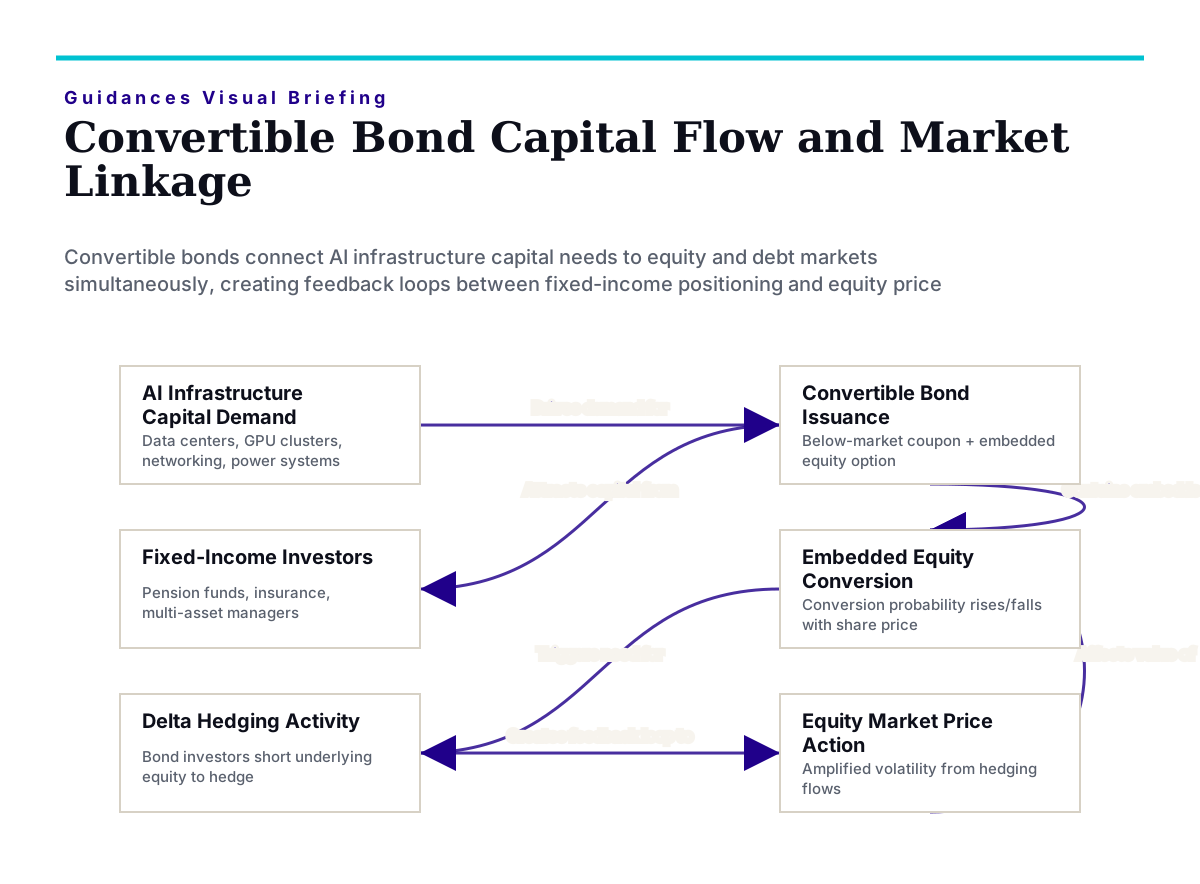
Convertible bonds create a mechanical linkage between AI capex financing and equity market behavior. As share prices move, the embedded equity option changes value, prompting bond investors to adjust hedges through short-selling, which can amplify equity price movements independent of fundamental news.
Corrections and safety
See a factual, privacy, rights, or safety issue? Review the corrections process or contact Guidances before relying on this article for important decisions.