Startups
Developing · 0 updatesFact 8/10Prometheus, the Bezos-backed industrial AI startup, reaches a $41 billion valuation
Article language
English
Axios reports that Prometheus, the industrial AI startup led by Jeff Bezos and former Google executive Vik Bajaj, is preparing to announce a $12 billion Series B round at a $41 billion valuation. The report highlights growing investor attention to tools aimed at engineering and manufacturing workflows.
Open article · no sign-in required
Sources and disclosure
The article is broadly supported by the provided sources. The core financing claim matches multiple references: Prometheus is associated with Jeff Bezos and Vik Bajaj, and reports say it is preparing to announce a $12 billion Series B at a $41 billion valuation. The article also stays mostly within informational market-context framing and includes uncertainty language. A few interpretive passages about broader AI capital flows and market implications are reasonable as analysis, not factual claims. No medical advice issues are present.
Market lens
Compliance copilots can turn regulatory pain into a vertical SaaS wedge
The signal is whether review-assist tools become budgeted workflow systems rather than experimental AI add-ons.
Impact path
Compliance pain → SaaS wedge
Signals to watch
- Regulated teams buying citation and policy-lineage features
- Pilots expanding from legal review into operating workflows
- Vertical SaaS vendors packaging domain-specific compliance copilots
Verification schedule
D+1 · Jun 16
Do pilots name budget owners?
D+3 · Jun 18
Do products move from assistant UI to workflow records?
D+7 · Jun 22
Do vertical vendors show repeatable templates?
Informational context only — not investment, legal, tax, or financial advice.
Axios reports that Prometheus, the industrial AI startup associated with Jeff Bezos and former Google executive Vik Bajaj, is preparing to announce a $12 billion Series B round at a $41 billion valuation. Based on the information provided, the story is not simply about a large financing event. It is also a sign of where AI capital is moving: toward tools that aim to reduce the time required to move from an engineering idea to a manufactured product.
What happened
According to the report, Bezos told Axios that the cycle from idea to product can be long, and that the company is building tools to help engineers make that loop faster. Bajaj is described as a co-leader of the effort. The available information is limited to the financing size, the valuation, and the company’s stated problem area. It does not include product architecture, customer details, revenue, deployment model, or performance evidence. Any interpretation should therefore remain within those boundaries.
Why the market cares
The market is paying attention because industrial AI is increasingly viewed as the next phase of generative AI. Over the past several years, AI attention has centered on text, code, and image generation. Manufacturing and engineering, however, may offer a larger economic footprint. Design review, simulation, process optimization, quality control, and component selection are all repetitive, time-intensive tasks. If AI can shorten even part of that cycle, the effect can extend beyond automation into faster product development and better capital efficiency.
The phrase Bezos used in the report, “cycle time,” points directly to that logic. Investors and builders are no longer looking only at what AI can generate on a screen. They are also asking how much it can compress the workflow that turns an idea into a physical product. In that sense, the Prometheus report is a signal about the direction of AI capital, not just a single financing headline.
Technology and policy linkage
Industrial AI sits at the intersection of technology and policy. Technically, model capability is necessary but rarely sufficient. Manufacturing and engineering environments involve legacy systems, specialized data formats, verification steps, and clear lines of responsibility. In practice, value often depends more on workflow integration than on model size alone. A product must connect to existing systems, present outputs in a reviewable form, and reduce repetitive work without disrupting established processes.
Policy considerations are also different from those in consumer AI. Safety, verifiability, accountability, and data handling matter more in industrial settings. Bezos’s framing suggests augmentation rather than replacement: the goal is to help engineers bring ideas to life more quickly, not to remove human judgment from the process. That distinction matters because it can affect adoption, oversight, and the practical path to deployment.
Market Lens
The $41 billion valuation cannot be fully assessed from the available information, but it does suggest that some investors are treating industrial AI as a platform opportunity rather than a narrow point solution. The number should not be overread. Without the underlying terms, it is impossible to know how much reflects current traction, future expectations, or the reputational weight of the founders. Even so, the scale indicates that capital is willing to price a long-duration thesis: AI will not only answer questions or draft code, but also reshape the engineering pipeline that turns ideas into physical goods.
For founders, the implication is clear. In industrial AI, model quality is necessary but rarely sufficient. The harder problem is integration. Manufacturing and engineering workflows are full of specialized constraints that do not resemble consumer software. A product that promises to accelerate engineering work must fit into existing systems, respect domain-specific requirements, and produce outputs that practitioners can trust. The report suggests that this integration layer is where durable value may accumulate.
What to watch next
The next questions are straightforward. What exactly is Prometheus building? Which industries is it targeting first? How does it plan to deploy its tools? Are there any details on customer adoption or technical validation? None of those answers are available in the current material, and that uncertainty should temper any attempt to draw firm conclusions.
It is also important to note that industrial AI often has a longer path from funding to deployment than software categories that can be launched and iterated quickly. Field data must be gathered, systems must be integrated, and performance must be demonstrated in environments where errors can be costly in time and resources. A large financing round does not by itself resolve those challenges.
Uncertainty and constraints
The source material is thin. There is no public detail here on revenue, customer base, technical benchmarks, or regulatory posture. There is no evidence in the provided text about market reaction or commercial traction. For that reason, the report should be read as a directional signal rather than a completed case study. The confirmed facts are limited to the planned financing, the valuation, and the company’s industrial AI positioning.
That limitation is part of the story. Large financings in frontier AI often arrive before the market can fully observe the product. The competitive field is still being defined, and the companies that matter may be those that can translate model capability into measurable operational gains. In practice, that means reducing cycle times, improving decision quality, and fitting into the cadence of engineering teams rather than asking those teams to reorganize around the software.
Builder Implications
For developers and founders, the report offers several practical lessons. First, workflow integration and measurable cycle-time reduction are likely to matter more than generic model capability. Second, large valuations can reflect strategic expectations, but deployment, customer trust, and operational fit remain essential. Third, industrial AI products should be designed with verification and human review in mind, especially where safety and accountability are important.
There is also a broader geographic implication, including for Korea. Manufacturing-heavy markets such as semiconductors, batteries, automotive systems, and precision machinery create natural opportunities for industrial AI experimentation. The lesson is not to chase a valuation headline. It is to identify narrow, economically meaningful bottlenecks where AI can improve engineering throughput without disrupting existing processes. That requires data discipline, workflow integration, and patience.
In short, the Axios report is less a finished portrait of Prometheus than a marker of market direction. The company appears to be building for the industrial layer of AI, and investors are assigning that layer a very large number. The public details are too sparse to draw firm conclusions about execution. Still, the strategic message is clear: AI capital is moving toward the systems that help engineers and manufacturers turn ideas into products faster. This article is for information only and is not investment advice.
Want follow-up alerts? Subscribe by email after reading the public article.
Market lens
Compliance copilots can turn regulatory pain into a vertical SaaS wedge
The signal is whether review-assist tools become budgeted workflow systems rather than experimental AI add-ons.
Impact path
Compliance pain → SaaS wedge
Signals to watch
- Regulated teams buying citation and policy-lineage features
- Pilots expanding from legal review into operating workflows
- Vertical SaaS vendors packaging domain-specific compliance copilots
Verification schedule
D+1 · Jun 16
Do pilots name budget owners?
D+3 · Jun 18
Do products move from assistant UI to workflow records?
D+7 · Jun 22
Do vertical vendors show repeatable templates?
Informational context only — not investment, legal, tax, or financial advice.
Visual Briefing
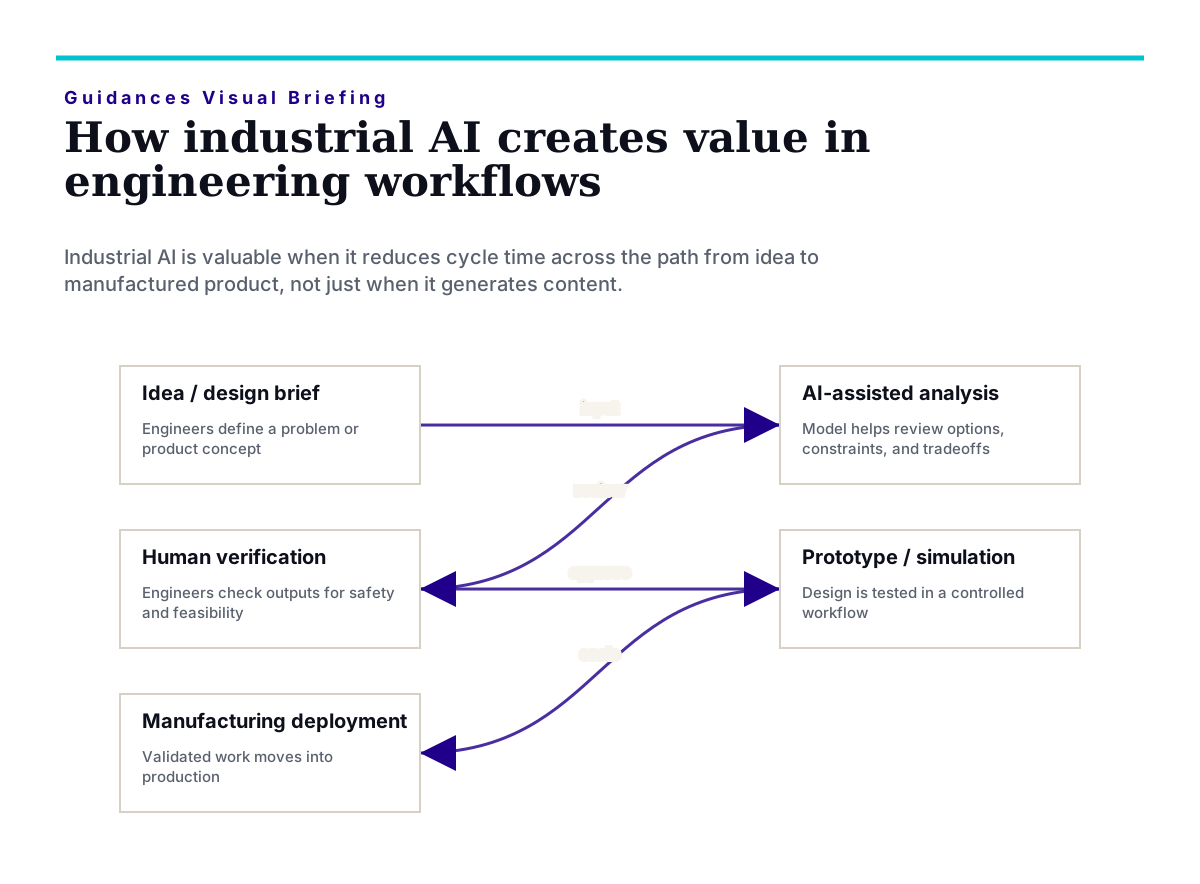
A simple workflow map showing where industrial AI can compress cycle time while keeping human review in the loop.
Corrections and safety
See a factual, privacy, rights, or safety issue? Review the corrections process or contact Guidances before relying on this article for important decisions.