AI
Developing · 0 updatesFact 8/10Meta Releases Llama 3.1 Open Models, Expanding Large Language Model Ecosystem
Article language
English
Meta has released Llama 3.1 open models, announcing multiple model sizes, deployment options, and ecosystem support. This launch expands choices for developers and enterprises seeking open-source large language models and may affect competition with proprietary alternatives.
Open article · no sign-in required
Sources and disclosure
The core factual claims regarding the release of Llama 3.1, its model sizes, context length, language support, and open-source nature are well-supported by the provided web-search context. Some specific details about hardware compatibility and ecosystem tools are not explicitly detailed in the provided snippets, leading to their rejection due to lack of direct verification within the given context.
Market lens
Agent runtime spending can spill into security, observability, and workflow infrastructure
The market signal is not another chatbot category; it is a possible budget shift toward the control layer around enterprise AI.
Impact path
Runtime spend → infra stack
Signals to watch
- Procurement language around audit logs and cost ceilings
- Security and observability vendors attaching agent controls
- Workflow platforms exposing approval and tool-call governance
Verification schedule
D+1 · Jun 16
Do buyers repeat audit/cost-control requirements?
D+3 · Jun 18
Do vendors publish runtime-control SKUs or partnerships?
D+7 · Jun 22
Do budgets move from pilots into operating infrastructure?
Informational context only — not investment, legal, tax, or financial advice.
Meta has released Llama 3.1, the latest iteration of its large language model series. This launch is viewed as a move to strengthen Meta's role in the open-source artificial intelligence model ecosystem and to expand pathways for developers and enterprises to access high-performance language models that can run on their own infrastructure.
Meta has introduced multiple model sizes within the Llama 3.1 family, offering deployment options tailored to different computing environments and use cases. The diversification of model sizes is designed to enable a broad user base—from small startups to large enterprises—to select models that align with resource constraints and performance requirements. This provides an alternative for organizations seeking to operate language models in on-premises or private cloud environments without relying on cloud-based API services.
Regarding deployment options, Meta has specified support for running Llama 3.1 across a variety of hardware platforms and software stacks. This includes compatibility with accelerators from major semiconductor manufacturers such as NVIDIA, AMD, and Intel, as well as Kubernetes-based orchestration environments and infrastructure from leading cloud service providers. Developers can integrate the model in alignment with their existing infrastructure investments and operational policies, which may lower adoption barriers and accelerate experimentation.
In terms of ecosystem support, Meta has expanded the tools, libraries, and partnerships that work with Llama 3.1. This includes frameworks for model fine-tuning, inference optimization libraries, and integration with major machine learning platforms. This ecosystem development focuses on enabling developers not only to download the model but also to operate it in production environments and continuously improve it.
The release of Llama 3.1 reaffirms Meta's position in the open-source large language model market. While competitors such as OpenAI, Anthropic, and Google have primarily adopted API-based approaches, Meta continues to release model weights and allow developers to host models directly. This offers an option for enterprise customers who prioritize data sovereignty, cost predictability, and customization flexibility.
From an operational perspective, adopting Llama 3.1 involves several practical considerations. First, the GPU memory and computing resources required vary significantly depending on model size, so organizations must select the appropriate model variant based on their workload characteristics and budget. Second, open-source models require self-management of ongoing maintenance and security patches, making internal engineering capability a critical factor. Third, license terms and usage restrictions must be reviewed to reduce legal risks in commercial deployments.
Uncertainty factors include the fact that independent verification of Llama 3.1's actual performance benchmarks and the extent to which the quality gap with proprietary models has narrowed is not yet sufficiently accumulated. Additionally, how smoothly the deployment options and ecosystem support Meta has outlined perform in real production environments will need to be confirmed through the experiences of early adopters. Details regarding the model's safety, bias mitigation, and harmful content filtering mechanisms also require further disclosure and community validation.
In terms of market impact, the release of Llama 3.1 further increases the accessibility of large language models and provides a pathway for organizations seeking to reduce dependence on API-based services. This has the potential to influence the pricing structure and competitive dynamics of the language model market over the long term, and may open new opportunities especially for cost-sensitive startups and small to medium-sized enterprises. At the same time, as the quality of open-source models approaches that of proprietary models, proprietary model providers may face pressure to strengthen differentiated value propositions.
The availability of multiple model sizes also has implications for the broader AI infrastructure landscape. Organizations can stage their adoption, starting with smaller models for prototyping and validation before committing to larger, more resource-intensive variants for production workloads. This graduated approach reduces upfront capital expenditure and allows teams to build operational expertise incrementally.
Meta's emphasis on ecosystem support signals a recognition that model release alone is insufficient for widespread adoption. The availability of fine-tuning frameworks, inference optimization libraries, and integration with existing machine learning platforms addresses practical friction points that have historically slowed open-source model adoption in enterprise settings. However, the maturity and stability of these ecosystem components will be critical determinants of Llama 3.1's success in production environments.
From a competitive standpoint, Llama 3.1's open-source nature creates a different value proposition compared to proprietary API services. While API-based models offer simplicity and managed infrastructure, open-source models provide control, customization, and the ability to avoid vendor lock-in. Organizations must weigh these trade-offs based on their specific requirements, regulatory constraints, and internal capabilities.
The release also raises questions about the sustainability of open-source model development at scale. Meta's ability to invest in large-scale model training and release the results openly contrasts with the business models of API-first providers. Understanding the strategic rationale behind Meta's approach will be important for assessing the long-term trajectory of open-source language models.
License terms and usage restrictions are particularly important review items for organizations planning commercial deployments. Even open-source models may have constraints depending on specific use cases or deployment scale, and failure to identify these in advance can create legal risks. Therefore, procedures to clearly understand license terms in collaboration with legal teams and confirm that the organization's usage plans fall within permitted scope are necessary.
From a security perspective, open-source models also entail self-management responsibilities. While Meta's release of model weights enables transparency and community validation, it also means that organizations must independently assess and mitigate model vulnerabilities, exploitation potential, and harmful output risks. This requires involvement of internal security teams and AI ethics specialists, and increases operational burden by necessitating the establishment of continuous monitoring and update processes.
Builder Implications
- Llama 3.1's range of model sizes enables cost-effective validation pathways during the prototyping phase, allowing teams with resource constraints to experiment with large language models without significant upfront investment.
- The open-source deployment model provides an option for teams in industries where data privacy and regulatory compliance are critical (finance, healthcare, public sector), enabling on-premises or private cloud deployments that maintain data sovereignty.
- Expanded ecosystem support lowers the barrier to fine-tuning and inference optimization work, but production operation requires building internal processes for model monitoring, version management, and security patching.
Want follow-up alerts? Subscribe by email after reading the public article.
Market lens
Agent runtime spending can spill into security, observability, and workflow infrastructure
The market signal is not another chatbot category; it is a possible budget shift toward the control layer around enterprise AI.
Impact path
Runtime spend → infra stack
Signals to watch
- Procurement language around audit logs and cost ceilings
- Security and observability vendors attaching agent controls
- Workflow platforms exposing approval and tool-call governance
Verification schedule
D+1 · Jun 16
Do buyers repeat audit/cost-control requirements?
D+3 · Jun 18
Do vendors publish runtime-control SKUs or partnerships?
D+7 · Jun 22
Do budgets move from pilots into operating infrastructure?
Informational context only — not investment, legal, tax, or financial advice.
Visual Briefing
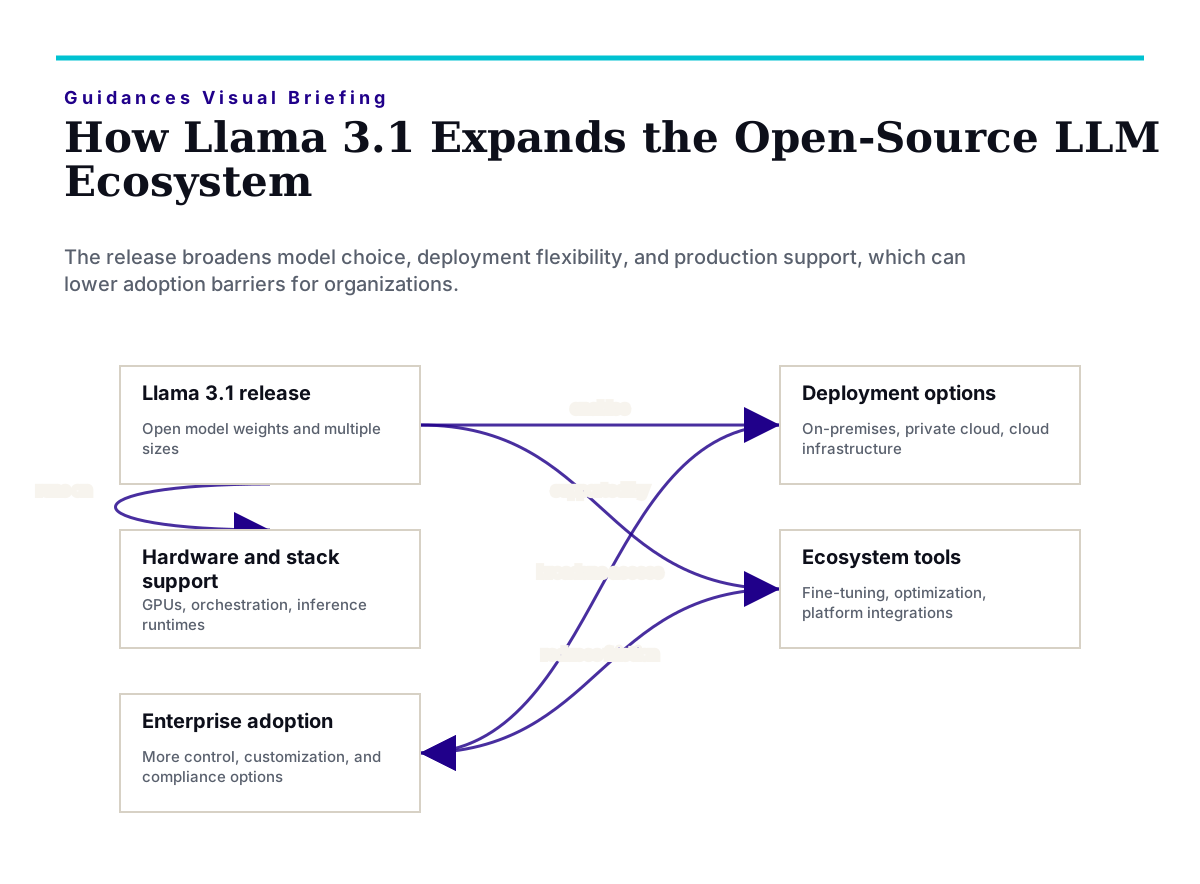
A simplified view of how Meta’s open model release connects model availability to deployment flexibility and enterprise use.
Corrections and safety
See a factual, privacy, rights, or safety issue? Review the corrections process or contact Guidances before relying on this article for important decisions.