AI
Developing · 0 updatesFact 8/10UK Moves Toward Under-16 Social Media Limits, Raising Fresh Pressure on Platforms and Ad Models
Article language
English
The UK government says it will move to restrict social media services for users under 16, putting age verification, recommendation systems, ad targeting, and youth-safety compliance back in focus. The enforcement details are still unclear, but the policy direction alone could shape product design and compliance costs for global platforms.
Open article · no sign-in required
Sources and disclosure
What happened
The United Kingdom says it will move to restrict social media services for users under 16, a policy step that immediately places youth-safety regulation back at the center of the digital platform debate. Based on the available snippet, Prime Minister Keir Starmer framed the move as an effort to strengthen protections for children, and the list of potentially affected services includes major consumer platforms such as Snapchat, TikTok, YouTube, Instagram, Facebook, and X. That is the extent of the verified record available here. The source does not provide the legal text, implementation timetable, enforcement mechanism, or any carve-outs, so those details remain unknown.
Even with limited information, the policy signal is clear enough to matter. This is not merely a statement about content moderation or parental concern. It is a direct challenge to how large platforms authenticate age, structure feeds, target ads, and design engagement loops. In other words, the issue sits at the intersection of public policy, product architecture, and monetization.
Why the market cares
The market relevance comes from the possibility that a national rule could force platform operators to change product flows and compliance systems in a way that affects user acquisition, engagement, and ad efficiency. Social platforms depend on scale, frequency, and precise targeting. If a meaningful share of younger users must be identified, separated, or restricted, the operational burden rises. That burden can show up as higher compliance spending, slower onboarding, more friction in account creation, and potentially lower ad inventory in certain age segments.
For public-market investors, the more important question is not whether the policy sounds strict, but whether it becomes operationally expensive. Large platforms with established compliance teams may absorb the change more easily than smaller services, but the cost is still real. The policy could also encourage a broader shift toward privacy-preserving identity checks, age-assurance vendors, and region-specific product controls. Those are not guaranteed outcomes; they are plausible mechanisms if the proposal becomes law.
The advertising model is especially sensitive. If under-16 users are excluded from certain services or placed behind stricter controls, platforms may need to alter recommendation systems and ad targeting logic. That can affect campaign reach and measurement, particularly for brands that rely on broad consumer discovery. The effect would likely be uneven across platforms, depending on how much youth engagement each service captures and how much of its revenue depends on consumer attention rather than enterprise or subscription models.
Tech / policy link
This is a technology-policy story as much as a social-policy story. Age verification is not a simple checkbox. It can involve identity checks, device-level signals, behavioral inference, parental consent workflows, and data-minimization rules. Each of those methods carries trade-offs between accuracy, privacy, user friction, and regulatory defensibility. If the UK proceeds, platform teams will have to decide whether to build a single global standard or maintain country-specific controls.
The recommendation layer is another pressure point. Youth-safety rules often push platforms to reduce the intensity of algorithmic feeds, limit autoplay or infinite scroll, and tighten content classification. That matters because recommendation systems are not just product features; they are core distribution infrastructure. Any change to feed ranking or content exposure can alter engagement metrics, which in turn can affect ad load, session length, and the economics of attention.
For AI operators, this is also a reminder that model governance is becoming product governance. If a platform uses machine learning to infer age, classify content, or personalize feeds, then the model itself becomes part of the compliance stack. That raises questions about auditability, explainability, and error handling. The source does not indicate any specific AI system change, so any direct claim about model impact would be unverified. Still, the policy direction points toward more constrained use of algorithmic personalization in youth-facing contexts.
Market Lens
Trigger: The UK government announced plans to restrict social media services for users under 16.
Mechanism: If implemented, the rule could require age verification, account segmentation, feed adjustments, and tighter ad-targeting controls. Those changes would likely increase compliance costs and could reduce engagement or monetization efficiency in youth-heavy segments.
Affected assets / sectors: The most directly relevant public-market names are large communication-services platforms such as Meta and Alphabet, given their scale in consumer attention and digital advertising. Consumer social platforms more broadly, ad-tech vendors, identity-verification providers, and privacy software firms could also be affected. Any ETF or index-level read-through is unverified at this stage because the source does not provide market reaction or cross-asset evidence.
Time horizon: The immediate horizon is the policy process itself: draft language, parliamentary or regulatory steps, and implementation details. The medium-term horizon is product redesign and compliance rollout. The longer-term horizon is whether similar rules spread to other jurisdictions, which would matter more for platform architecture than for a single-country announcement.
Next check: Watch for the UK government’s formal proposal, enforcement timeline, and any official guidance on age-assurance methods. Also watch company disclosures, earnings commentary, or policy updates from affected platforms for any mention of compliance cost, product changes, or regional feature restrictions. Until those appear, any broader market read-through remains tentative.
What to watch next
The first question is whether this becomes a binding rule or remains a political commitment. The second is how the government defines “social media” and whether the scope includes video platforms, messaging features, or only certain interactive services. The third is who bears responsibility for enforcement: the platform, the app store, the device maker, or the user.
Those details matter because they determine the cost structure. A platform-level obligation to verify age is materially different from an app-store gate or a device-based control. They also matter for competition. If compliance is expensive, large incumbents may be better positioned than smaller entrants, but that is a structural inference, not a confirmed outcome from the source.
For the broader tech sector, the policy is another sign that consumer internet products are being asked to prove not only utility but also age-appropriate design. That can influence product road maps, trust-and-safety staffing, and the pace at which new features are launched in regulated markets.
Uncertainty or constraints
The available source material is thin. It confirms the announcement and the broad policy direction, but not the legal mechanism, scope, or implementation details. It does not support claims about revenue impact, user losses, stock moves, or sector-wide valuation effects. Any such conclusion would be premature.
This analysis is market context only, not investment advice.
Market lens
Agent runtime spending can spill into security, observability, and workflow infrastructure
The market signal is not another chatbot category; it is a possible budget shift toward the control layer around enterprise AI.
Impact path
Runtime spend → infra stack
Signals to watch
- Procurement language around audit logs and cost ceilings
- Security and observability vendors attaching agent controls
- Workflow platforms exposing approval and tool-call governance
Verification schedule
D+1 · Jun 18
Do buyers repeat audit/cost-control requirements?
D+3 · Jun 20
Do vendors publish runtime-control SKUs or partnerships?
D+7 · Jun 24
Do budgets move from pilots into operating infrastructure?
Informational context only — not investment, legal, tax, or financial advice.
Builder Implications
- Product teams should treat age assurance and regional policy controls as core infrastructure, not as after-the-fact compliance patches.
- Recommendation and ad systems may need jurisdiction-specific guardrails, audit logs, and feature flags to support rapid policy changes.
- Founders building identity, moderation, or privacy tooling should expect continued demand for solutions that reduce compliance friction without adding excessive user friction.
Want follow-up alerts? Subscribe by email after reading the public article.
Market lens
Agent runtime spending can spill into security, observability, and workflow infrastructure
The market signal is not another chatbot category; it is a possible budget shift toward the control layer around enterprise AI.
Impact path
Runtime spend → infra stack
Signals to watch
- Procurement language around audit logs and cost ceilings
- Security and observability vendors attaching agent controls
- Workflow platforms exposing approval and tool-call governance
Verification schedule
D+1 · Jun 18
Do buyers repeat audit/cost-control requirements?
D+3 · Jun 20
Do vendors publish runtime-control SKUs or partnerships?
D+7 · Jun 24
Do budgets move from pilots into operating infrastructure?
Informational context only — not investment, legal, tax, or financial advice.
Visual Briefing
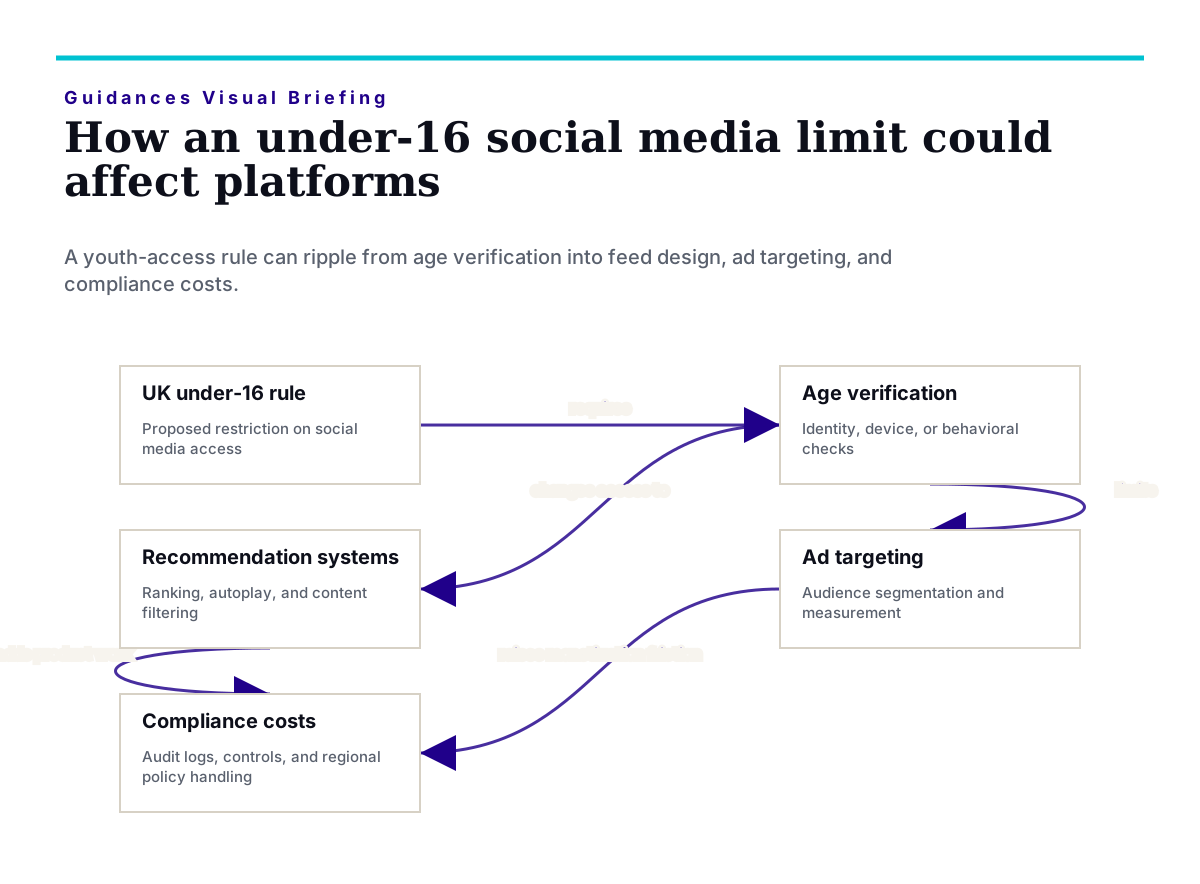
A policy change can cascade through verification, product design, and monetization systems.
Corrections and safety
See a factual, privacy, rights, or safety issue? Review the corrections process or contact Guidances before relying on this article for important decisions.