Policy
Ongoing · 1 updateFact 8/10The State of AI Red-Teaming: Diverse Practices Amid Absence of Standards
Georgetown University's Center for Security and Emerging Technology (CSET) has published an analysis of AI red-teaming methodologies. While red-teaming is gaining attention as an evaluation technique to discover flaws and vulnerabilities in AI systems, practices vary widely across organizations and few established standards exist. This raises challenges for consistency and comparability in AI safety evaluation.
Open article · no sign-in required
Sources and disclosure
Core claims are supported by the provided context: CSET published guidance on AI red-teaming design, threat models, and tools; practices vary widely; and standardized methods remain limited. The article stays broadly neutral and aligns with the source context. Some broader regulatory and ecosystem statements are generalized, but not materially unsupported within the provided evidence.
Market lens
AI governance becomes an operating checklist buyers can audit
The market effect depends on whether policy language turns into required logs, evaluations, incident-response records, and launch gates.
Impact path
Policy memo → ops checklist
Signals to watch
- Draft rules specifying retention or audit evidence
- Enterprise RFPs requiring AI operation logs
- Product launches centered on governance workflows
Verification schedule
D+1 · Jun 15
Do rules move from principles into required artifacts?
D+3 · Jun 17
Do RFPs ask for evidence before model benchmarks?
D+7 · Jun 21
Do vendors ship audit workflows as core product?
Informational context only — not investment, legal, tax, or financial advice.
Georgetown University's Center for Security and Emerging Technology (CSET) has released an analysis of AI red-teaming approaches, covering design considerations, threat models, and tools. The material describes red-teaming as a method for identifying weaknesses in AI systems, while observing that implementation differs substantially among organizations and that consensus standards remain scarce.
AI red-teaming is a concept borrowed from traditional cybersecurity, where systems are attacked from an adversarial perspective to identify vulnerabilities. When applied to AI systems, this approach is used to discover a range of issues including model bias, safety flaws, prompt injection vulnerabilities, data leakage risks, and unexpected outputs. However, according to CSET's analysis, the specific execution methods, evaluation scope, threat model definitions, tools used, and reporting formats for AI red-teaming differ significantly across organizations, limiting the consistency and comparability of evaluation results.
The absence of standards creates several operational challenges. First, AI development organizations lack a common framework to reference when designing red-teaming exercises, forcing each team to build approaches independently. This can affect the completeness and efficiency of evaluations. Second, it is difficult to compare or benchmark red-teaming results conducted by different organizations. Third, regulatory and audit bodies face challenges applying consistent criteria when verifying AI system safety. Fourth, it creates obstacles to building training and certification systems for red-teaming specialists.
The diversity of threat models also complicates standardization. Threats to AI systems vary significantly depending on use case, deployment environment, user population, and data sensitivity. For example, the threat model for a customer service chatbot focuses primarily on inappropriate responses, personal information leakage, and brand reputation damage, while the threat model for a medical diagnostic AI centers on misdiagnosis risk, patient safety, regulatory compliance, and data security. This context dependency makes it difficult to define a single red-teaming standard.
The fragmentation of the tool ecosystem adds to standardization challenges. Tools currently used for AI red-teaming include open-source frameworks, commercial platforms, and custom-developed scripts, each supporting different attack vectors, evaluation metrics, and output formats. Some tools specialize in prompt injection testing, while others focus on measuring model bias or generating adversarial examples. This lack of interoperability among tools creates barriers to conducting comprehensive red-teaming evaluations.
Nevertheless, the importance of AI red-teaming continues to grow. AI regulatory frameworks in major jurisdictions including the United States, European Union, and United Kingdom require pre-deployment safety evaluations, and red-teaming is considered one of the core approaches for meeting these requirements. Additionally, as the capabilities of large language models (LLMs) expand, unexpected risks are increasing, making systematic adversarial evaluation more necessary.
Early movements toward standardization are also observable. The U.S. National Institute of Standards and Technology (NIST) has published an AI Risk Management Framework, and some industry consortia and research institutions are developing red-teaming guidelines. However, these efforts are still in early stages, and widespread adoption and practical integration will likely require time.
AI development organizations should not wait for standards to be established, but rather actively adopt currently available best practices and build internal red-teaming capabilities. This includes defining threat models, designing diverse attack scenarios, combining automated tools with manual evaluation, systematically documenting evaluation results, and establishing processes for prioritizing and remediating discovered vulnerabilities. Organizations can also ensure evaluation independence and diversity through collaboration with external red-teaming experts, operating bug bounty programs, and participating in community-based assessments.
The CSET analysis highlights a critical gap in the AI safety ecosystem. While red-teaming is increasingly recognized as essential for responsible AI deployment, the lack of standardized approaches creates uncertainty for builders, operators, and regulators. Organizations that invest in robust red-teaming processes now, even in the absence of formal standards, will be better positioned to meet evolving regulatory requirements and maintain user trust. The development of common frameworks, shared tools, and interoperable evaluation methods will be essential for scaling AI safety practices across the industry.
The variability in red-teaming practices also reflects the nascent state of AI safety as a discipline. Unlike traditional software security, where decades of experience have produced established testing approaches and vulnerability classifications, AI safety is still developing its foundational concepts. Red-teaming for AI systems must address not only technical vulnerabilities but also behavioral risks, alignment failures, and emergent capabilities that may not be predictable from training data or model architecture alone. This complexity requires evaluation approaches that are both rigorous and adaptable.
For organizations building AI systems, the current landscape presents both challenges and opportunities. The absence of prescriptive standards allows flexibility in tailoring red-teaming approaches to specific use cases and risk profiles. However, this flexibility also places responsibility on builders to ensure their evaluation methods are comprehensive and defensible. Documentation of red-teaming processes, threat models, and remediation actions will be critical for demonstrating due diligence to regulators, customers, and other stakeholders.
The maturity of evaluation approaches is expected to evolve over time. Early red-teaming efforts focused primarily on obvious safety failures and easily elicited harmful outputs. However, as AI systems become more sophisticated and are deployed in broader contexts, evaluations must address subtle biases, long-term behavioral drift, multi-modal interactions, and system-level risks. This requires interdisciplinary approaches that combine technical testing, social science research, and domain expertise.
The economic implications of red-teaming also merit consideration. Comprehensive adversarial evaluation requires significant investment in specialized personnel, tools, and time. Organizations must balance the cost of thorough red-teaming against the potential risks of deploying systems with undetected vulnerabilities. This calculation varies depending on the application domain, user base, and regulatory environment. High-stakes applications such as healthcare, finance, and critical infrastructure justify more extensive red-teaming investments, while lower-risk applications may adopt lighter-weight approaches.
The role of external red-teaming is also evolving. While internal teams provide valuable evaluation capabilities, external experts bring fresh perspectives and may identify vulnerabilities that internal teams overlook due to familiarity with the system. Bug bounty programs, third-party audits, and community-based testing initiatives are becoming more common in the AI industry, mirroring practices from traditional software security. However, the effectiveness of these external mechanisms depends on clear scope definitions, appropriate incentives, and robust processes for triaging and addressing reported issues.
Builder Implications
- Establish internal red-teaming processes before AI system deployment, with approaches tailored to organizational threat models and use cases. In the absence of standards, document evaluation scope, methods, and tool choices to prepare for future audits and regulatory compliance.
- Integrate red-teaming results into product development cycles, systematizing severity classification of discovered vulnerabilities, remediation prioritization, and re-evaluation processes. This contributes not only to regulatory compliance but also to building user trust.
- Actively participate in industry standards formation and collaborate with open-source red-teaming tool development communities to contribute to building an interoperable evaluation ecosystem. This increases long-term adaptability to changing regulatory requirements.
Want follow-up alerts? Subscribe by email after reading the public article.
Market lens
AI governance becomes an operating checklist buyers can audit
The market effect depends on whether policy language turns into required logs, evaluations, incident-response records, and launch gates.
Impact path
Policy memo → ops checklist
Signals to watch
- Draft rules specifying retention or audit evidence
- Enterprise RFPs requiring AI operation logs
- Product launches centered on governance workflows
Verification schedule
D+1 · Jun 15
Do rules move from principles into required artifacts?
D+3 · Jun 17
Do RFPs ask for evidence before model benchmarks?
D+7 · Jun 21
Do vendors ship audit workflows as core product?
Informational context only — not investment, legal, tax, or financial advice.
Visual Briefing
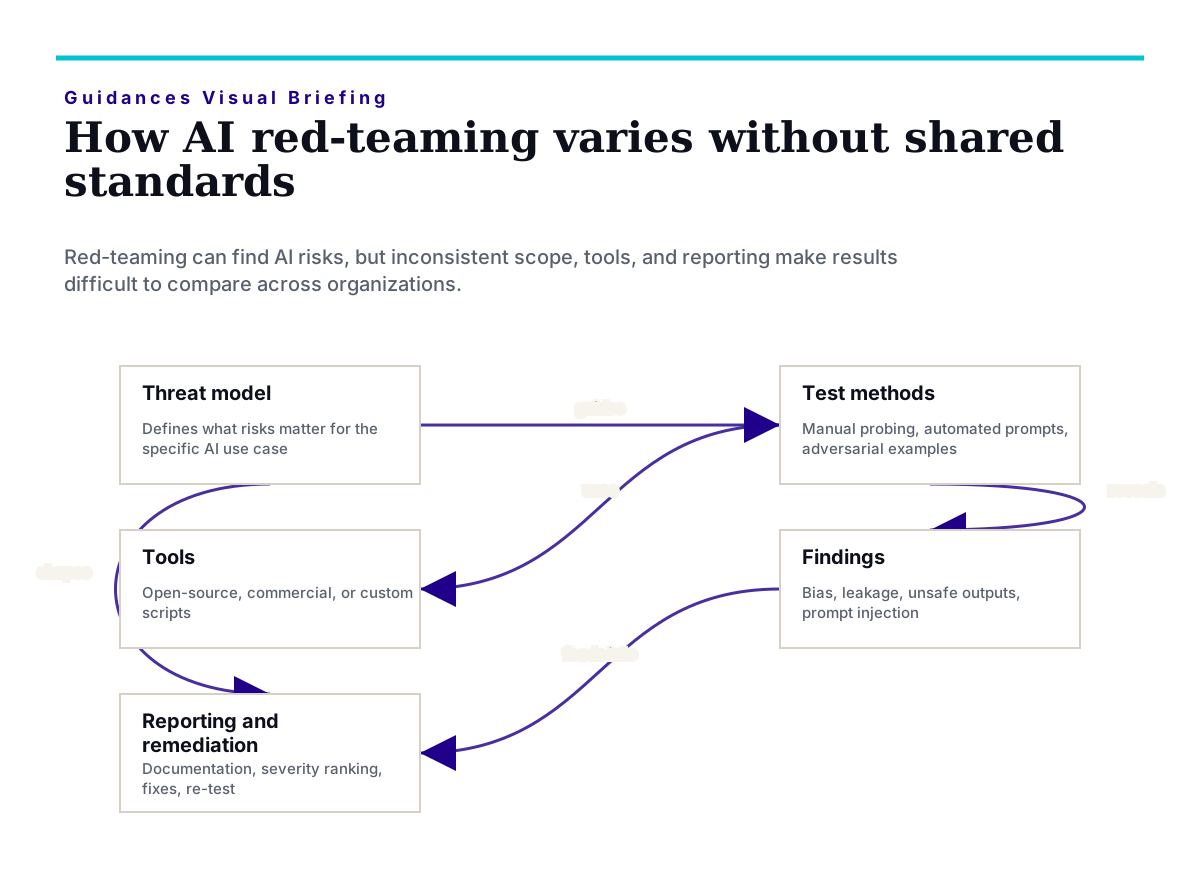
A simple workflow showing why AI red-teaming outputs differ when organizations define risks, tools, and reporting differently.
Corrections and safety
See a factual, privacy, rights, or safety issue? Review the corrections process or contact Guidances before relying on this article for important decisions.