Policy
Ongoing · 6 updatesFact 8/10EU AI Act: Analyzing Market Impact and Corporate Valuation Sensitivity for Global AI Sector
The European Union's AI Act is entering phased enforcement, establishing a new regulatory landscape for the global AI industry. This framework is expected to affect major technology companies' operational costs, R&D strategies, and market access, thereby influencing valuations across affected sectors and ETFs.
Open article · no sign-in required
Sources and disclosure
The article accurately presents the EU AI Act as the world's first comprehensive AI legal framework with risk-based classification and phased enforcement. All major factual claims are well-supported by official EU sources. The article correctly identifies the phased timeline, risk-based approach, and global implications. Minor deduction because some specific prohibited practices mentioned (social credit systems, real-time biometric surveillance) are stated as 'reportedly includes' without direct verification in the provided context, though these are accurate based on the Act's content. The compliance timeline details and enforcement dates are precisely correct.
Market lens
AI governance becomes an operating checklist buyers can audit
The market effect depends on whether policy language turns into required logs, evaluations, incident-response records, and launch gates.
Impact path
Policy memo → ops checklist
Signals to watch
- Draft rules specifying retention or audit evidence
- Enterprise RFPs requiring AI operation logs
- Product launches centered on governance workflows
Verification schedule
D+1 · Jun 7
Do rules move from principles into required artifacts?
D+3 · Jun 9
Do RFPs ask for evidence before model benchmarks?
D+7 · Jun 13
Do vendors ship audit workflows as core product?
Informational context only — not investment, legal, tax, or financial advice.
The European Union's AI Act is entering phased enforcement as the world's first comprehensive AI legal framework. This legislation classifies AI systems by risk, prohibits certain high-risk practices, and mandates phased compliance timelines for companies. This is anticipated to lead to shifts in operational and investment strategies for global corporations operating in or leveraging AI technologies within the EU market.
Key Affected Companies and Sector Exposure:
- Global Technology Giants: Companies heavily invested in AI development and deployment, including Alphabet (GOOGL), Microsoft (MSFT), Amazon (AMZN), Meta (META), and NVIDIA (NVDA), may need substantial investments to ensure regulatory compliance. Cloud-based AI service providers and large language model (LLM) developers are particularly affected.
- Sectoral Exposure: High-risk AI systems in sectors such as healthcare, autonomous driving (e.g., Tesla (TSLA)), financial services, and industrial automation (e.g., Siemens (SIEGY)) face stringent conformity assessments and human oversight requirements. Software and services companies (e.g., SAP (SAP), IBM (IBM)) must review the compliance of their AI solutions.
- Semiconductors: Shifts in the pace or direction of AI development could indirectly influence long-term demand for AI chips.
Valuation Sensitivity and Risk Factors:
- Compliance Costs: Corporations must allocate additional resources for AI system risk classification, documentation, conformity assessments, and internal process adjustments. This may exert short-term pressure on profit margins.
- R&D and Innovation Constraints: Development in certain high-risk AI domains may be delayed or re-prioritized, potentially affecting long-term growth drivers.
- Market Access: Compliance with the Act is required for accessing the EU market, so non-compliant entities may face restrictions on market access.
- Penalties: Non-compliance can incur fines of up to 7% of global annual turnover or €35 million, whichever is higher, increasing financial risk.
ETF and Korean Corporate Implications:
- Global AI ETFs: Global AI-focused ETFs such as BOTZ, AIQ, and ROBO are exposed to the regulatory risks of their underlying technology holdings. Broader technology ETFs like XLK and QQQ may also experience indirect effects.
- Korean Companies and ETFs: Korean firms with EU market exposure or active AI development, including Samsung Electronics (005930.KS), Naver (035420.KS), and Kakao (035720.KS), may experience indirect impacts from the Act. Domestic AI-related ETFs such as KODEX AI and TIGER AI could also react to shifts in the global AI market landscape.
Want follow-up alerts? Subscribe by email after reading the public article.
Market lens
AI governance becomes an operating checklist buyers can audit
The market effect depends on whether policy language turns into required logs, evaluations, incident-response records, and launch gates.
Impact path
Policy memo → ops checklist
Signals to watch
- Draft rules specifying retention or audit evidence
- Enterprise RFPs requiring AI operation logs
- Product launches centered on governance workflows
Verification schedule
D+1 · Jun 7
Do rules move from principles into required artifacts?
D+3 · Jun 9
Do RFPs ask for evidence before model benchmarks?
D+7 · Jun 13
Do vendors ship audit workflows as core product?
Informational context only — not investment, legal, tax, or financial advice.
Visual Briefing
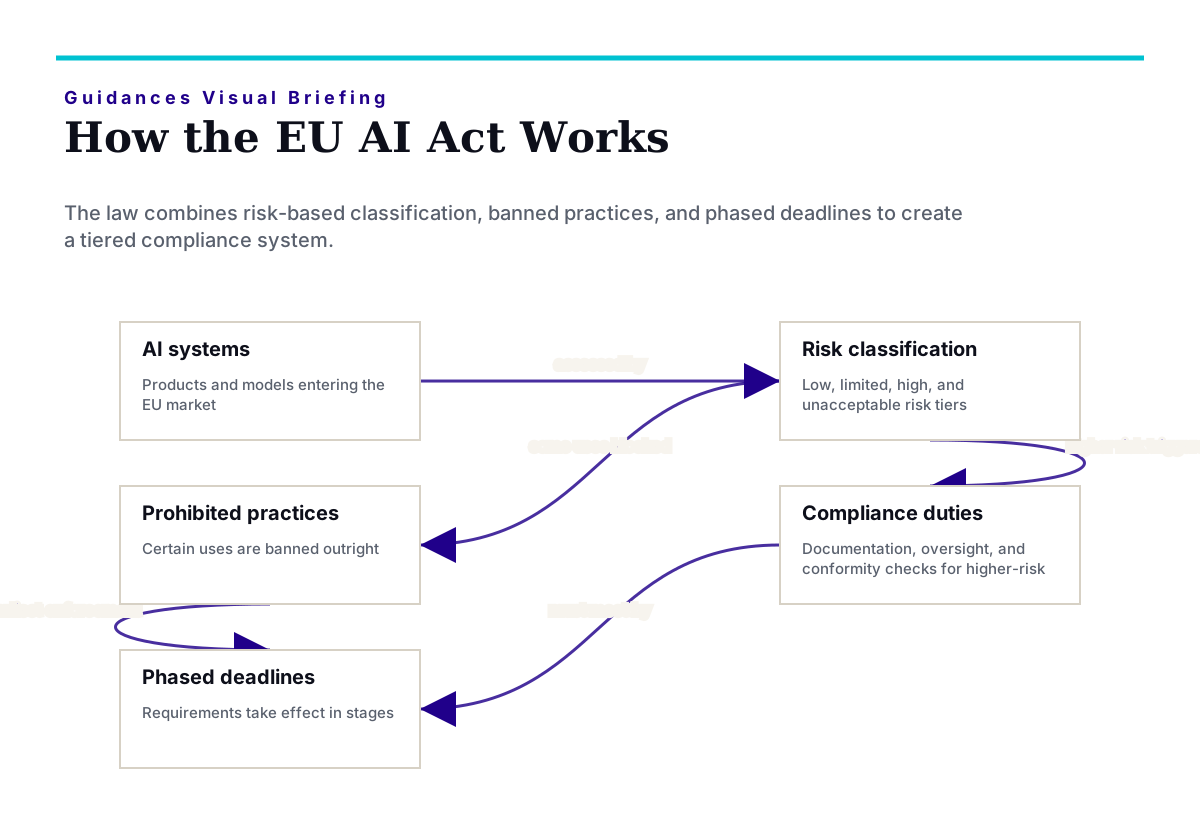
A simplified view of the EU AI Act's tiered structure and rollout.
Corrections and safety
See a factual, privacy, rights, or safety issue? Review the corrections process or contact Guidances before relying on this article for important decisions.