Finance
Developing · 0 updatesFact 8/10Perplexity's Financial News Tracker API: What Real-Time AI Market Intelligence Means for Operators and Builders
Article language
English
Perplexity has published developer documentation for a real-time financial news monitoring tool built on its Sonar API, featuring market sentiment analysis, impact scoring, sector tagging, and structured JSON output. The release signals a deliberate push by AI search infrastructure providers into financial data workflows, with implications for fintech builders, market-data vendors, and enterprise AI procurement.
Open article · no sign-in required
Sources and disclosure
What Happened
Perplexity has released official developer documentation for a financial news tracker built on its Sonar API, catalogued under its public cookbook of example applications. According to the snippet, the tool is designed as a real-time financial news aggregation and analysis system. Its documented feature set includes market sentiment analysis, impact assessment categorized across high, medium, and low tiers, sector- and company-specific tagging, investment insights generation, and structured JSON output. The documentation is positioned as a reference implementation — a working example that developers can adapt for production financial monitoring workflows.
This is not a standalone consumer product announcement. It is a technical disclosure: Perplexity is demonstrating, through its own documentation, that its Sonar API is capable of powering financial intelligence pipelines at a level of specificity that goes well beyond general-purpose search.
Why the Market Cares
The financial data and market intelligence industry is a large, entrenched, and highly monetized segment of the broader information services market. Established vendors have historically commanded significant subscription revenues from institutional clients who require structured, low-latency, and reliable financial news feeds. The emergence of AI-native alternatives — particularly those that combine real-time retrieval with automated sentiment scoring and sector classification — introduces a structural question about where value accrues in that chain.
Perplexity's documentation reveals several capabilities that are directly relevant to this competitive dynamic. First, the tool aggregates financial news in real time, which places it in direct functional overlap with traditional news wire and aggregation services. Second, it applies automated impact labeling — a task that has historically required either human editorial judgment or proprietary natural language processing models built and maintained at considerable cost. Third, it produces structured JSON output, which is the format that downstream systems — trading platforms, risk dashboards, portfolio management tools — require for programmatic consumption.
For enterprise buyers evaluating AI infrastructure, this combination of retrieval, classification, and structured output in a single API call represents a meaningful reduction in integration complexity. The question is whether the accuracy, latency, and reliability characteristics of an AI-native system can meet the standards that financial workflows demand — a threshold that is considerably higher than general consumer search.
Technology and Policy Linkage
The Sonar API is Perplexity's externally accessible interface to its underlying search and reasoning infrastructure. By publishing a financial news tracker as a cookbook example, Perplexity is effectively signaling to enterprise and developer audiences that financial use cases are within scope and supported. This matters for several reasons beyond the immediate product.
First, it raises questions about data sourcing and attribution. Financial news monitoring tools that aggregate from multiple sources must navigate licensing agreements, fair-use boundaries, and, in some jurisdictions, regulatory requirements around the redistribution of market-sensitive information. The documentation references source attribution as a feature, which suggests Perplexity is aware of this dimension, but the extent to which the tool's outputs satisfy institutional compliance requirements is not determinable from the available snippet alone.
Second, the structured output and investment insights features touch on a regulatory boundary that varies by jurisdiction. In many markets, automated systems that generate investment-relevant analysis are subject to financial advice regulations. Builders deploying this tool in client-facing or advisory contexts would need to assess whether outputs require regulatory disclaimers or licensing. This is a constraint that applies broadly to AI-generated financial content, not specifically to Perplexity, but it is a material consideration for any operator building on this infrastructure.
Third, the release reflects a broader pattern in AI infrastructure: foundation model and search API providers are moving up the value stack by publishing domain-specific reference implementations. This accelerates adoption but also compresses the differentiation window for startups that have built proprietary financial NLP layers on top of general-purpose models.
Market Lens
Trigger: Perplexity publishes developer documentation for an AI-powered financial news monitoring tool built on its Sonar API, with explicit features for sentiment analysis, impact scoring, and structured data output.
Mechanism: If AI-native APIs can replicate or approximate the core functions of traditional financial data aggregation and NLP classification at lower cost and integration friction, demand patterns for incumbent financial data infrastructure could shift over a medium-term horizon. The mechanism is substitution pressure on workflow-layer financial data products, not on primary data sources such as exchanges or regulatory filings.
Affected sectors (source-supported): AI infrastructure and API providers; financial data and analytics vendors; fintech application developers; enterprise software integrators building market intelligence tools. Specific company or ETF linkages are not directly supported by the available source metadata and are therefore excluded here.
Time horizon: Medium term. Enterprise procurement cycles in financial services are long, compliance review adds friction, and institutional buyers require demonstrated reliability before displacing established vendors. Near-term impact is most visible at the developer and startup layer, where adoption of AI APIs for financial workflows is already accelerating.
Next check: Perplexity enterprise customer announcements or case studies in financial services; updates to the Sonar API pricing and rate-limit structure that would indicate institutional-scale positioning; regulatory guidance in major jurisdictions on AI-generated financial analysis; and competitive responses from established financial data vendors in the form of their own AI-native product launches or API partnerships.
This section is market context only, not investment advice.
What to Watch Next
Several developments would materially clarify the significance of this documentation release. The first is whether Perplexity follows the cookbook example with enterprise-grade service-level agreements, dedicated financial data compliance documentation, or partnerships with established financial data distributors. The second is how incumbent vendors respond — whether through accelerated AI integration of their own, through licensing negotiations with AI API providers, or through regulatory advocacy around AI-generated financial content standards.
The third, and perhaps most consequential for builders, is how financial regulators in the United States, European Union, and major Asian markets treat AI-generated investment insights at scale. If regulatory frameworks require human-in-the-loop review or specific disclosures for AI-generated financial analysis, the compliance cost could limit the addressable market for fully automated deployments.
Uncertainty and Constraints
The available source material is limited to a documentation snippet and headline. The full technical specification, pricing, rate limits, data sourcing agreements, accuracy benchmarks, and latency characteristics of the financial news tracker are not available from this source. Any assessment of competitive impact or enterprise readiness must therefore be treated as directional rather than definitive. Builders and operators evaluating this tool should consult the full documentation, conduct independent testing, and seek appropriate legal and compliance review before deploying in regulated financial contexts.
Market lens
Separate infrastructure signal from investable outcome
Treat market-linked stories as context: identify the mechanism, then wait for evidence before treating it as an outcome.
Impact path
Signal first, outcome later
Signals to watch
- Primary-source guidance and filings
- Price, volume, margin, and renewal evidence
- Follow-up reporting that confirms or rejects the mechanism
Verification schedule
D+1 · Jun 19
Is the mechanism visible in primary data?
D+3 · Jun 21
Do follow-up sources confirm direction and magnitude?
D+7 · Jun 25
Did the initial read overstate the market effect?
Informational context only — not investment, legal, tax, or financial advice.
Builder Implications
- Compliance-first architecture is non-negotiable. Any application built on AI-generated financial news analysis that surfaces investment insights to end users must be reviewed against applicable financial advice regulations in each target jurisdiction before launch. The structured JSON output and impact-labeling features are technically useful, but they do not resolve the regulatory question of whether the application constitutes financial advice.
- The cookbook pattern accelerates the baseline, not the moat. Perplexity's reference implementation lowers the barrier to building a functional financial news monitor, which means the differentiation for fintech founders must now come from proprietary data integrations, domain-specific fine-tuning, workflow depth, or distribution — not from the retrieval and classification layer itself.
- Evaluate latency and reliability against institutional standards before committing to architecture. Financial workflows, particularly those touching trading, risk management, or compliance monitoring, have latency and uptime requirements that general-purpose AI APIs may not yet consistently meet. Builders should benchmark the Sonar API against their specific use-case requirements and design fallback mechanisms accordingly.
Want follow-up alerts? Subscribe by email after reading the public article.
Market lens
Separate infrastructure signal from investable outcome
Treat market-linked stories as context: identify the mechanism, then wait for evidence before treating it as an outcome.
Impact path
Signal first, outcome later
Signals to watch
- Primary-source guidance and filings
- Price, volume, margin, and renewal evidence
- Follow-up reporting that confirms or rejects the mechanism
Verification schedule
D+1 · Jun 19
Is the mechanism visible in primary data?
D+3 · Jun 21
Do follow-up sources confirm direction and magnitude?
D+7 · Jun 25
Did the initial read overstate the market effect?
Informational context only — not investment, legal, tax, or financial advice.
Visual Briefing
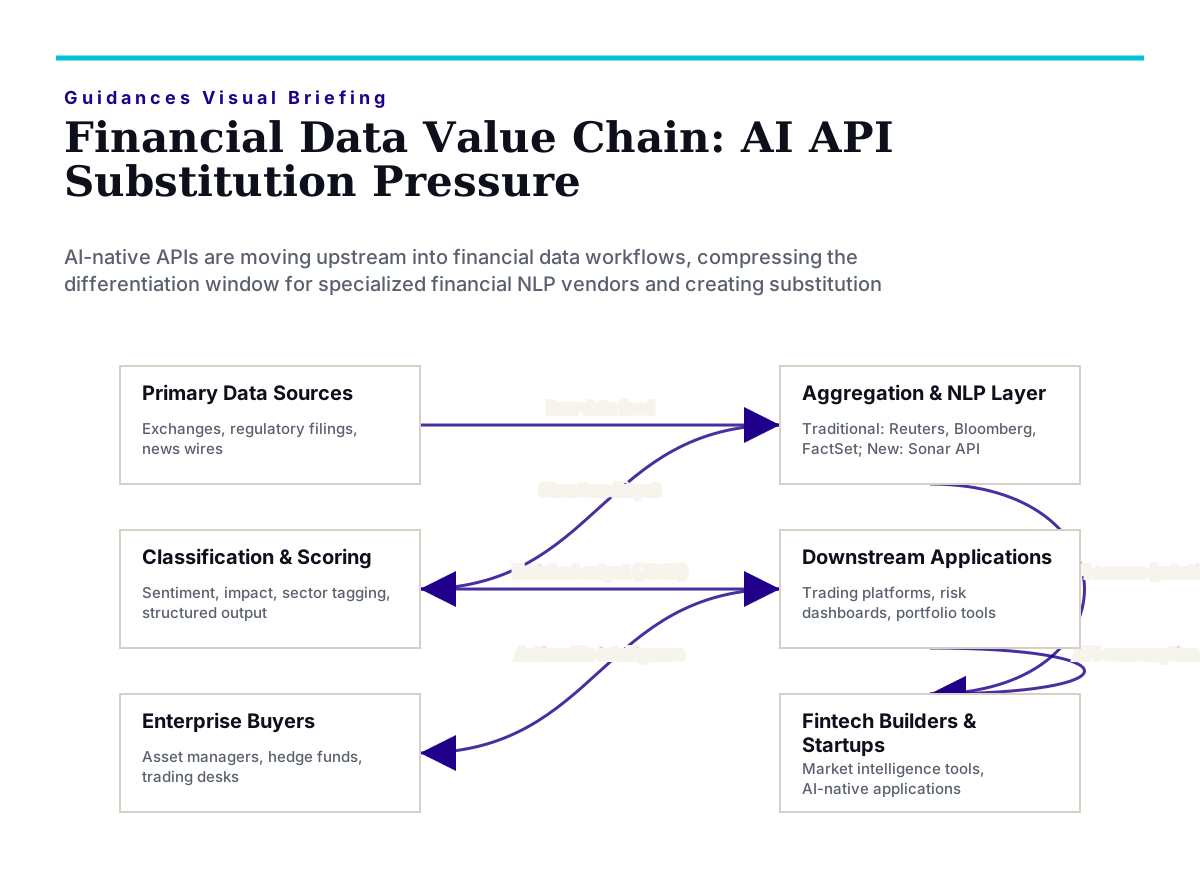
The Sonar API financial news tracker enables fintech builders and enterprise buyers to bypass traditional aggregation and NLP vendors by combining retrieval, classification, and structured output in a single API call. This creates substitution pressure on workflow-layer financial data products but does not displace primary data sources.
Corrections and safety
See a factual, privacy, rights, or safety issue? Review the corrections process or contact Guidances before relying on this article for important decisions.